


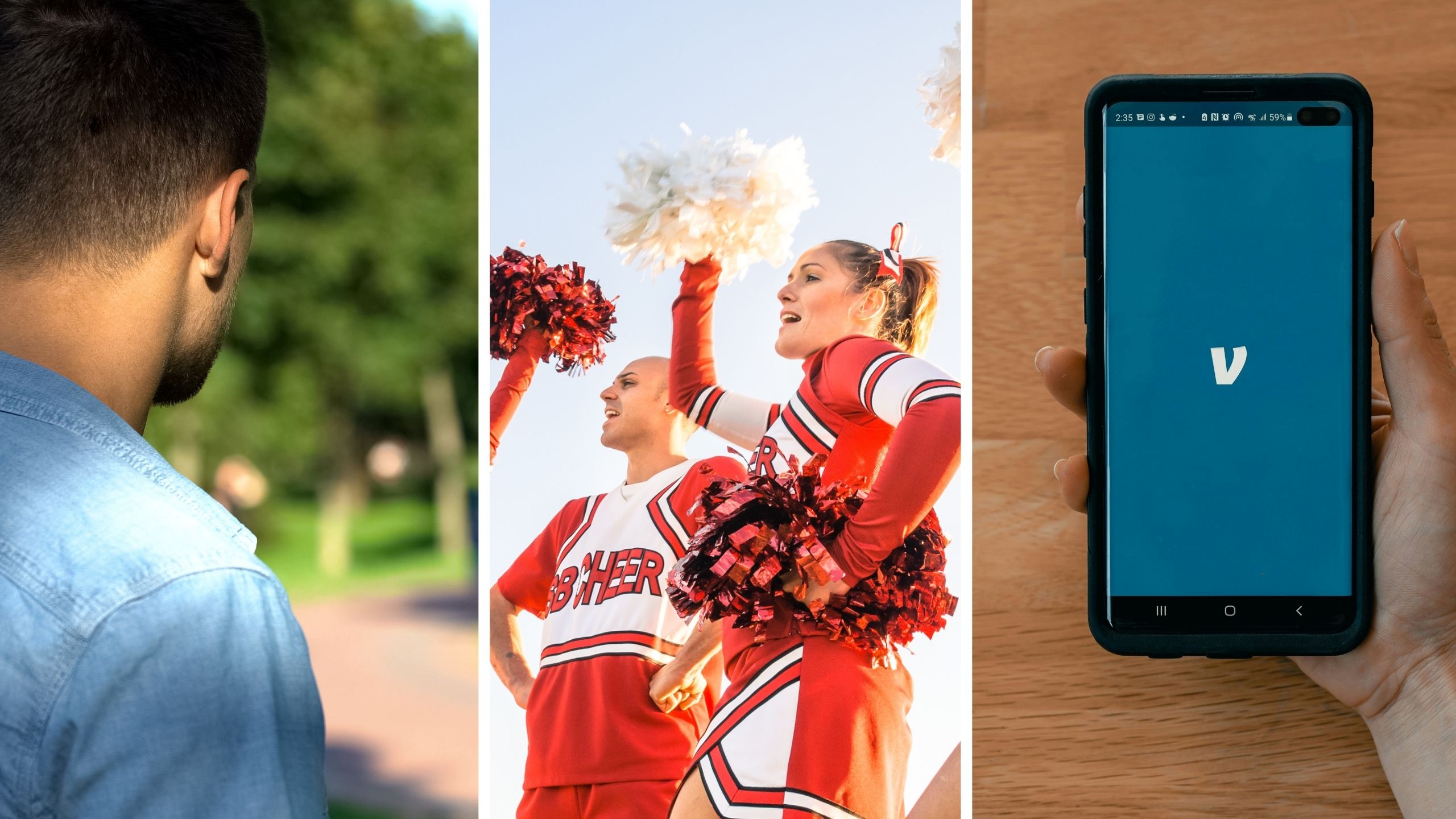
What started as a harmless photo at a spring game turned into something no college student should ever have to deal with.
An Alabama cheerleader’s TikTok about a stranger who offered her money out of nowhere—and what happened next—has racked up nearly 250,000 views.
It Started With A Picture
In a viral video with more than 249,000 views, an Alabama cheerleader on TikTok tells the story while getting ready for a basketball game.
She explains that it started her freshman year at a spring game. A guy asked to take a picture with her, and she said yes. Normal enough interaction for a cheerleader. But then he direct messaged her the photo on Instagram and tacked something on at the end: Let me know if you need any money.
“Disclaimer: I’ve fully learned my lesson to not accept money from strangers,” she says. “But at the time I had sent him my Venmo.”
She’s quick to clarify she never sent him anything in return, no pictures, nothing. He’d just text her weekly, asking if she needed money.
“I mean, I was a college student,” she says, though she admits her parents were already giving her money and she didn’t really need more. It went on like that for a while until her mom found the Venmo payment notifications in her email.
“She was like, ‘Who is this person sending you money?'” she recalls. Her mom told her to stop accepting it immediately. She blocked him on Venmo. That was April going into June, end of story, she thought.
It wasn’t.
By her sophomore year in September, she says he was sending her Venmo requests for a dollar, just to try to get her attention. She says he would send messages like: Are you going to be at this game? Are you going to be here?
She says she blocked him again. And then came October.
Scary Encounter
The TikToker was at the cheer tailgate tent before a game with her mom and her aunt when she felt a tap on her shoulder. She turned around.
“Sure enough, it’s the guy who sent me a bunch of money,” she says. “He proceeds to be like, ‘Don’t you remember me?’ And I was, like, literally so taken aback by him being there, because he’s not even from Alabama.”
She says she told him he had to leave. He walked away, per the cheerleader. But she recalls that she was shaking.
“I start crying, and my mom’s like, ‘What’s wrong?'” she says. She says she had to decide whether to tell her mom this was the same guy she’d been warned about.
It got worse. When the team went to warm up inside the stadium, hours before the game, barely anyone else around, she says he was standing at the gate. Staring at her.
“He was just like, locking eyes with me,” she says. “Nobody was in the stadium really at this point.”
She says she went back to the locker room in tears. Her coach heard her out and told her if she saw him when she got back out, to tell a security guard and point him out. She did.
“He fully saw me point at him,” she says. “And then the security guard went and got him. And I watched him get dragged out of the stadium.”
Later that night, the security guard was able to investigate further and speak with him directly. She reported back that something seemed seriously wrong with him.
“‘I asked him if he had been stalking you,'” she recounts the security guard telling her. “‘And he admitted to stalking you.'”
Alabama’s response was immediate. She says security was posted at the gate. Police escorted her home. She says they walked her all the way to her room and stayed outside her apartment overnight. They called to check in on her for the next several weeks.
“Alabama did a really good job handling it,” she says. “As soon as I was uncomfortable, they got rid of the person and made sure I was safe.”
She ends the video with a straightforward warning: “Moral of the story, don’t accept money from people that you do not know. If it sounds too good to be true, it is. I hope everybody can learn from my mistakes. Stay safe, guys.”
What The Numbers Say
The woman’s experience is more common than most people realize, and college students are among the most vulnerable.
According to the Stalking Prevention, Awareness, and Resource Center, people aged 18-24 have the highest rate of stalking victimization of any age group, and between 6% and 39% of college students report being stalked since entering college. Nearly 1 in 6 women will experience stalking at some point in their lifetime.
The pattern the cheerleader described—Venmo requests, showing up at games, escalating contact—tracks closely with how stalking typically unfolds. Stalking is generally defined as a pattern of behavior directed at a specific person that would cause a reasonable person to fear for their safety, and it almost always involves multiple tactics.
The Domestic Violence Services Network reports that 75% of victims receive unwanted phone calls, 57% receive unwanted messages via email, text, or social media, and 57% experience their stalker showing up somewhere they did not want them. Seventy-eight percent of stalkers use more than one means of approach, and almost half of victims experience unwanted contact at least once a week. And despite the popular image of stalkers as strangers, the vast majority of victims are targeted by someone they know.
Perhaps most striking: 43% of college stalking victims who meet the legal definition of stalking don’t identify their experience as stalking at all. The woman herself didn’t seem to fully clock what was happening until he showed up in person.
Commenters React
People in the comment section are split about how the college student handled things. Some comments are giving victim shaming, with people saying the young woman should have known better.
“So many questions.. why would you accept money from a random person? Why would he randomly send you money?” a top comment read.
“Yall hating… im never saying no to money sooo i get it,” a person said.
“I appreciate you being honest and telling your story – warts and all – knowing that people always have to make rude comments. Your story has probably opened the eyes of many others,” another wrote.
BroBible reached out to the cheerleader for comment via email and Instagram direct message. We’ll be sure to update this if she responds.