


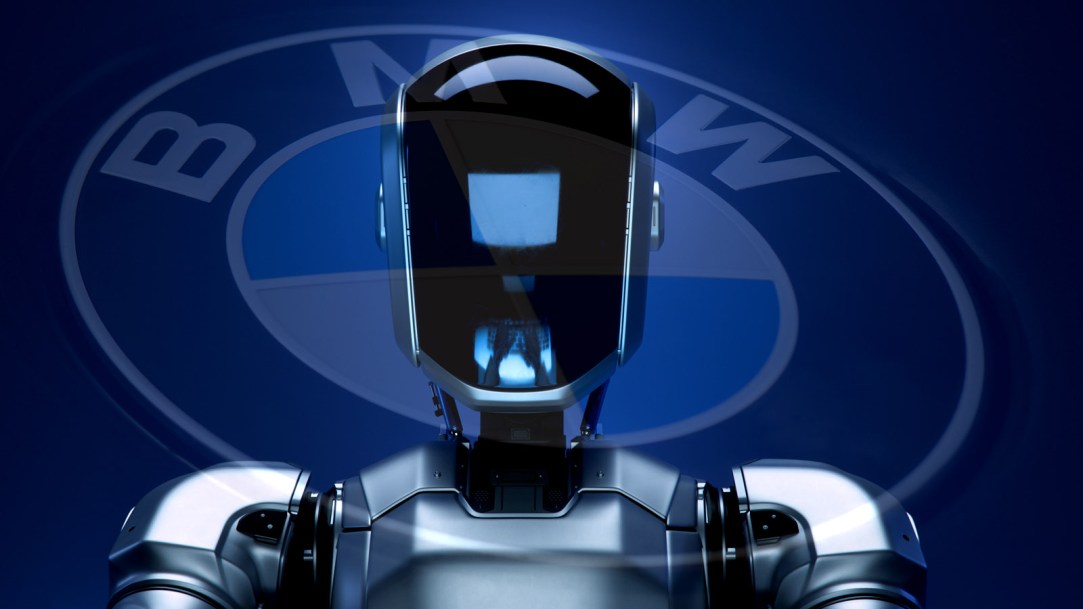
BMW is adding humanoid robots to the factory floor in Germany after an earlier pilot project at its Spartanburg, South Carolina, plant in America. To evaluate how humanoid robots function in live production, the automaker has launched a trial program at its Leipzig facility, beginning with battery assembly and component fabrication.
This deployment comes after a nearly year-long experiment at BMW’s Spartanburg facility, where humanoid robots positioned sheet-metal parts for welding during ten-hour stints.
How are humanoid robots better than humans when it comes to assembling automobiles?
According to BMW Blog, who attended the exclusive reveal of AEON – the humanoid robot heading to BMW’s Leipzig plant – at BMW’s Talent Campus in Munich, they have an edge on humans when it comes to consistency.
“The scanning is a good example,” Arnaud Robert, President of Hexagon Robotics, stated. “The robot learns the optimal way to scan and does it exactly the same way every time. Humans make mistakes and try again.”
How does the humanoid robot work?
According to BMW Blog, AEON uses four levels of physical AI to learn. Fundamentally, thousands of virtual instances operate concurrently to find the best movement tactics through simulation and reinforcement learning.
“It turned out, through simulation and running thousands of potential ways to do this, the most efficient way is actually using inertia,” Robert said.
AEON carries 22 integrated sensors — peripheral cameras, time-of-flight, infrared, SLAM cameras, and microphones — giving it full 360-degree real-time awareness. That sensor suite isn’t just for navigation: it enables quality inspection tasks that traditional fixed robots can’t perform. AEON moves on wheels rather than legs, a choice Robert said came after rigorous testing of multiple locomotion systems. “Wheels turn out to be by far the most efficient locomotion mechanism in terms of energy use and speed over distance,” he explained. “A factory floor is usually super-even surfaces, so we truly benefit from the speed.” AEON reaches 2.5 meters per second and swaps its own battery in 23 seconds, enabling genuine around-the-clock operation.
During the demonstrations, they discussed the subject of LLM hallucination by the machines. Robert said they “see very, very little hallucination” because instead of using the public internet, AEON’s foundation models use carefully selected, domain-specific manufacturing data for training.
As for whether we will see these intelligent machines fully replace human workers on BMW’s assembly lines, Robert said, “A robot jumping into a moving car and assembling parts – I cannot see this in the near future.”
BMW is far from the first automaker to begin using humanoid robots in its assembly plants
BMW isn’t alone in the automotive industry when it comes to employing humanoid robots in their assembly plants. According to CarScoops, Mercedes-Benz has also been testing them at its Berlin facility. Mercedes-Benz has tested an Apollo unit on logistics, quality checks, and repetitive tasks on the line.
Also, a recent 60 Minutes special on humanoid robots featured Boston Dynamics’ Atlas, a robot developed and now being tested at a Hyundai car factory outside Savannah, Georgia. The plant currently utilizes over 1,000 manufacturing robots and 1,500 human workers, according to MotorBiscuit.
Of course, Hyundai owns Boston Dynamics, so their integration of robots in facilities is not unexpected. Boston Dynamics CEO Robert Playter downplayed humanoid robots taking jobs away from humans – at least in the near future. He said that while these machines are gaining “common sense” through AI, full factory integration is still years away.