


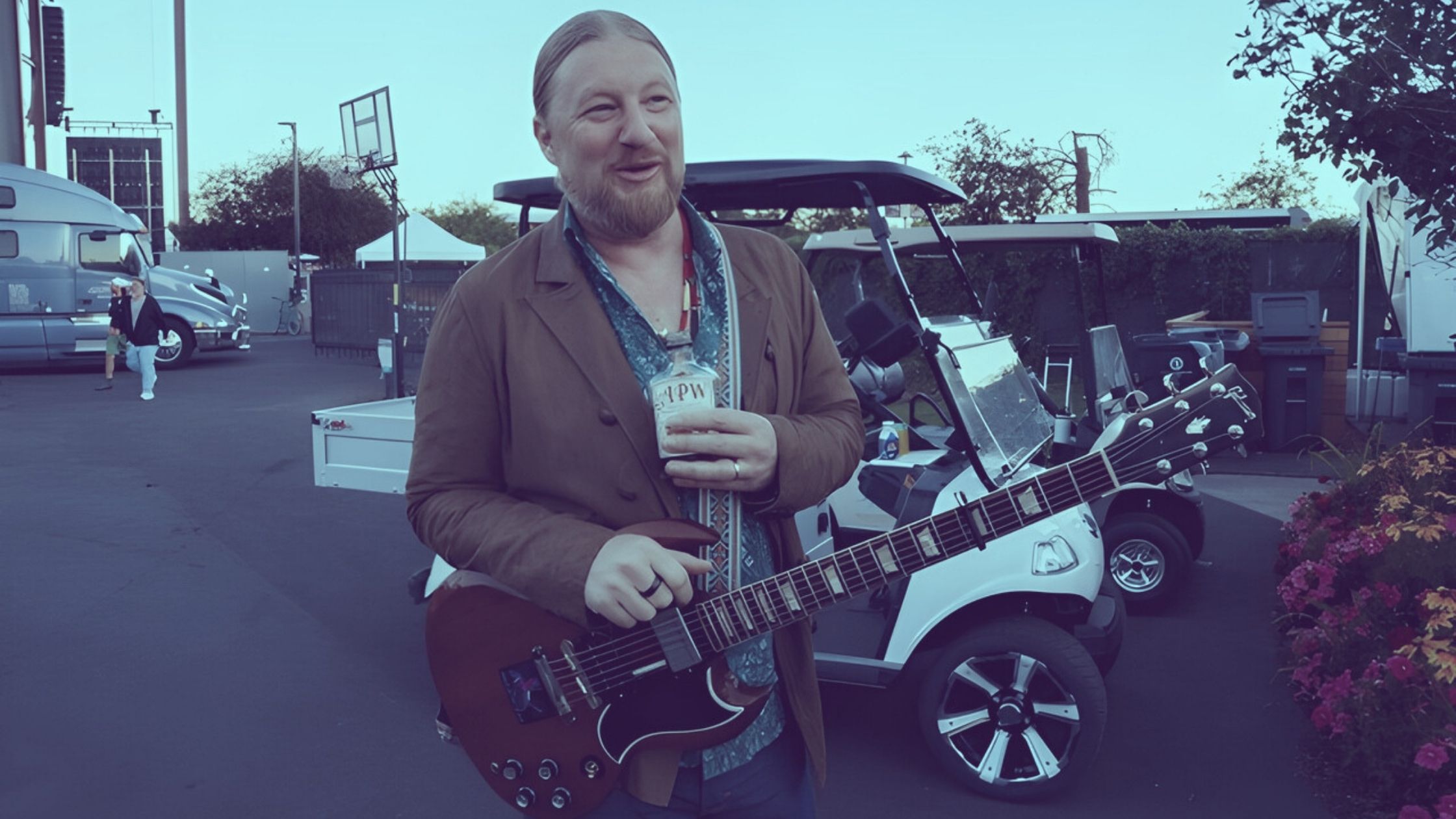
via APW
Derek Trucks is trying to explain the finer points of 50-year-old Cuban cigars smuggled from the warehouse of a gangster mayor of Philadelphia when his internet cuts out. On the day of our Zoom call, I’m in a hotel in Palm Springs, preparing to drive a $350,000 Ford Mustang that costs at least 5x my state school college education. Derek is on his tour bus somewhere in Syracuse, New York, tethered to a phone’s hotspot, surrounded by what can only be described as a rolling museum of impossibly rare bourbon.
It’s a perfectly imperfect setting for one of the greatest guitarists alive. For a man whose entire life feels like a series of cosmic, bluesy synchronicities, a little technical difficulty is just an earthly inconvenience.
“Can you hear me all good?” he asks, his calm, Southern drawl cutting through the digital static. He sounds great. He looks great. And for the next hour, he proceeds to spin yarns that connect the dots between B.B. King’s grave, the saddest Super Bowl afterparty in history, and the holy grail of lost American whiskey.
Our pretense for talking is Ass Pocket Whiskey, or APW, the cheekily named bourbon brand he started with his brother, David. It’s a passion project born from years of “dusty hunting” before the bourbon boom turned every corner liquor store into a secondary market battlefield. “It’s kind of an excuse for us to find some really high-end bourbon and kind of side-door it,” he explains. “Trying to get people good juice without, you know, right now, if you find a good bottle in a store…they’re asking 1,200 bucks. You’re just not going to do it. It doesn’t feel good.”
Watch our interview on YouTube below:
That’s the thing about Derek Trucks: he’s a completist, but not a snob. Whether tracing a guitar lick to its source or hunting a forgotten bottle, he geeks out on the story and the lineage. Provenance is his whole jam, man.
The night before our chat, the bus had a day off in Covington, Kentucky. They paid a visit to Revival, a vintage spirits shop run by a friend who’s essentially the Mike Wolfe of booze, an “American Picker for bourbon.”
“Basically, we found some of the old hoots that I’d bought over the last few years,” Trucks says casually, as if he’s talking about picking up dry cleaning. He gestures to the bottles arrayed behind him. There’s an Old Forester from 1978. A strange bottling from the legendary Willett distillery called “Lawyer’s Pride” from the early ’80s. And then there were the cigars — dozens of boxes of old Cubans that belonged to Frank Rizzo, the notoriously iron-fisted former mayor of Philadelphia.
“We had a few Frank Rizzo cigars last night,” he says with a grin. “Like a 50-year-old cigar. It was quite a night. So we slept in on the bus today. It was a slow start.”
A slow start fueled by half-century-old tobacco and 45-year-old whiskey. Just another Tuesday on the road.
This obsession began about 15 years ago, when he and his brother David started scouring the backroads of North Florida and Georgia. “Until about 10 years ago, you could find some pretty incredible stuff out there,” he reminisces. “We were finding cases of Weller 12 for 29, 39 bucks a bottle. Back when that was still doable. And then that ship sailed, and the party was over.”
The party may be over for bargain hunters scouring storage units and old liquor store basements for dusty bottles of rare hooch, but it led Trucks to one of the most unbelievable whiskey tales you’ll ever hear. It’s a story that has it all: the ghost of a blues king, bad bourbon karma, and a bottle so rare it belongs in a museum.

via Bradley Strickland
It was the first show he and his wife, the formidable singer and guitarist Susan Tedeschi, played coming out of the pandemic. The gig was at the B.B. King Museum in Indianola, Mississippi — on the very site of the cotton gin where King worked as a young man. Across the street was a funky old liquor store. With some time to kill, Trucks wandered in.
“I looked behind the counter, and I see a bottle that I was like, ‘Did they repackage the vintage Old Fitzgerald?'” he recalls, the excitement still evident in his voice. He asked the clerk to see it. It was a bottle of Stitzel-Weller bourbon, the most revered and mythologized distillery in American history. Barreled in 1953, bottled in 1961. The stuff Pappy Van Winkle built his legend on. A bottle that fetches upwards of $10,000 on the rare occasion it even surfaces.
“I’m looking at it in disbelief,” he says. “I’m almost shaking.”
He asks the clerk how much. The guy has no idea. He tries to scan the non-existent UPC code. “A collector may even pay 50 bucks for it,” the clerk muses.
Trucks, possessed by a sense of fairness that would doom most treasure hunters, couldn’t do it. “I can’t give this guy 50 bucks for this,” he remembers thinking. “Somebody left this here, and he’s gonna get fired. That’s bad bourbon karma.”
He cobbles together all the cash he and Susan have — $700 — and offers it. The clerk starts counting. But as he does, another employee starts looking up the bottle online. The clerk bags it, takes the money… and then takes it back. The deal is off. Susan is pissed. Trucks is crestfallen but lets it go.
That night, they play the show at B.B.’s grave. It’s a magical, historic evening. As they walk off stage, he sees the kids of the liquor store owner. An awkward phone call follows. The owner felt terrible about how it all went down. At two in the morning, he shows up at their hotel with the bottle. A deal is struck.
But the story doesn’t end there. In a move that speaks volumes about his reverence for history, Trucks didn’t hoard the bottle. He took it to the Van Winkle family.
“That’s the juice that Julian is trying to make. That’s the stuff his grandfather made,” Trucks explains. “To be able to deliver it back to him, that was a cool moment. It felt like… every once in a while, an instrument will pop up that has some connection to the family, and it’s always cool to at least put your hands on it. I felt the same way with their booze.”
It’s this spirit of sharing — this fundamental, unshakable idea that great things are meant to be experienced, not just collected — that defines him. This ethos makes sense when you consider how he shares his gifts with a guitar with the world.
He tells another story about a barrel pick he did years ago at the Buffalo Trace distillery. Afterwards, Julian Van Winkle himself gifted him a bottle of Old Rip 10 Year with a custom label: “Specially Bottled for the Trucks Family Barrel Pick.”
“I feel like we should crack it,” Trucks said at the time.
“That’s what I’m talking about,” Julian replied. “My dad would always say, if you’re cracking a bottle, you should finish it with the people you’re there with.”
They drained the whole thing around a fire that night. “That’s what you’re supposed to do with that sh*t,” Trucks says, laughing. It’s the entire philosophy behind Ass Pocket Whiskey. The name itself, borrowed from a classic R.L. Burnside album, is a deliberate jab at the high-mindedness that has taken over the bourbon world. “We love good booze, but I don’t love how pretentious the whole game has gotten,” Trucks says. “So it’s just kind of a way to maybe take the piss out of it a little bit.” The smaller, 200ml bottles are an extension of that philosophy—designed to be opened, passed around, and finished.
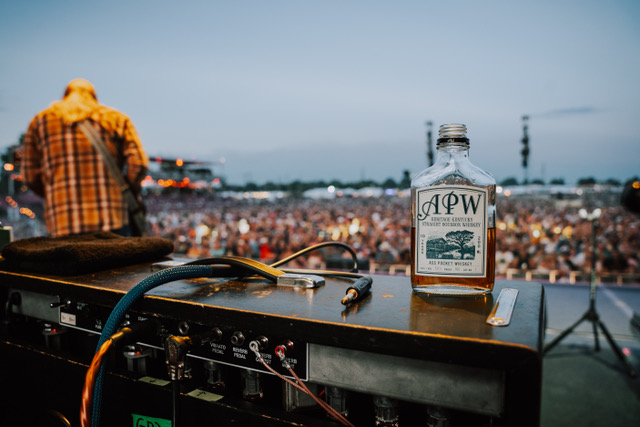
via Bradley Strickland
That mission continues with his latest release, a collaboration with festival promoter Danny Wimmer dubbed “The Search.” The first fruit of a multi-year partnership, Ass Pocket Whiskey No. 4 is a small-but-mighty 10-year-old bourbon designed to unite their shared passions for world-class bourbon and unforgettable music. There are only 18 barrels of this stuff for sale via the Ass Pocket Whiskey website, and when it’s gone, it’s gone for good. And, of course, it’s packaged for camaraderie — a collectible box containing two 200ml bottles — it practically begs you to find some good company and drain them both.
In the world of Derek Trucks, pretense is not allowed.
The same ethos applies to his music. He’s a conduit, a student of the masters who is now a master himself. He speaks of touring with Buddy Guy, now approaching 90, who would insist on a pre-show ritual.
“He turns around and he goes, ‘What, you don’t drink anymore, Derek?'” Trucks mimics. “He was like, ‘You know, I used to get nervous before I’d go on stage, but Muddy Waters told me, Just have a drink and calm your nerves. You’re not going to please all those mother***kers anyway.’”
Every night, Buddy would pour out some XO cognac. Trucks dubbed it the “Blues Holy Communion.” One night he missed the ritual, and Buddy spotted him from the stage. “He goes, ‘Oh, you thought you got away!'” Buddy called him over, pulled a coffee mug from a drawer, filled it halfway with cognac, and handed it to him mid-set. “I was like, ‘Yes sir, I will make sure to drink that.'”
It seems fitting for a man who is himself a piece of rock and roll history—the nephew of founding Allman Brothers Band drummer Butch Trucks. His life is a collection of these Forrest Gump moments, where he finds himself at the nexus of history.
For instance, he attended the Super Bowl for 12 straight years as a guest of the late Microsoft co-founder Paul Allen. Their connection wasn’t just a billionaire’s whim; Allen was an avid guitarist who, in 2013, even cut an album with Trucks in a band called Paul Allen and the Underthinkers.
My jaw dropped when Trucks said, ever so nonchalantly, that he’s been to so many Super Bowls, because I remember blogging about Trucks joining the Seahawks on stage in Jersey City after Seattle won the Super Bowl in 2013. He was standing shoulder-to-shoulder with Allen in his suite during Super Bowl XLIX the following year, when the Seahawks, on the one-yard line, decided to throw the ball.
“That interception happened, and it was like everyone went ghost white, like somebody just passed away,” he says. Tom Brady and the New England Patriots won their fourth Super Bowl of the Bill Belichick era.
Trucks’ son, a long-suffering Jaguars fan, leaned over and whispered, “Hey Dad, at least it wasn’t the Jags.” The afterparty, with Snoop Dogg performing, was “the saddest afterparty you’ve ever seen in your life.”
But of all the strange, intersecting lines of his life, none is more poignant than the one that connects him to his own name. Years ago, he collaborated with Phish’s Trey Anastasio on a full performance of the classic album Layla and Other Assorted Love Songs. On the way to rehearsal, a thought struck him. He knew the album was by Derek and the Dominos, the band Eric Clapton formed. He knew his parents had named him after it. But he’d never thought about the specifics.
He looked up the release date: November 9, 1970.
“I was like, ‘Sue, you were born on the day this record came out,’” he says, the wonder still fresh. “Chills thinking about it. I was named after that record. She was born on the day it came out. It was just like… of course, that’s true.”
Just go read what he wrote in the liner notes for the release, and tell me that’s not the damnedest thing you’ve ever read?
Years later, he’d be playing in Clapton’s band, having high tea at the English country estate where Clapton lived with Pattie Boyd—the real-life Layla. His father, a roofer from Jacksonville, was sitting right there with him.
“I’m thinking, what kind of life are we living?” he muses.
It’s certainly a good one. Steeped in lore, lubricated with fine bourbon, and soundtracked by one of the most expressive slide guitars in history.
A life where every bottle, every note, and every name has a story.
You just have to be willing to crack it open and share it.
Brandon Wenerd is the Los Angeles-based publisher of BroBible.com. Follow him on Instagram here and Substack here.