


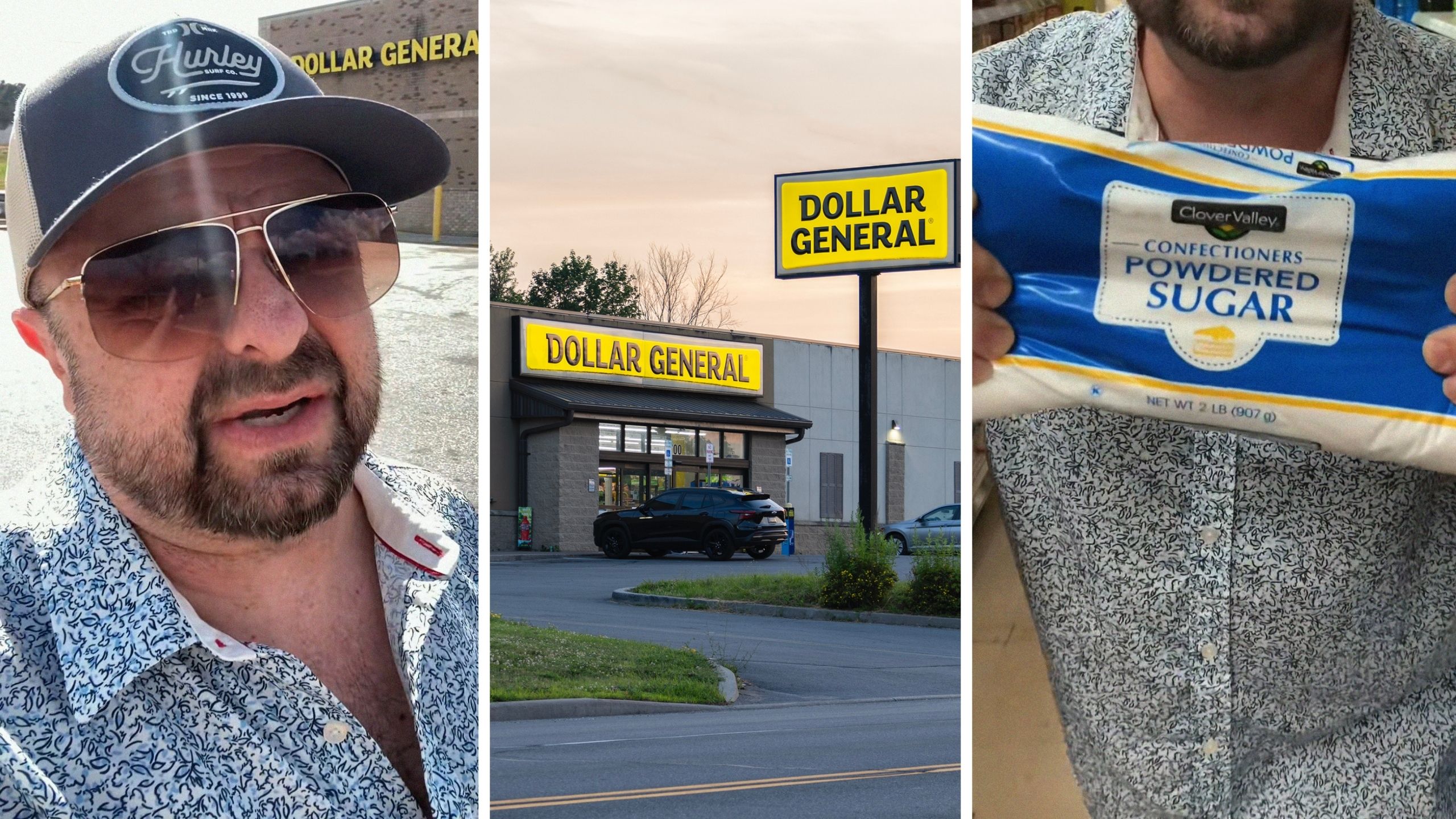
The internet is filled with stories of snack food “shrinkflation.” However, there appears to be another problem plaguing the food industry: straight up lies.
For context, packaged food sold in the United States generally needs to list a net weight. If you look at any cereal box, bag of ramen noodles, or other packaged product, you should see the weight listed along with the goods’ nutritional ingredients.
But how accurate are these weights? A few internet users have gone viral after claiming that the weights aren’t accurate at all—and, as a result, customers are getting ripped off.
Now, a user on TikTok says he’s found another example, and this one may be the worst yet.
What’s Wrong With This Listed Weight?
In a video with over 155,000 views, TikTok user Jimmy Wrigg (@james_wrigg) travels to Dollar General to investigate what he calls a “possible shrinkflation item.”
“Dollar General carries these Clover Valley products right here,” Wrigg explains, showing items on the shelf. “These would be comparable to the Walmart Great Value. It’s their generic brand.”
Eventually, Wrigg lands on the bags of Clover Valley powdered sugar. To demonstrate the alleged weight difference, he produces a scale, then tests it with a weight to ensure its accuracy.
The Clover Valley powdered sugar is listed at 2 pounds. However, every single bag he puts on the scale is significantly underweight.
Several bags weigh around 1.2 pounds. Others weigh around 1.5 pounds. No bag tested weighs 2 pounds or more.
“That right there is definitely shrinkflation,” he says.
To conclude, he advises, “Remember: when you’re out shopping, check your weights.”
Is This Legal?
Generally speaking, U.S. law requires the listed weight on a package to be accurate.
The Fair Packaging and Labeling Act (FPLA) says, in part, that “the net quantity of contents … shall be separately and accurately stated in a uniform location.”
That said, there are allowances made for variance in weight. There are just two stipulations. First, the item must meet the “Average Requirement.” This means that, when you test a group of packages from the same batch, the average amount inside them must be at least the amount printed on the label.
The second stipulation is the “Individual Package Requirement.” This means that individual packages can’t be far above or below the amount listed on the label.
For example, if one weighs a pallet of sugar bags and finds that they average to 2 pounds per bag, the products are likely in compliance—even if some individual bags weigh slightly more or less than 2 pounds. However, this cannot be achieved by dramatically overfilling some bags and underfilling others.
To put it simply, a batch with bags ranging between 1.9 and 2.1 pounds—averaging 2 pounds per bag—is likely in compliance. A batch with bags ranging between 1 and 3 pounds that also averages to 2 pounds per bag is probably not.
Given this, it seems that the products discovered by Wrigg are not in compliance with the law.
Commenters Are Shocked
In the comments section, users expressed their anger about these incorrect weights.
“And here I am, a small business with a brick and mortar, weighing each handcrafted and hand-poured bottle of lotion one by one to ensure each one is at least 8oz,” wrote a user.
“So if you’re making a frosting that calls for 2 [pounds] you’re going to ruin it without even trying,” noted another.
“This isn’t shrinkflation. This is false advertisement!” exclaimed a third. “At what point and time are we gonna start some class action lawsuits? Are there any attorneys in the chat?”
@james_wrigg DOLLAR GENERAL SCALEFRAUD! Clover Valley Brands #dollargeneral #shrinkflation #shrinkflationisreal
BroBible reached out to Dollar General via email and Wrigg via Instagram direct message.