


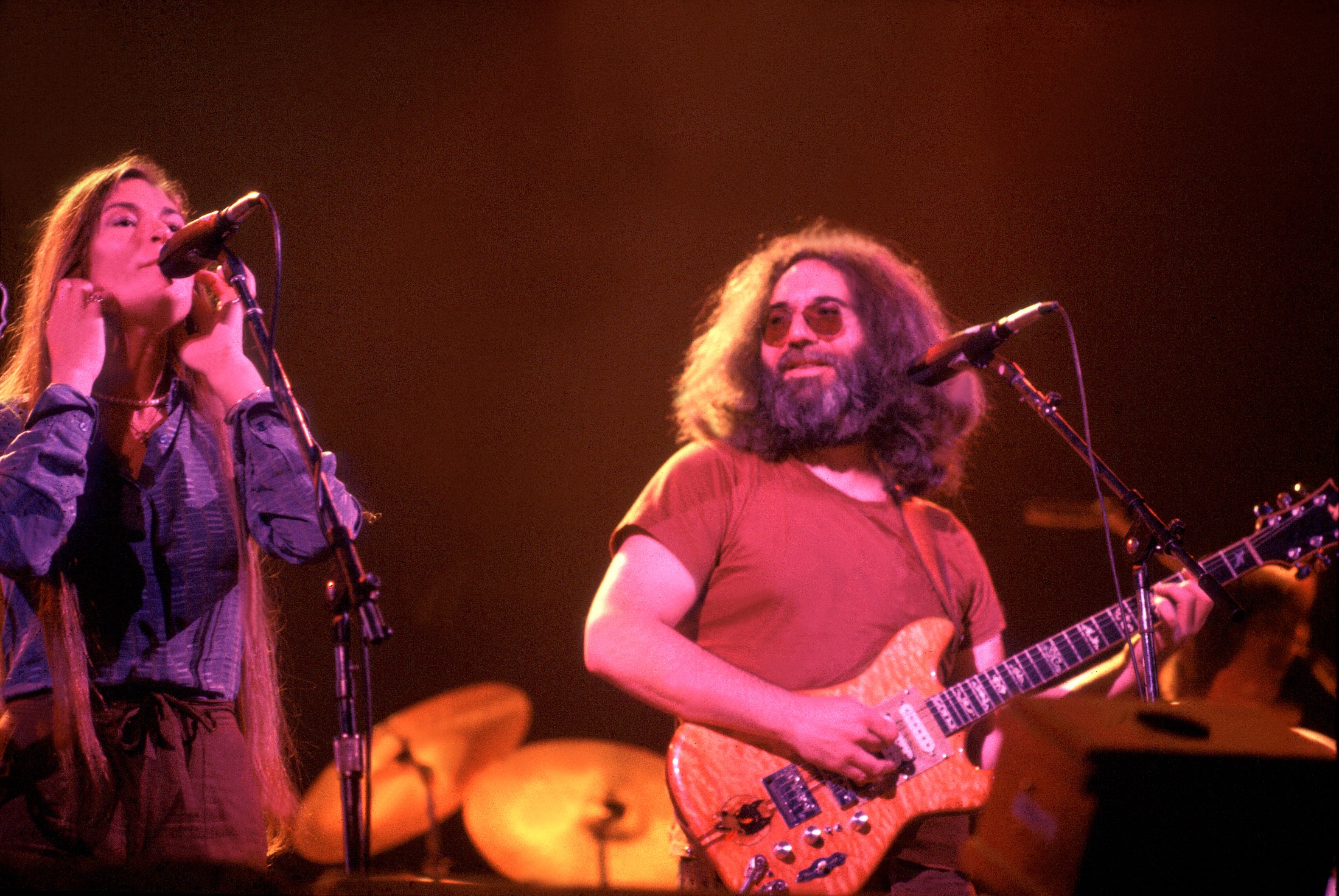
Photo by Paul Natkin/Getty Images
The last time Donna Jean Godchaux saw Jerry Garcia, he was clean. He was exuberant. He was, for that morning, the man she remembered.
It was April 5, 1995, in Birmingham, Alabama. The Grateful Dead had played the Birmingham-Jefferson Civic Center Coliseum the night before, a show deep into their final Spring tour. The setlist was a strange, winding journey, mixing classics like “Truckin'” and “Uncle John’s Band” with rarities like a “Wang Dang Doodle” opener, a cover of Paul McCartney’s “That Would Be Something,” and a “Matilda” bust-out, all before landing on a powerful “Morning Dew.”
But for Godchaux, who had left the band 16 years prior, watching them in 1995 was “slightly painful.” “Everything had changed,” she told Evans. The complex, telepathic musical organism she had joined was fractured, with strained relationships.
But the next morning, Garcia asked her to come up to his hotel room for breakfast.
Following the recent passing of Godchaux — the only woman to ever be a full-time member of the Grateful Dead — this memory, shared in her own words, has become a definitive and poignant reflection on her legendary career.
Godchaux died at age 78 on November 2, 2025, at a hospice facility in Nashville after a lengthy struggle with cancer. She shared the story of her final morning with Garcia in a remarkable interview in June 2023 with Sid Evans, Editor-in-Chief of Southern Living, on Southern Living’s “Biscuits & Jam” podcast.
Listen to the full podcast on Apple. It’s wonderful.
Her brother, she told Evans, called her “the real Forrest Gump of rock and roll,” and he wasn’t wrong. Her philosophy, as she explained it, was that “you never know when you’re making history.” For her, it was just about a deep, driving need to be a part of the music. “It was a have to thing,” she said. “It wasn’t something that we wanted to do… It was something that you had to do.” That “have to thing” put her in the room for history, time and again.
She was there when “When a Man Loves a Woman” was recorded and personally delivered the Billboard magazine to Percy Sledge in his hospital room to show him he was number one. As a nine-year-old in her “best frock,” she’d seen Elvis Presley’s first movie; years later, she was the session singer Elvis demanded for “Suspicious Minds,” after which she and her vocal group “screamed bloody murder” in an IHOP.
It was that same “have to thing” that made her walk away from her perfect career to chase an “adventure” in California.
To an Alabaman who went to grammar school in Louisiana, it was a place so foreign she had to have her mother ship her proper cornmeal, and where her attempts to grow okra yielded only “two pods.” And it led her to a Jerry Garcia Band gig, where she poked the man himself on the shoulder. “Keith and I have something I want to talk to you about,” she told him, recounting the audacious moment for Evans. “He is your next piano player, and I need your home telephone number so that we can call you.”
It was an introduction, not an audition. She simply willed herself and Keith into the Grateful Dead. Her very first time on any stage, she told Evans, was with them at Winterland on New Year’s Eve, 1971.
“It took some guts,” she said, attributing it to her “Southern guts” and an identity defined by a place where she “grew up with the sensitivity of you can, you can, you can, you can.” It was a philosophy she learned from her Nanny, who, when asked the secret to her perfect biscuits, replied, “Well, honey, you just have to hold your mouth right.”
As Godchaux explained to Evans, “It’s just to be in the moment. You got to feel it… and that is translated on so many levels in my life.” This combination of belief and intuition was a philosophy she’d need, stepping out “in front of that audience who obviously hated me, didn’t want me.” But she found her place with the band, particularly in the studio, which she described as a “comedy routine” where Garcia would introduce new songs like “Scarlet Begonias” and the band would dissolve into “idiotic” fun that was “crystal and clear and pure.”
That era ended in 1979, when she and Keith left the group. “Keith and I, we were wasted. We were exhausted. And the band was exhausted with us,” she told Rolling Stone in 2014. “We needed to go, and they needed for us to go.” The couple formed the Heart of Gold Band, but tragedy struck just a year later. In July 1980, Keith died in a car accident. He was 32.
But that bravado and that tragedy were a lifetime away by 1995. The woman who faced down hostile audiences and joined the circus was just happy to see an old friend.
That friend was Jerry Garcia.
“Jerry and I talked about the most wonderful, sweetest, personal experiences that we had had together,” she recalled of that hotel breakfast just five months before Garcia died on the podcast to Evans. “And laughed and laughed and laughed. He was exuberant. He was alive, he was clean.”
For Godchaux, the morning felt like a reprieve, a sign that the light she knew was still in there. “I had the most hopeful thought that things were going to change,” she confessed.
She left that breakfast feeling a sense of peace, a reconnection to the man and the music that had defined her adventure. It was a hopeful grace note.
“And then it was a few months later that he passed,” she told Evans, her voice carrying the weight of those decades.
“I didn’t know it was goodbye.”
A voice of pure Southern soul, whose soaring harmony became an essential thread in the Grateful Dead’s sound.
Fare thee well, Donna Jean.
Brandon Wenerd is the publisher of BroBible.com. Read and subscribe to his weekly Substack newsletter, The Wenerd Weekly, where he shares thoughts on men’s fashion, footwear, Grateful Dead, and the intersection of music, media, and culture.