


iStockphoto
The FDA routinely issues recalls for products that have the potential to harm consumers. The problems that serve as the basis for those decisions tend to be fairly unremarkable, but that’s not the case with one that’s led to the agency warning people to avoid frozen shrimp that may have been exposed to a radioactive substance.
Anyone who read Upton Sinclair’s The Jungle in school is likely very aware of the revolting factory conditions that played a major role in Congress passing the Pure Food and Drug Act that Theodore Roosevelt signed into law in 1906.
That law led to the creation of the Food and Drug Administration, which has spent more than a century serving as a watchdog that plays a pivotal role in protecting people from hidden dangers lurking in the countless products people across the United States consume on a daily basis.
Inspecting foods that are imported from other countries is one of the many responsibilities that fall under the FDA’s purview, and the agency recently flagged a shipment of frozen shrimp that was destined for Walmart stores for a fairly head-turning reason.
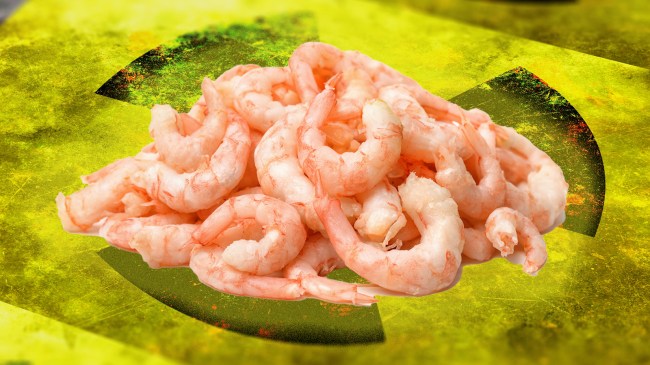
Radioactive shrimp Walmart imported from Indonesia have ended up at the center of an FDA recall
Walmart has to deal with plenty of logistical headaches as an $800 billion company that oversees more than 5,000 stores in the United States alone, and it was greeted with a new one due to the issue at the center of a press release the FDA shared on Tuesday.
The agency says it recently flagged a shipment of Great Value frozen shrimp sourced from a company in Indonesia that tested positive for Cesium-137, a radioactive isotope that is a product of nuclear fission and has been linked with an increased risk of pancreatic cancer.
The FDA noted “no product that has tested positive entered the U.S. commerce” but is still concerned that other batches may have been potentially contaminated (three specific lot codes are listed in the release). It’s also worth noting the shrimp that was flagged registered at 68 Bq/kg, which is a fraction of the “Derived Intervention Level” of 1,200 Bq/kg that the agency has set for Cs-137.
As a result, it asserts the shrimp in question would not pose an “acute hazard” to people who did inadvertently consume it, but it’s hard to blame the powers that be for erring on the side of caution when radioactivity is involved.