


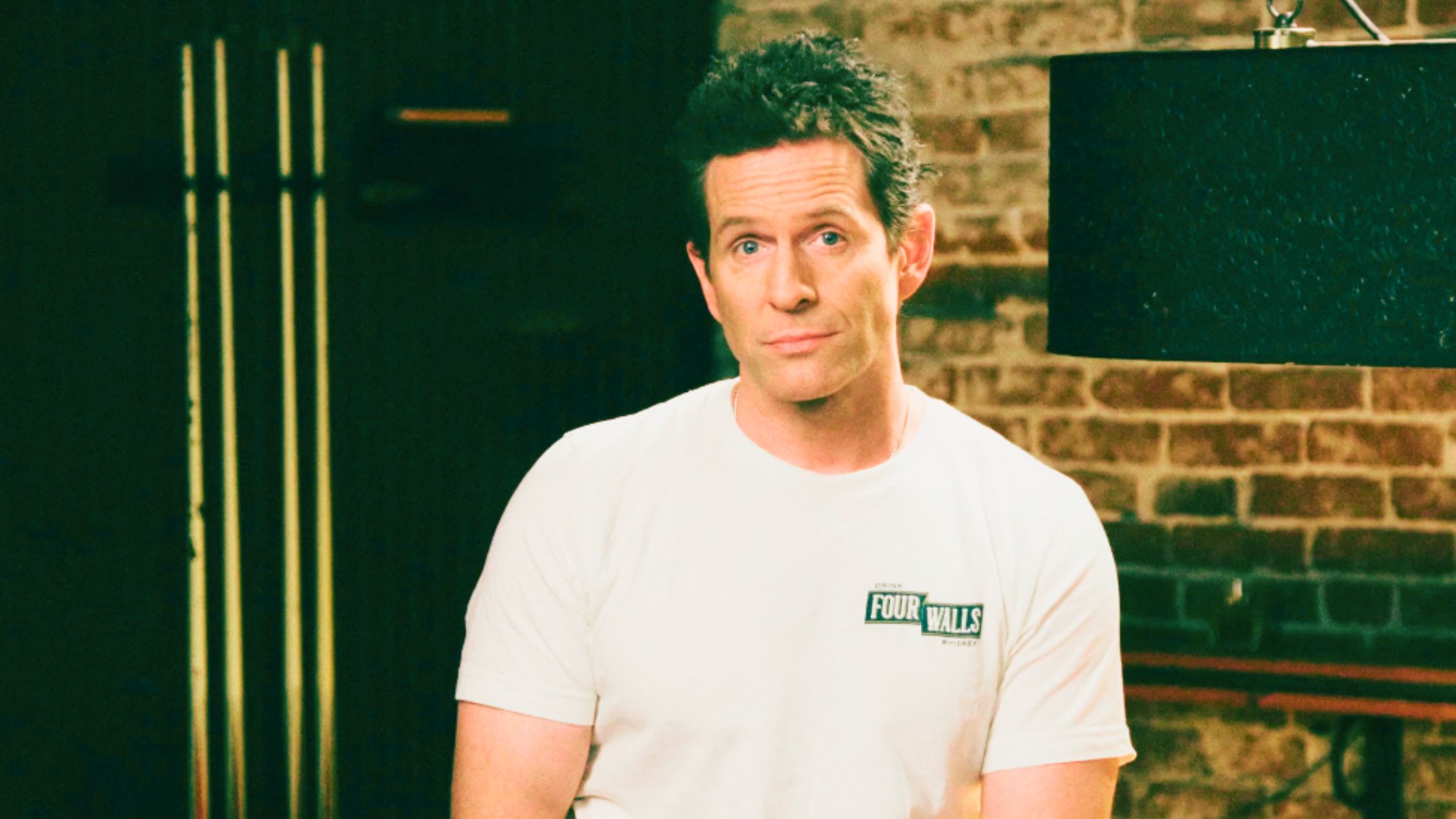
via Four Walls Whiskey
There is a specific, Pavlovian terror that comes with the idea of Dennis Reynolds telling you how to live your life. If the “Golden God” of It’s Always Sunny in Philadelphia demands you do something, it usually involves a camcorder, a boat, and the ominous “implication” of danger.
So, when I hopped on a Zoom call with Glenn Howerton—the Juilliard-trained actor who has spent nearly two decades embodying the most lovable sociopath on television—to discuss his whiskey brand, Four Walls, I half-expected a scheme. I expected a PowerPoint presentation on monetizing friendship, or perhaps a pitch for a wolf-hair-based energy drink legally distinct from “Fight Milk.”
It was a Friday on Halloween. I mentioned something about the “good energy in the universe” and the “art of the hang,” trying to set a casual mood. But Howerton wasn’t interested in small talk; he was interested in the decline of the human species.
“I think I took it for granted,” Howerton says, launching immediately into the existential philosophy behind the brand.
Howerton comes from the last generation of feral children — the ones who had to be home when the streetlights came on. Maybe you, like me, are one of them.
Note from the author: I couldn’t fit everything from my conversation with Glenn Howerton into this piece, but I have our full conversation + video over on my Substack, The Wenerd Weekly. Subscribe for weekly thoughts on 15+ years of BroBible, Internet trends, Always Sunny jokes, and lots of Phish and Grateful Dead jam band references.
Tap here To READ + SUBSCRIBE TO THE WENERD Weekly
“I grew up at a time where computers weren’t as much of a thing,” he recalls. “So you could watch only so much TV before it was time to run out of the house and hop on your bike and go see your friends.”
Howerton, along with his Sunny co-creators Rob Mac and Charlie Day, is currently pushing a Four Walls campaign called “Pledge to Hang.” It is a necessary corrective measure for a society that has traded physical presence for pixels.
“Screens are really an exciting world to live in, right? It’s a big dopamine rush,” he says. “You got your video game universe… You got whatever weird video game you’re playing where you got to take care of your crops. You got to make sure your crops are taken [care of]—I don’t know what the hell’s going on in that world.”
He laughs, but his point about our digital distractions is clear. We are digitally farming while our real-world relationships wither.
“We were meant to live and thrive in tribes,” he insists. “We’re meant to be around each other. We need to be in each other’s physical space. Otherwise, I think we start to get a little crazy.”
Watch our conversation on YouTube:
The Gang Solves The Friendship Crisis
Celebrity liquor brands are a dime a dozen. Usually, they feel like a cash grab or a talent agency’s lazy gimmick to turn fame into equity. But Four Walls feels different because it’s rooted in the specific chemistry of three guys who have spent 16 seasons screaming over each other in a dive bar.
The brand has, ironically, saved “The Gang” from the fate of their characters on Always Sunny. While Dennis, Mac, and Charlie are trapped in a co-dependent hellscape, Glenn, Rob, and Charlie were drifting into the typical isolation of successful adulthood.
“We’re just as guilty as anybody else of neglecting the hang,” Howerton confesses. “We’ve got families… we live far apart from each other.”
The whiskey business became the excuse to get back to basics. “It’s been a really great opportunity for us to hang out in ways that we used to hang out when we had less obligations,” he says. “To get to reconnect with that part of our friendship has been amazing.”
I witnessed this firsthand last year at a Wrexham AFC game in Los Angeles. I was standing right behind the Sunny crew when a game-winning goal was scored. The three of them spun around, embracing in a moment of pure, unadulterated sports euphoria, raising glasses of their own supply. It was a core memory in real-time, a “Five Star Man” moment without the narcissism. It completely rocked.
“I forgot about the Four Walls aspect of that game. That was really fun,” Howerton laughs when I remind him. “Drinking is not for everybody, and that’s okay… but it is a great social lubricant. Whiskey happens to be the connoisseur’s drink. It’s the kind of thing where you’re like, ‘Oh dude, have you tried this?'”
The Art of the Cold Call
The problem isn’t the desire to hang; it’s the logistics. We are all paralyzed by the awkwardness of the initial text. To illustrate how simple it should be, Howerton offers a piece of deep lore: the origin story of his friendship with Rob McElhenney.
It was 2001. Howerton had just moved to Los Angeles for That ’80s Show (a deep cut for the heads). He barely knew Rob.
“Rob moved out, and he called me out of the blue,” Howerton says. “He was like, ‘Hey, I got your number from Nick… we’re going to this party tonight. You want to hang out?'”
No pretense. No weeks of scheduling. Just a cold call to a guy he barely knew.
“Sometimes it’s just about taking that step,” Howerton advises. “The longer we don’t hang out with each other… the more we get in our own little world… and it gets more and more awkward to reach out. You feel stupid. You don’t want to be rejected.”
His advice? Get over yourself. “I’ve got friends that are a little flaky… and I’ll text them and I’ll be like, ‘I want to see you guys. I want to hang out.’ And they’re like, ‘Yeah, cool. Let’s do it.'”
Down with the Brown
To truly understand the chaotic, “wild card” energy that has kept Sunny on the air for a record-breaking run, you have to look at Howerton’s Spotify Wrapped. It reveals a deep, abiding love for the band Ween, which he’s tweeted about in the past as well.
For the uninitiated, Ween is the musical equivalent of Charlie Kelly’s dream journal. Hailing from New Hope, Pennsylvania, the duo (Dean Ween and Gene Ween) are cult heroes known for “The Brown Sound”—a philosophy of grunge rock fuzz, imperfection, and generally unhinged wrongness. Yet all that cranked-to-11 speaker feedback is absolute freedom to those “down to get brown.” They careen from country ballads to sludge metal and nautical sea shanties, crooning about spinal meningitis and pork rolls with equal conviction.
One of my favorite Ween songs is called “Poop Ship Destroyer”—it’s a classic in the Ween world. They are absurdist, abrasive, and secretly virtuoso musicians, symbolized by a demon-god known as Boognish, which you might have seen us Northeast bong-hit types wear on our favorite beanie in the winter.
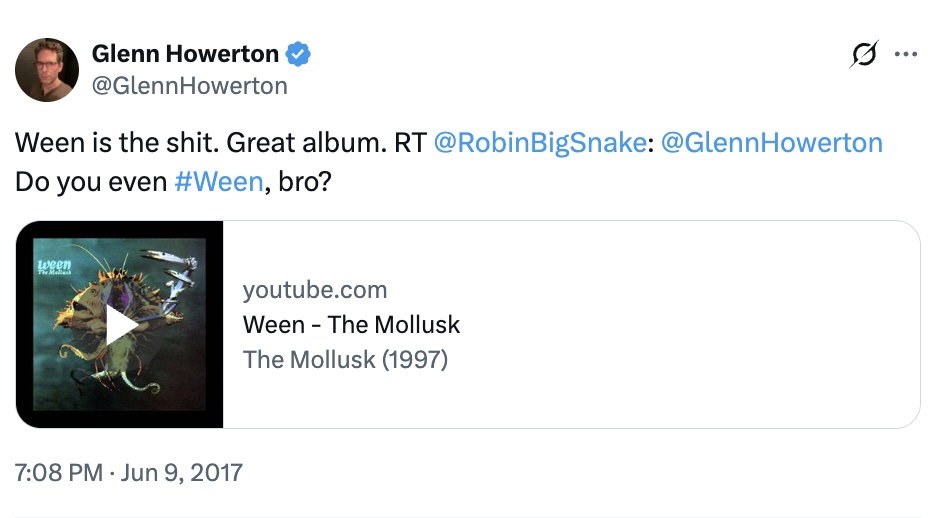
For Howerton, they are an artistic blueprint.
“I’ve always gravitated towards any artist… that just don’t seem to give a fuck what people think,” he says, citing David Bowie and the “wild men” in the Swedish punk band Viagra Boys as similar spirits. “Ween ended up making music because they’re like, ‘This is amusing to me.’ And some people will get it, and some people won’t.”
It’s the exact philosophy that launched Sunny. In a television landscape desperate for likable characters and moral lessons, The Gang went the other way.
“We tried to take that into study from the very beginning,” Howerton says. “It was like, ‘Okay, well, let’s just make a show that we think is funny.’ You can’t constantly be answering the question, ‘What do people want?’ and then authentically make that.”
Howerton’s entry point was the 1994 album Chocolate and Cheese. “That one just absolutely blew my mind,” he says. Then he cites their maritime-prog-rock masterpiece The Mollusk as his favorite. “It’s just so damn catchy and so weird and so thematically specific.”
He also delights in the “bit” of it all. Much like the Sunny cast, Ween is an act; Dean and Gene aren’t brothers, and those aren’t their real names. “I think a lot of people probably don’t even realize that,” Howerton laughs. Just as The Gang created a universe populated with inside jokes, Ween invited the world into their own manufactured chaos.
The Jerk Paradox
Here is the disconnect: Howerton plays a narcissist so convincing that it’s unsettling. And yet, talking to him, you are struck by how incredibly decent he is. In that way, the “Pledge to Hang” is truly sincere, not some cynical marketing ploy.
I asked him about the “shock value” humor he shares with McElhenney and Day, and whether strangers ever overhear them and assume they are terrible people.
“The three of us actually, in real life, strive to be good citizens,” he says earnestly. “I hope if you were to really dig… you’re really not going to find many things, if any, about the three of us being dickheads.”
He compares it to the Danny DeVito phenomenon. “If you really look at the characters [Danny] has played over his wonderful career, most of them have been despicable pieces of shit. So then you got to ask yourself, ‘Okay, well, what is that?’ I think it’s because the person that he really is somehow still comes through.”
That is the connective tissue of Sunny, and it’s the secret sauce of Four Walls. We buy the whiskey not because we want to be Dennis, Mac, and Charlie, but because we want to hang out with Glenn, Rob, and Charlie. We want the chemistry without the felony charges.
The Perfect Bar
As we wrapped up, I asked the man who owns the most famous fictional TV bar in Philadelphia what makes a bar great. Just as suspected, it’s not the lighting or the drink specials.
“It’s just the vibe that you get,” he says. “But that vibe is often set by the servers or the bartenders. If the people who work there seem like they enjoy working there, it makes me feel like I’m in a good place.”
And, crucially: “If a bar plays shitty music, I’m out.”
Glenn Howerton has given us 16 seasons of laughter, a backlog of reaction GIFs, and now, a whiskey designed to force us off the internet. His mission is simple.
“Text your friends,” he says, signing off. “That’s it. Make a plan and show up.”
The Golden God has spoken.
You heard the man. Go get a drink.