


via Do Good Crew
“Believing in someone is powerful to the extent that it triggers like this dopamine hit of gratitude, right?”
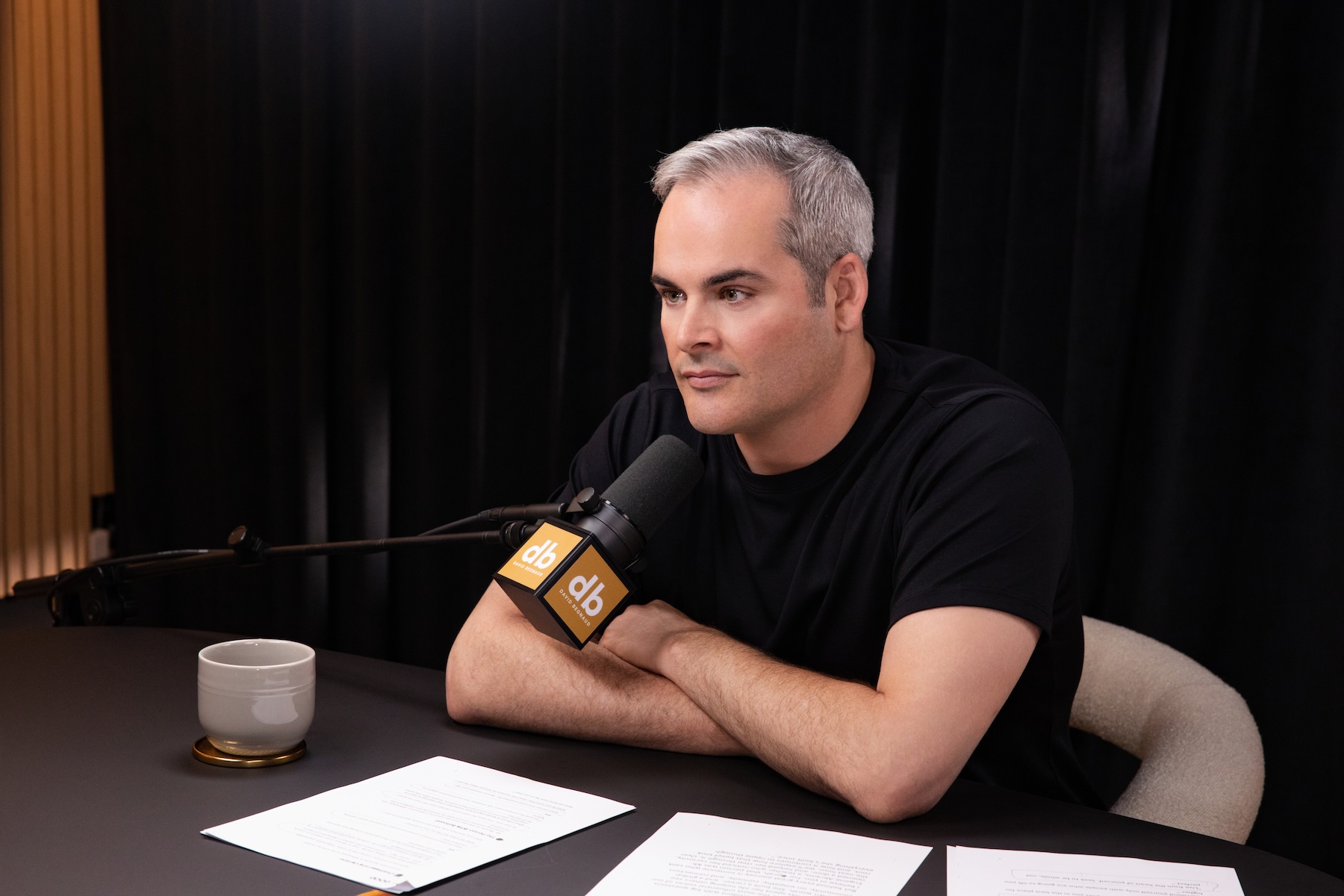
David Begnaud is sitting in his Los Angeles home studio, the same one where he just interviewed Oprah and 2Chainz on his podcast, The Person Who Believed in Me, dropping the kind of profound, stop-you-in-your-tracks wisdom that makes you want to immediately put down your phone and text your high school baseball coach.
“And so when we believe in someone… it triggers this gratitude that what I hope makes you want to do is call somebody and say, ‘Hey, thanks for believing in me at that point, at that time, that helped me kind of move on,’” he continues.
“Or I think it also helps us ask ourselves, How can we be the person who believes in someone? And overall, the practice of considering belief in each other is a practice of gratitude, and that’s a pretty dope thing these days.”
If you watch the news, you know Begnaud. For years, the CBS News lead national correspondent was the guy parachuting into the absolute worst days of people’s lives. He was the face you saw standing in the howling winds of Category 5 hurricanes, or standing outside yellow police tape while a community was shattered. He was, in his own words, “the disaster guy.”
But right now, in this LA studio, Begnaud isn’t talking about disasters. He’s talking about dopamine. He’s talking about gratitude. And most importantly, he’s talking about a radical, highly intentional pivot to hijack the internet’s relentless rage machine and inject it with something entirely different: relentless humanity.
Welcome to the Do Good Crew.
Watch David talk about his mission in his own words on the BroBible YouTube:
It’s been almost impossible to miss Begnaud’s recent PR blitz, but if you’re out of the loop, Do Good Crew is his new media venture. It’s not a charity. It’s not a non-profit. It is a full-fledged, for-profit business built on a staggeringly simple, yet heavily contrarian thesis: giving a damn about each other is actually incredibly interesting.
But to understand why a heavyweight network news anchor decided to walk away from the anchor-desk fast-track to build a community celebrating the good in the world, you have to understand the toll the bad takes on a person’s soul.
“I started off as the disaster guy,” Begnaud admits, his voice dropping the polished broadcaster cadence for something much more raw. “I covered more mass shootings and massacres and kids who had their heads blown off at school, and I knocked on more doors of mothers and fathers who were burying children, and it became too much. It’s not what I wanted the rest of my career or my life to be.”
So, he did what most people only fantasize about doing when they hit a wall at work. He marched into his bosses’ offices and drew a line in the sand.
“I remember going to my bosses and being like, this doesn’t work for me anymore,” he says. “And they were like, ‘Oh, that’s nice. Why don’t you take a vacation? Just cut it, you know, like reset, you’ll feel better.’ And I came back and I was like, ‘I don’t think you understand. I’m not doing this anymore. I’m not covering disasters.’”
He pivoted. But Begnaud is quick to clarify that this wasn’t about running away to cover puppy adoptions or bake sales. He has a visceral allergy to manufactured perfection.
“I didn’t want to do this, like, woo-woo, happy, soft stuff,” he laughs. “I wanted to do things that celebrated local heroes, but, like, leaned into the imperfection. I can’t stand stories about perfect people. You know why? Because I pretended I was perfect the whole time growing up when I was gay and pretending to be someone I wasn’t.”
This is where Begnaud’s mission goes from a cool career pivot to a deeply personal crusade. Growing up in Lafayette, Louisiana, Begnaud carried the weight of dual secrets: grappling with his sexuality in the Deep South, and dealing with Tourette’s syndrome. It was, as he describes it, “a very traumatic childhood with peers.” He was used to the world looking at him as a problem to be solved, or worse, a glitch to be mocked.
Until he was 18.
“I went to a Catholic school… and this teacher of mine, Josette Surratt, called me into the confessional because the chapel at the school had been made into a speech room,” Begnaud recalls. “This lady calls me in and she looks at me, and I’ll never forget, she dead-sets on me, and she goes, ‘What are you running from?’”
For Begnaud, that sentence shifted the tectonic plates of his entire life.
“I remember that moment thinking it was an invitation to find out what I was running from, rather than an indictment of, like, What the f** is wrong with you?*” he says. “All I had heard through my childhood is ‘wrong with you, dude,’ right? And so I open up and like Niagara Falls, the stuff starts flowing. All she did was say, what are you running from? And the way I received it led me to just open the floodgates, and it truly changed my life.”
That single conversation in a converted Catholic confessional ultimately forged the DNA of the interviewer Begnaud is today. It taught him that the sanitized, highlight-reel version of a person’s life—the stuff we all post on Instagram—is kinda boring.
The real connection is in the scars.
“I hate small talk about people’s successes, because most of the time, whatever you did well, I can’t totally relate to,” he explains, perfectly encapsulating the modern exhaustion with hustle-culture bragging. “I can, like, applaud for you and be genuinely happy about it. But as soon as you start talking to me about your struggles and your pain and your trauma, that is where we start to connect. And so for me, my whole career is based around conversations about pain, struggle, and then triumph.”
This philosophy is the beating heart of The Person Who Believed in Me. The premise is elegantly simple: sit down with highly successful, famously untouchable people, and ask them to name the one person who kept them going before they were anybody.
The result is absolute magic. It turns out, when you ask a billionaire or a rap god to talk about the person who saved them, the media training melts away.
“People at the end of the day who are famous become more human, softer, kinder, sweeter when you ask them a question that sets them back on their heels,” Begnaud says. “Because the question always takes them back to a time before they were famous and successful. The conversation ends up becoming a vulnerable one, where they’re speaking from a place before everybody stepped out of the way, or before everybody wanted a picture or an autograph.”
He casually drops a roster of guests that would make any producer weep with envy.
“We end up having at this table these deeply human conversations where Oprah suddenly becomes an ostracized girl sitting in a cafeteria reading a book, and her peers thought she talked like she was too white,” he says. “2 Chainz becomes a dude who’s in his room, you know, rolling marijuana to go sell at school with his mom saying, ‘You sure you want to take that much, because that seems like a lot.’ And he’s a kid who’s about to get kicked out of school, and a lady named Miss Love steps in and writes a letter on his behalf that saves him from expulsion.”
He mentions Barry Diller, the titan who fundamentally changed the business of Hollywood, morphing back into a closeted gay man terrified of being outed. He mentions Sherry Lansing, the legendary former CEO of Paramount Pictures, talking about a therapist who believed in her during the 1970s—an era when admitting you were in therapy meant people assumed you were clinically insane.
“These are the most profound conversations that just make Oprah more human than I think you’ve ever seen in an interview before,” Begnaud challenges. “I guarantee you were going to call me afterwards and say ‘I wasn’t expecting to see her so open and vulnerable.’ And it’s not a testament to me. It’s a testament to the question: Who is the person who believed in you?”
Which brings us back to the Do Good Crew.
If the podcast is about looking backward at the heroes who shaped us, the Do Good Crew is about looking around right now and finding the heroes among us. It’s Begnaud’s master plan to Trojan-horse genuine human connection into our daily doomscroll.
“What I hate is that so much of the algorithm amplifies rage,” Begnaud states bluntly. “And so I said to myself, I want to work within that same algorithm. I can’t build a new one, but I want to work within that same algorithm to amplify the good. The really good.”
He leans forward, the former breaking-news guy clearly energized not by sirens, but by synergy. He recounts a story from South Carolina: A homeless man caught in a brutal ice storm with his dog. One guy stops to help. That guy calls a buddy. An EMT hears about it and raises some cash. The women at City Hall chip in. The local hotel manager comps a room.
“I get the chills re-telling you the story because it’s everyday heroes helping everyday people,” Begnaud says, genuinely fired up. “What I’m after is, where are the everyday people doing extraordinary things? And for me, I reject the notion that that’s like soft news and like feel-good programming bullshit. You know why? Because if you got a buddy who does something extraordinary for someone, you will tell everybody you know. So there’s interest there.”
He’s not wrong. In an era where every news chyron feels like a threat and every social media reply section looks like a digital gladiator arena, there is something profoundly rebellious about choosing to spotlight decency. It’s not ignoring reality; it’s choosing to focus on the part of reality that doesn’t make you want to punch a hole in the drywall.
“If you think it’s good enough to call me or text me and give me all this stuff about the details, then why isn’t it interesting enough to put on CBS?” he asks. “And so Do Good Crew came about because I was like, there are plenty of do-good people out there. We’re going to build a business around it, and we’re going to bring together a community of like-minded folks who want to show up to celebrate local heroes.”
The craziest part is that all of this is actually working.
In a hyper-polarized world where we can’t even agree on what color the sky is, Begnaud has found a way for us to actually have some human unity via conversation, just like we used to have at the dinner table or around the campfire.
“My inbox is full of MAGA folks and liberal folks and gay folks and straight folks and dudes and bros and like everybody,” he smiles. “Because we can all get behind a story that reminds you of our better angels.”
David Begnaud walked away from the blood and the wreckage not because he couldn’t stomach the dark, but because he realized the light was infinitely more compelling.
And in doing so, he might just be building exactly the kind of internet we actually want to log into.
Pretty dope, indeed.