


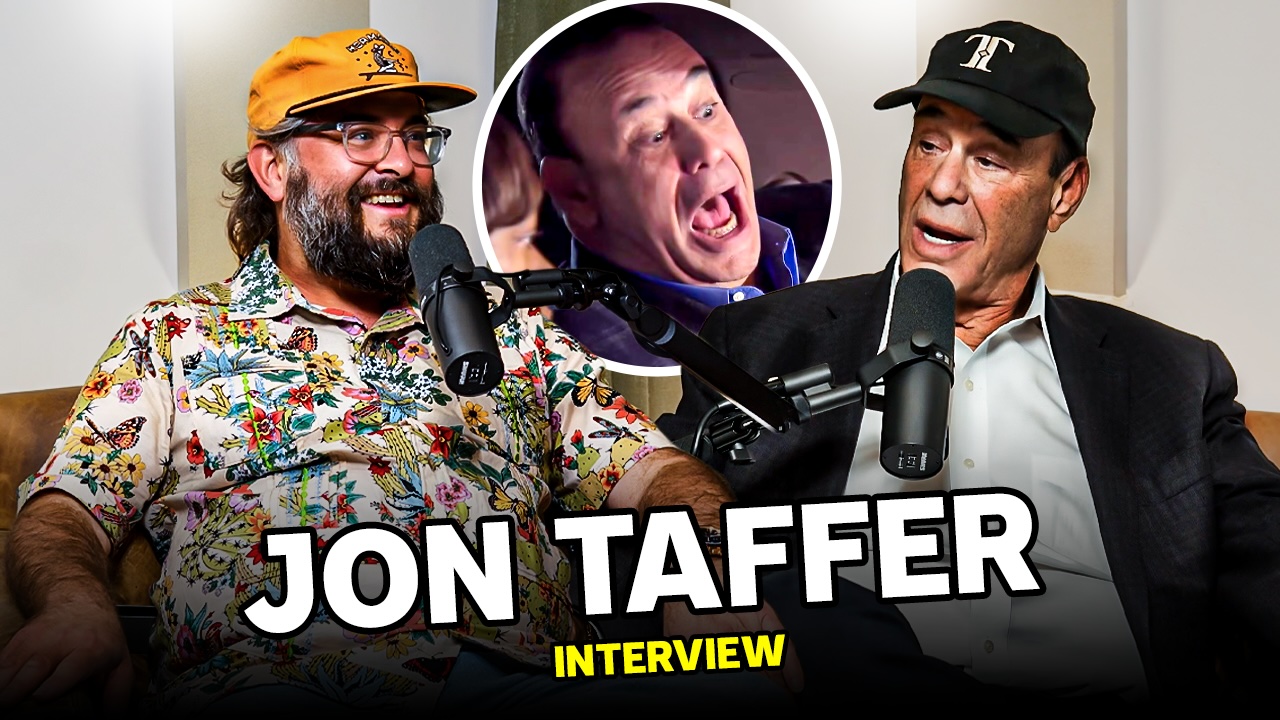
via BroBible
Jon Taffer is staring down a cultural sickness creeping across America, and it smells like a DoorDash bag left on a porch.
A whole generation is retreating indoors. They are swiping, scrolling, and self-medicating on their couches while the grand American tradition of walking into a dimly lit room full of strangers and ordering a stiff drink is on life support.
If you want to know exactly why this is happening, you don’t ask a sociologist. You ask the loudest, most ruthlessly effective man in hospitality.
It’s been 15 years since Bar Rescue first aired. Back in 2011, when the show debuted on the glorious, testosterone-soaked cathedral that was Spike TV, BroBible was there. We started blogging about that very first season because there was an undeniable, magnetic corollary between what Taffer was doing and the ethos of our readers who would binge watch it on Sundays on the couch while dealing with a hangover from a big night out before. He was a force of nature in a suit, stress-testing and screaming at inept bar owners, throwing raw chicken across kitchens, and miraculously turning irredeemable dives into money-printing machines. We noticed him. He noticed us. Over the past decade and a half, we’ve interviewed him at least a half-dozen times, most recently in 2024 when he told Connor Toole that the “burger test” is the so-called best way to evaluate a bar.
We’ve watched him outlast networks, executives, and cultural tectonic shifts. Remember Spike TV? Pepperidge farm remembers…
“I was with my new network team just yesterday,” Taffer tells me, grinning with the hard-earned satisfaction of a battle-tested general, “and we were laughing about the fact that I’m the last one standing.”
He truly is. Bar Rescue is entering its monumental 10th season, boasting a staggering 283 episodes.
“Kelsey Grammer was a friend of mine years ago,” Taffer muses, “and I used to think to myself… he’s been Frasier for all. How do you do it the same way year after year after year? Now here I am, 283 episodes in I’m that guy. But you know what? It doesn’t feel that way, because every time I look in their face, it’s like all fresh again.”
TAP HERE TO WATCH our full conversation on the BroBible YouTube:
The Psychology of a Rescue
But the faces looking back at him from across the bar are changing. And over 10 seasons, Taffer’s approach has morphed from a focus on cosmetics to a deep-dive into the human psyche.
“In the beginning it was about dirt and filth and bad drinks and all of that,” he admits. “As I’ve evolved over the years, I’ve learned that every failing business is a failing owner. If I build them to Taj Mahal, they’ll still f*** it up. So I got to change them.”
To Taffer, a bar is a theater of human vulnerability. “To me, Bar Rescue isn’t about bars,” he says. “To me, it’s about it’s very Shakespearean. Person in trouble resists change, transforms, redeems themselves, happy ending. It’s as Shakespearean as it gets.”
The rescue operation is a ruthless, high-speed psychological demolition. He doesn’t take applications from owners pleading for help. Why? Because losers don’t ask for help.
“First of all, they don’t apply,” Taffer bluntly reveals. “They’re not smart enough, and they’re not savvy enough to apply. Remember, these people are failing, so they’re not going to do anything to help themselves.”
Instead, his team hunts down the biggest disasters in a given market. And Taffer demands high stakes. “I want real stakes. I don’t want them bullshitting me to get a free remodel. I want a house on a line. I want a family on the line. I want a real story to tell here.”
He goes in blind, armed with only a 60-second briefing before executing a grueling 36-hour remodel. It requires an insane level of urgency to break through the thick skulls of failing proprietors. You don’t get through to a guy who is $500k in debt by speaking softly. You get through to him by bulging a vein in your forehead and screaming to SHUT IT DOWN. “The other thing I’ve learned about Bar Rescue after 15 years is the man with the biggest egos got the thinnest wallet,” Taffer laughs. “The ego is they know the place is failing, but they won’t change anything, because they’re right, the customer’s wrong. I love that one, the customer’s wrong, I’m right. I’m going to educate the customer.”
Breaking that ego requires a relentless and aggressive dismantling. It’s often deeply personal.
“You have to embarrass them. You have to shame them. You have to appeal to their pride,” he says. “Imagine if I gave you four days to do a 60 day project, you’d be a f***ing raving maniac. That’s me in Bar Rescue. My clock, there’s a clock ticking in my head… I don’t have time for you to get on a bus. Man, you’re getting on a bus right now. So it that pressure cook is very powerful man.”
But that pressure cooker yields incredible results. He recalls a recent owner on the Season 10 premiere of Bar Rescue who suffered from what Taffer dubs “BMS”—Broken Man Syndrome. “This guy couldn’t even wash his own face. He cared nothing about… and now it’s almost a year since I shot that episode. The bar is still open. I’ve spoke to him. He’s doing great. You know, to think that I changed this guy’s life. How freaking cool is that?”
The Gen Z Problem and the Death of the “Training Ground”
While Taffer can fix a broken man, fixing a broken culture is a much taller order. The landscape of American nightlife is shifting beneath our feet, largely because Gen Z is fundamentally altering how they socialize.
“Alcohol consumption is down to 54% of the society, which is a big deal, huge deal,” Taffer says, laying out the grim statistics. “Everything is down. Beer is down, wine is down, seltzers are down, spirits are down. Everything is down. I’ve seen one or two be down. I’ve never seen them all be down at the same time.”
The root cause, according to Taffer, isn’t just a sudden, collective aversion to hangovers and our own mortality. It’s the death of the “training ground.”
“The coffee shops of the world are the training grounds for bars,” he explains. “You’re 18, 19, 20 years old. You’re in college. You go to your local Starbucks, you sit at a small table, you sip beverages together, you talk to people. It’s a prerequisite for the socialization of a bar. Look at the student unions and colleges. All of these things create that social connection. The pandemic killed that.”
Without that training ground, a generation has defaulted to the path of least resistance: isolation.
“Now I’m sitting home making drinks myself,” Taffer continues, painting a bleak picture of the modern Friday night. “I’m now doing DoorDash. I’m now eating my edibles, I’m now smoking my joints, right? All of these things are working against us. So this generation is much more comfortable at home than some of them are in bars.”
I stop him and chirp up.
“Yeah, but… all that sucks.”
“That does it… f***ing sucks,” he says bluntly.
For a man who has dedicated his life to the magic of the public house—noting that the second public building ever built in America was a bar, right after the church—this is both bad for business and, perhaps more critically, bad for the human soul.
Add to this the toxic drip of social media, which has completely warped the concept of what it means to actually “go out.” Going to a bar is no longer about community; for many, it’s a desperate play for digital clout.
“If you post the ugliest picture in the world of yourself online tonight, somebody’s gonna say, looking good buddy. Great pick. You’re gonna get all this bullshit relevancy, right?” Taffer says, his voice rising with that signature, righteous incredulity. “I go to a place where the plate is hip because I want to be f***ing relevant. Then I hold up the spirit, the premium spirit, because I want to be f***ing relevant. All of this is about relevancy today, and it’s a little f***ed up that people are sitting home, sitting on their couch, eating an edible, singing a cocktail, and claiming they’re relevant. How are you relevant when you’re not out there? How are you relevant when you’re not around people? So I think it’s a major bummer.”
Yet, despite these headwinds, Taffer is far from a doomer. The playbook just has to evolve. Bar owners must double down on local community.
“I tell bar operators all the time, LA, is not your market 10 blocks? Is your market own it be that neighborhood place within those 10 blocks, and you can be successful. Your marketplace is within five or 10 blocks, not a mile away.” It’s why he praises New York (“a great neighborhood dive bar on every freaking block”) and relentlessly dunks on Los Angeles (“I would not call LA a good bar town… It’s a terrible bar. It’s a terrible nightclub town too.”).
The Science of Menus, Music, and… Chicken Tenders?
If you want to run a successful joint in 2024, you have to master the science of human behavior. Taffer’s rules are uncompromising.
Take the menu. If you have a 20-page, Cheesecake Factory-style tome, you’ve already lost. Taffer gives his rescued bars exactly five menu items. And he manipulates exactly what you order through pure visual engineering.
“Do you know, if you box something on a menu, sales of that item go up 20% really,” he reveals, detailing the Jedi mind trick of menu design. “If I shadow it or list it as John’s special whatever, sales go up 14 to 16%… My most profitable item in dollars, not points, is boxed. I am steering you to buy what I want you to buy, because that’s where my profit is.”
When it comes to the actual food, you need wings. But do not get Jon Taffer started on the great American lie that is the “chicken tender.”
“I’ll tell you what bothers me, chicken tenders,” he unloads, his voice practically begging for a lawsuit against Big Poultry. “Chickens have a tenderloin, just like beef tenderloin. But people say chicken tenders, but it’s not, it’s the chicken breast. If you’ve ever had a chicken tender, it is nothing like a chicken breast. It is juicier, it is more tender, it is more flavorful. And that one bothers me. I shouldn’t be allowed to tell you it’s a tender if it’s a breast, because the chicken tender cost a lot more. That’s the next lawsuit. I might be the one who perpetuates there.”
Then there is the music. In a world where every 22-year-old thinks their Spotify playlist is genius, Taffer holds a literal federal patent for music management in hospitality properties. His golden rule?
“A bar should never play new music. Oh, never, ever,” he declares. “Your job is not to break new music. Your job is to play recognizable music that people enjoy, so recurrent, which means at least six months old, is the newest music we will ever play in a bar. New music that nobody knows is of no value to you in the bar business.”
He wants you screaming “Mr. Brightside” or “New York, New York” at the top of your lungs. He wants you out of your house. He wants you engaged.
He knows what towns do this best. When pressed for his top bar cities in America, he fires off an elite list: New York City, St. Louis (bolstered by Anheuser-Busch history), Atlanta (home to two of his Taffer Taverns), Chicago, and, unsurprisingly to anyone who’s ever been, Milwaukee, citing the tavern association in Wisconsin as “the most active and most incredible bar organization in the country.” A quick honorable mention goes to Detroit’s proud blue-collar bar culture.
The Last One Standing
After 283 episodes, you’d think the man would be ready to kick his feet up. He isn’t. He’s still expanding his empire, recently launching Taffer’s Brown Butter Bourbon, a spirit born from stroke of genius while watching a cook prepare brown butter, tossing it in a sous-vide bag with whiskey, and letting science do the rest. It’s now expanding across 32 states.
Taffer reminds me a handful of times during our conversation that he doesn’t have to be doing this. I like that. He doesn’t have to be standing on a balcony on Bourbon Street on Halloween night while hordes of drunk revelers scream “Show me your penis!” at him during an episode reveal, which, yes, actually happened in the early days of Bar Rescue.
But he stays because the stakes are real, and the payoff is profound.
“I don’t need the money anymore, certainly,” Taffer says, his tone softening slightly, reflecting on the bar owners who were on the brink of divorce, bankruptcy, and total collapse before he walked through their doors. “But, you know, to change people’s lives, to help them, to get that hug, man, how freaking cool is that?”
It’s very cool, Jon. Long live the bar.
And long live the guy willing to scream at us until we realize how lucky we are to be sitting in it.