


iStockphoto
It’s been a little over 10 years since researchers in Georgia discovered spiders that are native to Asia had gained a foothold in the state. The species is known for harnessing a unique strategy to get from one place to another, and it’s helped them slowly but surely expand a domain that could eventually consist of all of America.
The increasingly global nature of the world’s economy has played a central role in the spread of invasive species that have managed to infiltrate ecosystems where they formerly had no business appearing.
Most countries have safeguards in place to try to prevent unwanted pests from infiltrating their borders, but when you consider a fox recently managed to travel on a ship from England to the United States before it was detected, it’s no surprise that more minuscule animals are able to sneak into uncharted territory.
That includes a wide variety of insects that end up in foreign shipments and manage to proliferate once they arrive in another country, like spotted lanternflies and the so-called “murder hornets” that started popping up in the Pacific Northwest at the start of the 2020s before they were successfully eradicated.
Experts have also been keeping tabs on a species of spider that arrived in the southeastern United States over a decade ago, which doesn’t show any signs of slowing down when it comes to expanding its territory.
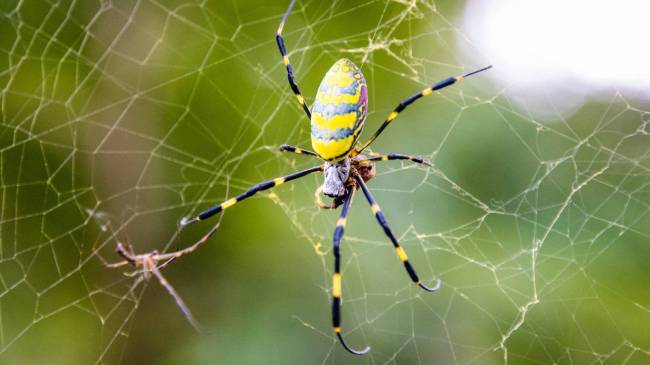
The Joro spider, an invasive species that uses its web as a parachute, has now been spotted in close to ten states
The Joro spider can be found in the wild in China, Japan, Taiwan, and Korea, and that list has also included the United States since its presence was first reported in northern Georgia for the first time in 2013.
The legs of the female spiders can grow up to four inches in length, and while any true arachnophobe will be triggered by their presence, they can take some solace in knowing their venom doesn’t pose a risk to humans in the rare situation where it bites one.
Younger spiders are able to travel significant distances by engaging in an act known as “ballooning,” which involves releasing silk that serves as a parachute that carries them wherever the wind ends up taking them. That sparked concerns that the Joro spider’s domain in America would not be limited to Georgia for very long, and that ended up being the case.
The spiders had already been spotted in other states by the time researchers revealed they were more resistant to the cold than they initially assumed, and there’s also evidence they thrive in urban environments.
According to the Miami Herald, the spiders have now been spotted in ten states as they’ve slowly made their way up the East Coast. Georgia, Tennessee, North Carolina, and South Carolina seem to be the biggest hotbeds based on a map of sightings, but they’ve also been detected in Alabama, West Virginia, Pennsylvania, and Maryland.
There have also been isolated sightings in California and Oklahoma, which would seem to suggest the rest of the United States has the potential to become Joro Country in the not-so-distant future.
Unlike some other invasive species, there’s been no active effort to eradicate the spiders, as there’s nothing that suggests they have the potential to negatively disrupt the natural order. However, that probably doesn’t do much to assuage the fears of people who’d prefer to avoid them.