


iStockphoto / poco_bw / rarrarorro
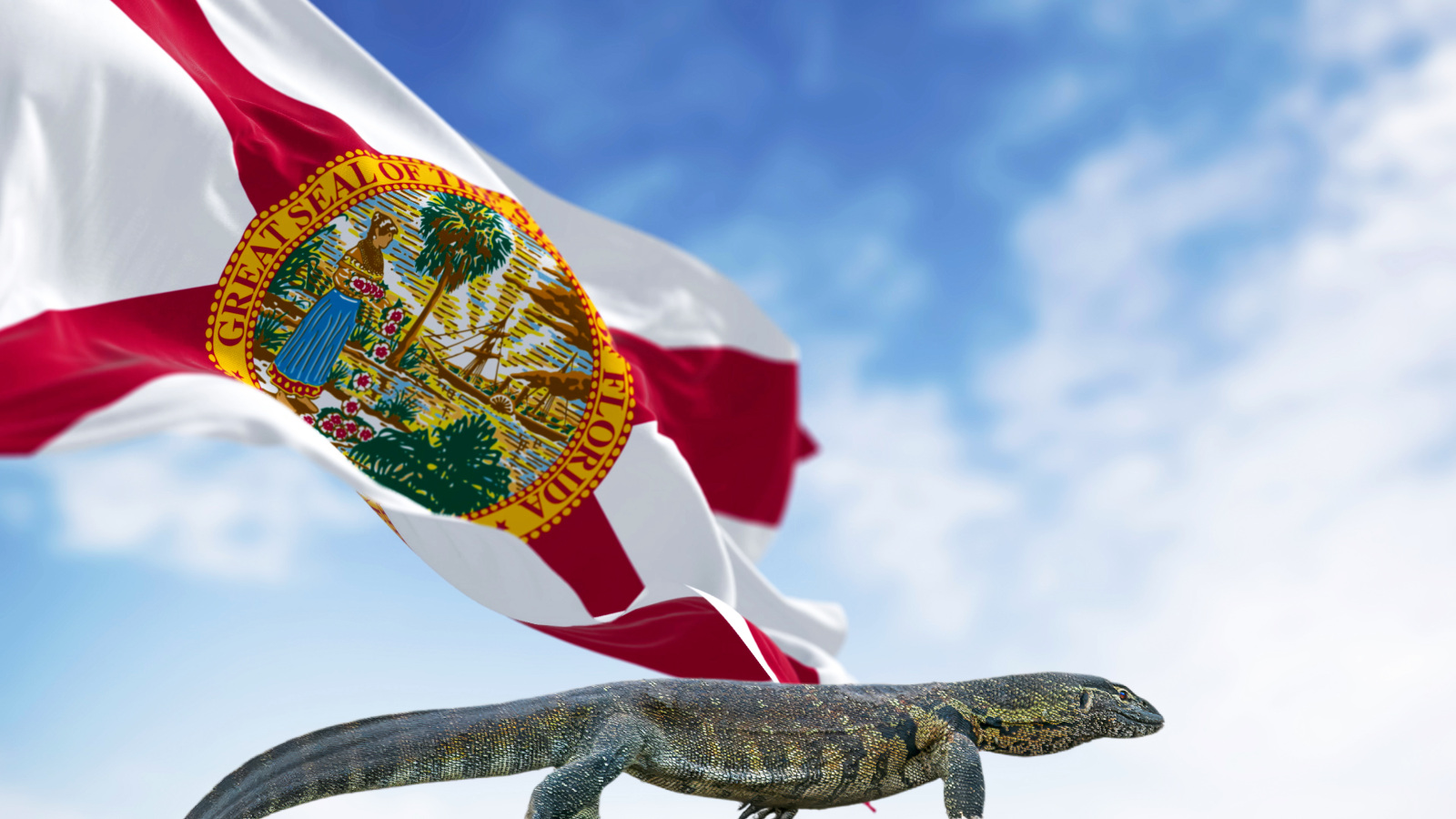
The state of Florida‘s ‘Dirty Dozen’ invasive species list recently got an update, adding three new species to the list and remove three that pose less of a threat. Remaining steadfast on the list is the Nile monitor which, according to the Python Cowboy, is emerging as Florida’s next major invasive threat.
In a recent clip, Mike Kimmel aka the ‘Python Cowboy’ who I recently ran into with Tucker Carlson at Eldred’s Marina off Boca Grande, says that “here in Florida we got more than pythons, iguanas, and New Yorkers. We got Nile monitors and all kinds of other invasive species.”
Are Nile Monitors Taking Over Florida As An Invasive Species?
As a born and raised Floridian, I write extensively here at BroBible about invasive species like the Burmese python and I covered the recent changes to the ‘Dirty Dozen’ list. In my part of SW Florida, the Nile monitor is not really a massive threat yet but if the Python Cowboy is to be believed, and I think he is, the threat is growing by the day.
On average, Nile monitors lay between 12-60 eggs per clutch. This happens generally once a year and the incubation time is quite long, between 6 to 9 months. That means that if the eggs can be found and terminated then up to 60 Nile monitors can be prevented from damaging the local ecosystem. If not, well, this invasive species can grow exponentially.
Here’s the recent clip from the Python Cowboy where he trapped a large Nile monitor he had seen recently:
What’s next?
After that video, Kris Millgate of OutdoorLife spoke with Mike Kimmel about the Nile monitor’s impact on Florida’s ecology. He said “it’s a predatory lizard and they don’t mess around … They’re more like a python mixed with an iguana.” Not great!
To give you a sense of how many are out there, a report found there are over 1,000 of them in the Cape Coral area alone. These invasive lizards are concentrated in SW Florida in and around the Everglades. They also possess remarkably efficient natural camouflage for the region making them difficult for trappers to spot and eradicate.
For more on the Nile monitor, what to do if you spot one here in Florida, and the threat they pose, visit the Everglades CISMA website which has information on their distribution map, behavior, and more.