


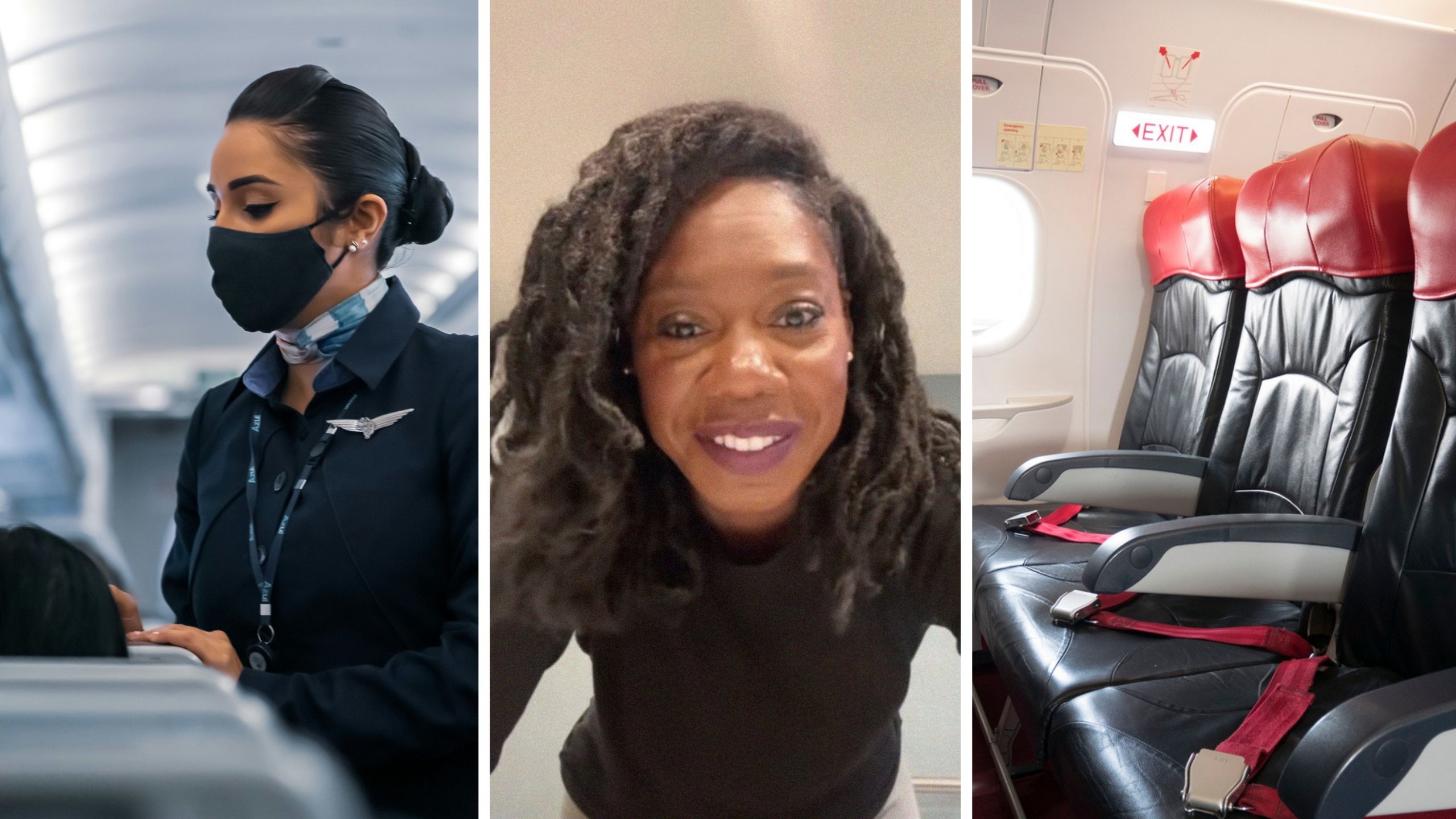
A flight attendant’s routine exit row safety briefing took an unexpected turn when one passenger refused to follow simple instructions.
What started as a standard compliance check quickly escalated, and the cabin crew member was forced to channel her inner “Airplane Barbie.”
Flight Attendant Describes Exit Row Standoff
In a viral video with more than 214,000 views, flight attendant Soph (@sofortunatetv) recounts a recent interaction that made her training worth every moment.
Soph explains that exit row briefings can be challenging because passengers sometimes choose to “show their donkey” in those seats.
She describes her standard procedure: reminding passengers they’re in an exit row, explaining they’ll be responsible for opening the door in an emergency, and asking if they’re willing and able to assist.
Most passengers respond with a simple “yes,” but one particular passenger decided to nod instead of verbally confirming. Soph gave him multiple opportunities to comply with the requirement.
“I need a verbal ‘yes,'” she tells him.
When he continued nodding without speaking, she made her decision.
“I should have just airplane Barbied him right then and there, but I gave him one more chance,” Soph recounts.
After her final request for a verbal confirmation, the passenger’s attitude shifted dramatically. He claimed he didn’t want to sit in the exit row anyway.
That’s when Soph delivered her iconic line: “Come with me.”
The passenger suddenly became eager to comply, repeatedly saying “yes” and insisting he was willing and able to assist. But Soph had made her call.
“Oh, baby. It’s too late. It’s too late,” she says. “You think I’m gonna let you save these passengers left? Baby, you can’t even follow simple instructions. Come with me.”
The moment felt empowering for Soph, who credits social media influencer “Airplane Barbie” with inspiring her approach to setting boundaries with difficult passengers.
“There was so much power in that moment,” she says. “And I said, you know what? I run this cabin. I run this cabin.”
In the caption, she questions whether her reaction was justified: “I feel like it takes more energy to nod then to say yes… is it me? Am I the drama?”
Why Flight Attendants Require A Verbal ‘Yes’
Exit row passengers carry a critical responsibility that goes far beyond just enjoying extra legroom.
The Federal Aviation Administration has implemented extensive restrictions on who can occupy these seats because of their importance during emergency evacuations. Flight attendants are required by law to brief any passenger seated in an exit row prior to departure, and they have the authority to remove anyone they deem unfit to operate the emergency exit, The Points Guys reports.
The requirement for a verbal “yes” isn’t arbitrary—it serves multiple purposes.
According to Going, passengers in exit rows must be able to communicate verbally because they have the important task of articulating directions to other passengers during an evacuation. The verbal response allows flight attendants to determine whether a passenger can understand instructions and articulate a logical response.
This is particularly critical because passengers seated in the emergency exit row must be able to comprehend all oral, visual, and written commands.
The FAA mandates seven specific requirements for exit row passengers:
- Sufficient mobility, strength, and dexterity in both arms, hands, and legs (emergency exit hatches at overwing exits can weigh upwards of 40 pounds and require considerable dexterity to open)
- At least 15 years old
- Able to read and understand instructions in English (or the primary language of the country)
- Adequate visual capacity to perform emergency functions
- Adequate hearing capacity to perform emergency functions
- Able to communicate verbally and articulate directions to other passengers
- No responsibilities (like caring for small children seated elsewhere) or conditions that might prevent them from assisting or cause them harm
What Happens If You Don’t Comply
If a flight attendant determines a passenger is unfit to operate the emergency exit, federal regulations require that passenger to forfeit their seat.
The degree to which restrictions are enforced is entirely up to the flight crew, and their decisions must be made in a non-discriminatory fashion.
In cases where the only remaining seat is in an exit row and a passenger doesn’t meet requirements, they can be involuntarily denied boarding.
@sofortunatetv I feel like it takes more energy to nod then to say yes… is it me? Am I the drama? #exitrowbriefing #flightattendant #safetyprocedures #flightattendantlife #flightattendanttiktok
Commenters React
“GRAB YOUR THINGS AND COME WITH ME,” a top comment read.
“I flew to the comment section to find out who the airplane Barbie is and I subscribed immediately,” a person said.
“Great job! This is a perfect example of ‘you can choose your actions, but you can’t choose your consequences’!” another wrote.
“I have seen this happen in real time on an international flight. The man was French, he smarted off to her. She yelled at him to get up, he started begging. She put him in the middle seat AT THE BACK OF THE PLANE,” a commenter shared.
BroBible reached out to Soph for comment via email and TikTok direct message. We’ll be sure to update this if she responds.