


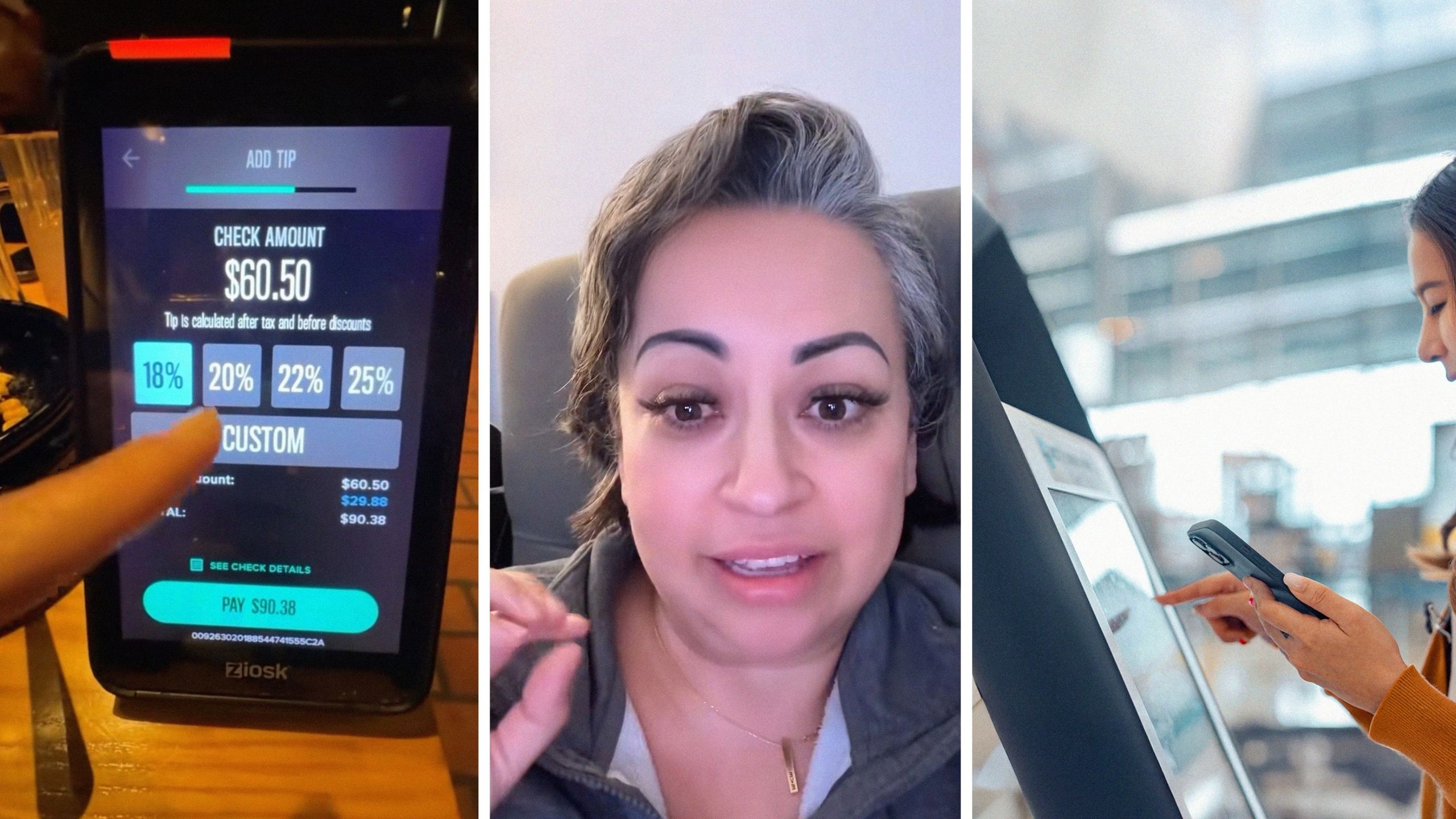
When this woman went to pay her bill on a restaurant kiosk, she was shocked by what was on the tipping screen. Sure, she expected to tip a standard amount. What she didn’t expect was for the device to miscalculate her tip amount by such a large margin.
Now, commenters are wondering whose fault it really is.
TikToker Exposes Restaurant Billing Error
In a viral video with more than 334,000 views, content creator Kim (@kimexplains_) warns diners to pay close attention to the pre-calculated tip suggestions at restaurant payment kiosks.
“Don’t just punch in 15 or 18% because my check came out to 60, and they’re saying 18% is almost $30 out of 60,” she says, showing the kiosk screen. “That’s a 50% tip. So they’re trying to trick us.”
The numbers tell the story. Kim’s bill totaled $60.50. But when she looked at the suggested tips on the payment screen, something didn’t add up. The kiosk showed:
- 18% tip: $29.88
- 20% tip: $33.20
- Total with 18% tip: $90.38
Here’s the problem: 18% of $60.50 is actually $10.89—not $29.88. The tip amount the kiosk suggested was 49.4% of her bill, essentially a 50% tip. For the math to work out to a $29.88 tip at 18%, her bill would need to be around $166, not $60.50.
“Don’t get bamboozled. Don’t just start clicking stuff,” she warns, adding a “be careful” in the caption.
What Actually Happened
After her video gained traction and commenters questioned what happened, Kim posted a follow-up explaining the situation in more detail.
“Some people are getting really heated about this. So I’m gonna try to explain again what happened from what I understand,” she begins.
Kim explains the restaurant had run other customers’ food on Kim’s tab. When she received her digital check, the suggested tip amounts were based on the total tab, including meals that weren’t hers. When she reviewed the receipt the restaurant texted her, she found food items she never ordered along with someone else’s credit card information.
“It also has somebody else’s credit card information. And then it’s comped. It says it doesn’t say comp. It actually says credit. And it says $325 credit and I think a $15 one,” Kim explains. “This is from the restaurant that’s crediting the meals that weren’t mine.”
Kim emphasizes she had nothing to do with the other diners; she came with a party of four and ordered only for her table. But the billing practice created multiple problems beyond just the inflated tip suggestion.
“Not only that, but the tax is for the total bill amount, not just for my little portion,” she points out. “So not only are you paying a higher tax… Not only are you paying or being suggested a higher tip, you’re also paying a higher tax.”
The compounded effect meant customers were being asked to tip on an already-inflated total that included tax on food they didn’t order.
Would You Catch The Mistake?
“If someone’s drinking and unaware of what’s going on, click, click, click, click, they’re paying 50% for their little meal,” Kim says. “This should not be allowed. This should not be happening.”
During her visit, another server at the restaurant admitted they use this practice but didn’t realize the suggested tip amounts were calculated on the entire bill, not just the customer’s portion.
The server had been running multiple customers’ tabs on one bill, then deducting the other charges, without understanding that the tip suggestions remained based on the original inflated total.
“Yeah, you servers need to know that this is causing us to have a suggested tip that’s way higher and, again, taxes that are way higher,” Kim tells the server.
Commenters Weigh In On The Practice
The video sparked debate about whether the practice was intentional fraud or an innocent restaurant industry error.
One commenter offered context that suggests the latter:
“This actually makes a lot of sense, it’s probably food that a manager was supposed to comp and she was forced to ring on an already open tab otherwise your food wouldn’t come to your table. Sucks for the server bc she’s seen as scammy when I don’t think she was.”
Another commenter with restaurant experience agreed:
“Every restaurant makes this mistake everyday. And it’s usually the servers who are at fault. I go out to eat just like you. When my charge is wrong, I have them resolved my problem. They usually apologize and credit me back. No manager or server wants to steal. That’s an automatic termination.”
What You Should Know About Restaurant Tipping Systems
According to Reader’s Digest, the current standard for restaurant tipping is 20% to 25% of the total check for good service. That means on Kim’s $60.50 bill, an 18% tip should have been $10.89, and a 20% tip should have been $12.10. Instead, the kiosk suggested $29.88 for 18%—nearly triple the correct amount.
The issue stems from how restaurants handle comped meals and credits in their point-of-sale (POS) systems. According to ABC POS, order inaccuracies and data tracking issues are among the most common restaurant challenges. Modern POS systems are designed to eliminate errors by allowing staff to enter orders directly into the system, which instantly sends them to the kitchen.
How To Protect Yourself:
- Always verify the bill total matches your actual order before looking at tip suggestions.
- Calculate tips manually based on your actual food and drink total.
- Check itemized receipts for charges you didn’t make.
- Don’t tip on tax if you want to be precise, calculate the tip on the pre-tax subtotal.
- Ask for corrections immediately if you spot errors.
- Take your time with digital kiosks, even when you feel rushed.
Reader’s Digest etiquette experts note that while tipping is technically optional, it’s considered part of the total cost of dining out. However, that doesn’t mean customers should accept incorrect bills.
Commenters React
“And that’s when they get nothing,” a top comment read.
“Not only is the calculation way off, but it also says tip is calculated after tax. Why would you pay tip on tax?” a person said.
“The company is stealing that money. Not the server,” another wrote.
“This is why, cash is king,” a commenter added.
BroBible reached out to Kim via TikTok direct message and comment.