


When you’re placing an order at a restaurant, you might want to avoid this common item.
While we’d like to think that every restaurant is spotless and has great sanitation practices, anyone who’s actually worked in the industry will tell you that’s not often the case.
For example, diners have virally reported finding everything from steel wool to cockroaches in their food. Restaurant workers have also told stories about rats in food preparation areas and bugs in batched products.
Still, you might think that some items are safer than others. Alternatively, you may believe that a high-end restaurant will have higher standards than your local diner or fast food joint. For one menu item, a chef is claiming that’s not the case.
What Item Should You Never Order?
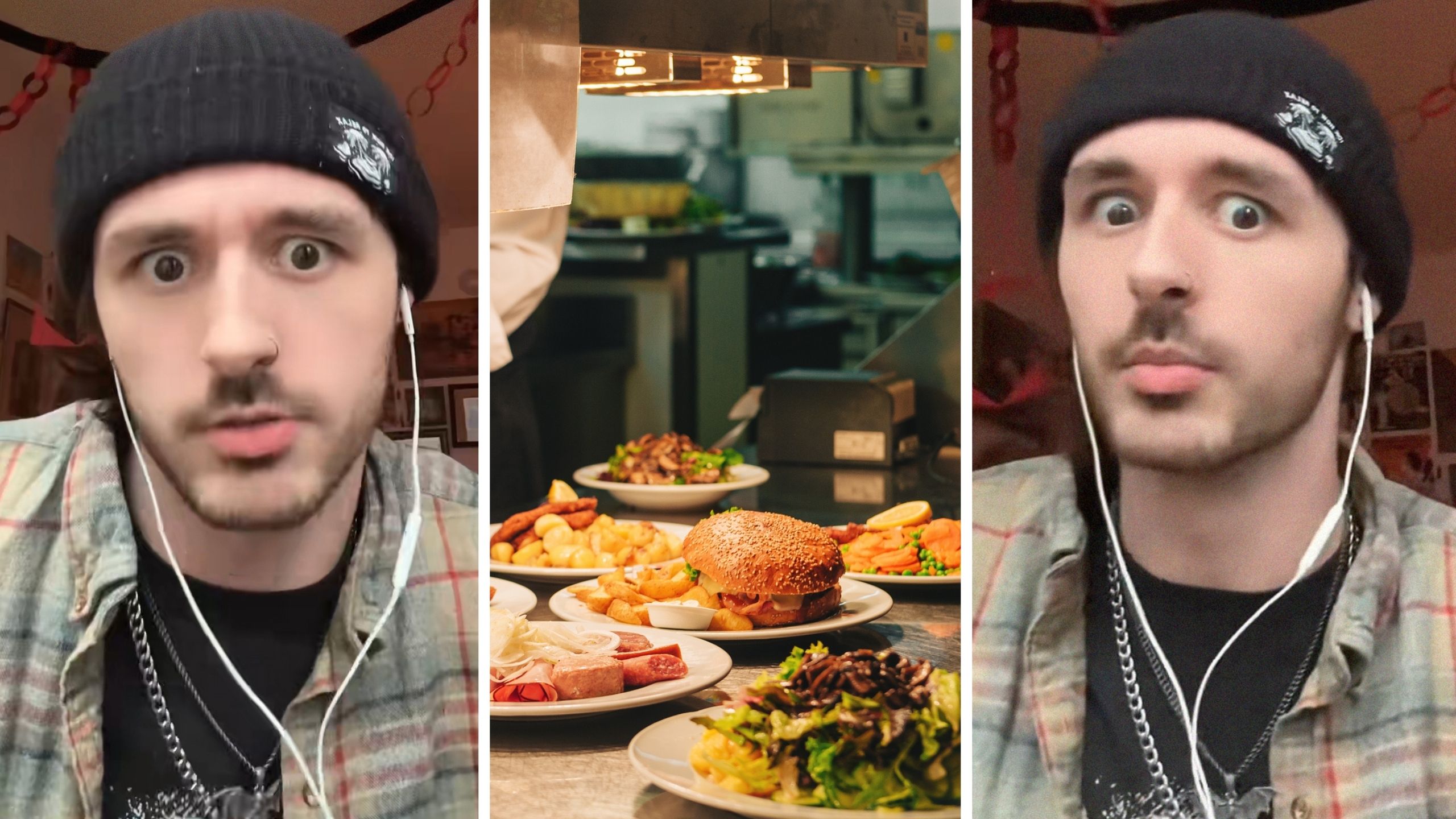
In a video with over 1.1 million views, chef and TikTok user Solomon Ince (@chefsolomonince) pretends to be someone with stomach pain.
“‘Ugh, I ordered a salad at a restaurant. Now, my tummy feels all sorts of funky and funny,’” he starts. “Don’t order salad at a restaurant.”
The reason, he says, is that leafy greens in salad are “like, the number one carrier of foodborne illness out there.”
While this can be mitigated by washing the greens, Ince says that in every level of the industry in which he’s worked—from taco shop to gastropub to Michelin restaurant—workers did not know how to wash lettuce.
“I can’t trust every single person to wash lettuce well enough, so therefore, I’m not gonna order salad,” he summarizes. “Every single restaurant, I would give it, like, maybe 15% of staff knows how to wash lettuce correctly.”
What Happened At Chipotle?
According to Ince, improperly washed lettuce was the reason for the E. coli scare that got Chipotle “canceled.”
The specific incident Ince is likely referring to happened in 2018 at a location in Powell, Ohio. According to several reports, 647 customers at that location got sick, and their illnesses were linked to the lettuce and beans not being held at the right temperatures—the beans were kept too cool and the lettuce was kept too warm—not improperly washed lettuce. Furthermore, their illnesses were linked to Clostridium perfringens, not e. Coli.
“So if you always go to restaurants and you get sick often after eating at said restaurant, stop ordering salad,” he concludes.
Is This True?
It’s true that leafy greens are responsible for a significant amount of foodborne illnesses.
According to a 2013 study from the Centers for Disease Control and Prevention, which looked at data from 1998 to 2008, around half of all American foodborne illnesses could be traced back to produce.
But does washing lettuce actually eliminate the risk of pathogens? Sadly, no.
A 2017 study investigated whether the common method of lettuce washing—rinsing under a sink—removed bacteria. The study’s abstract notes, “Even after washing, the lettuce contained high levels of bacteria that in a high dose and under certain circumstances may constitute a health risk.”
Studies show that fully washing lettuce—which involves soaking it in cold water, repeatedly agitating it, and rinsing it thoroughly under water—does have some benefits. For example, it can reduce pesticide residue. It can also remove visible problems like dirt and debris as well as some bacteria.
However, these methods still can’t get rid of all of the issues. Microbes can hide in the tiny crevices of greens like salad, and their tendency to strongly adhere to the surface of leafy greens makes them difficult to remove, even with repeated rinsings.
The only real way to eliminate the risk of contamination is cooking the produce. That said, this isn’t great for making salad.
Why Does This Happen?
The issue with contamination in leafy greens has little to do with the greens themselves. Instead, it’s because of the environment in which they’re grown.
As noted by Health, leafy greens are grown in large farms. On these farms, factors like manure being used as fertilizer, nearby livestock, contaminated irrigation water, and more can introduce bacteria like E. coli and Salmonella.
While farms do their best to prevent this from happening, it can be difficult to monitor at scale. This is why smaller, specialty greens like arugula are often considered less susceptible to such issues than their larger, more mass-produced counterparts.
Commenters Are Upset
In the comments section, many users affirmed Ince’s statements. Others simply expressed their annoyance at the dangers of purchasing restaurant salad.
“Chef for 10 years, I dont ever see lettuce washed,” wrote a user.
“Side note, people that don’t wash their produce from the grocery store. I spent half my life in grocery stores and I can’t stress enough, WASH YOUR PRODUCE BEFORE EATING IT!” exclaimed another.
“But a restaurant salad tastes so much better than salad I make on my own!” shared a third.
@chefsolomonince Yucky salad #michelin #restaurant #chef #industry #boh
BroBible reached out to Ince via Instagram direct message and website contact form.