


iStockphoto
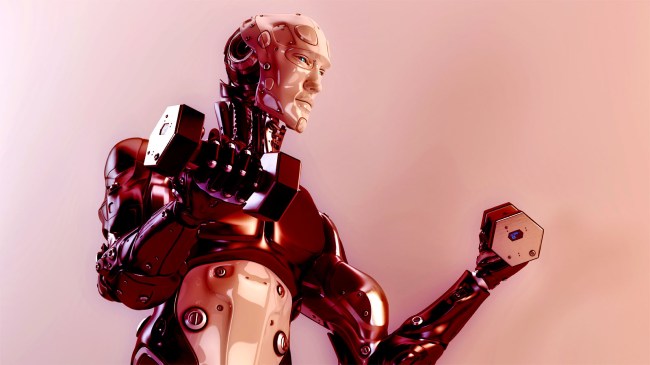
Once again, scientists have created something to give humanoid robots skills that no human possesses without asking themselves if it is truly a good idea. This time engineers in South Korea developed an “artificial muscle” that can lift more than 4,000 times its own weight, and it can be used by humanoid robots.
Thanks to their work, for the first time ever, soft “artificial muscles” are now flexible enough to handle massive amounts of weight without breaking. So if this research works out as the scientists believe it will, in the future, some humanoid robots will have the strength of close to 20 men.
“While soft artificial muscles hold tremendous promise for applications in robotics, wearable devices, and medical assistive technologies that require human-like interaction, their widespread use has been limited by an inherent trade-off: they tend to be either highly flexible or capable of exerting significant force, but not both simultaneously,” the scientists wrote in a release announcing the results of their study.
Scientists plan to give humanoid robots never-before-seen strength
The researchers managed to overcome these limitations by engineering a composite muscle that becomes stiff when bearing heavy loads and softens when it needs to contract. They report that in its stiffened state, this artificial muscle can support roughly 4,000 times its own weight. Then when returned to a softened state, it can be stretched up to 12 times its original length.
While contracted, this “artificial muscle” can handle more than double the strain typical of human muscles. It also can reach a work density (how much energy per unit volume the muscle can deliver) 30 times higher than that of human tissue. Granted, the muscle that was tested was weighed just 1.25 grams, meaning it could support up to 5 kilograms, but it is still progress, at least in the scientists’ eyes.
“This research overcomes the fundamental limitation where traditional artificial muscles are either highly stretchable but weak or strong but stiff,” said lead study author Hoon Eui Jeong, a professor of mechanical engineering at the Ulsan National Institute of Science and Technology (UNIST). “Our composite material can do both, opening the door to more versatile soft robots, wearable devices, and intuitive human-machine interfaces.”
If we weren’t doomed before, we are getting very close to it now. The funny thing is, we might not even know it until it’s too late.