


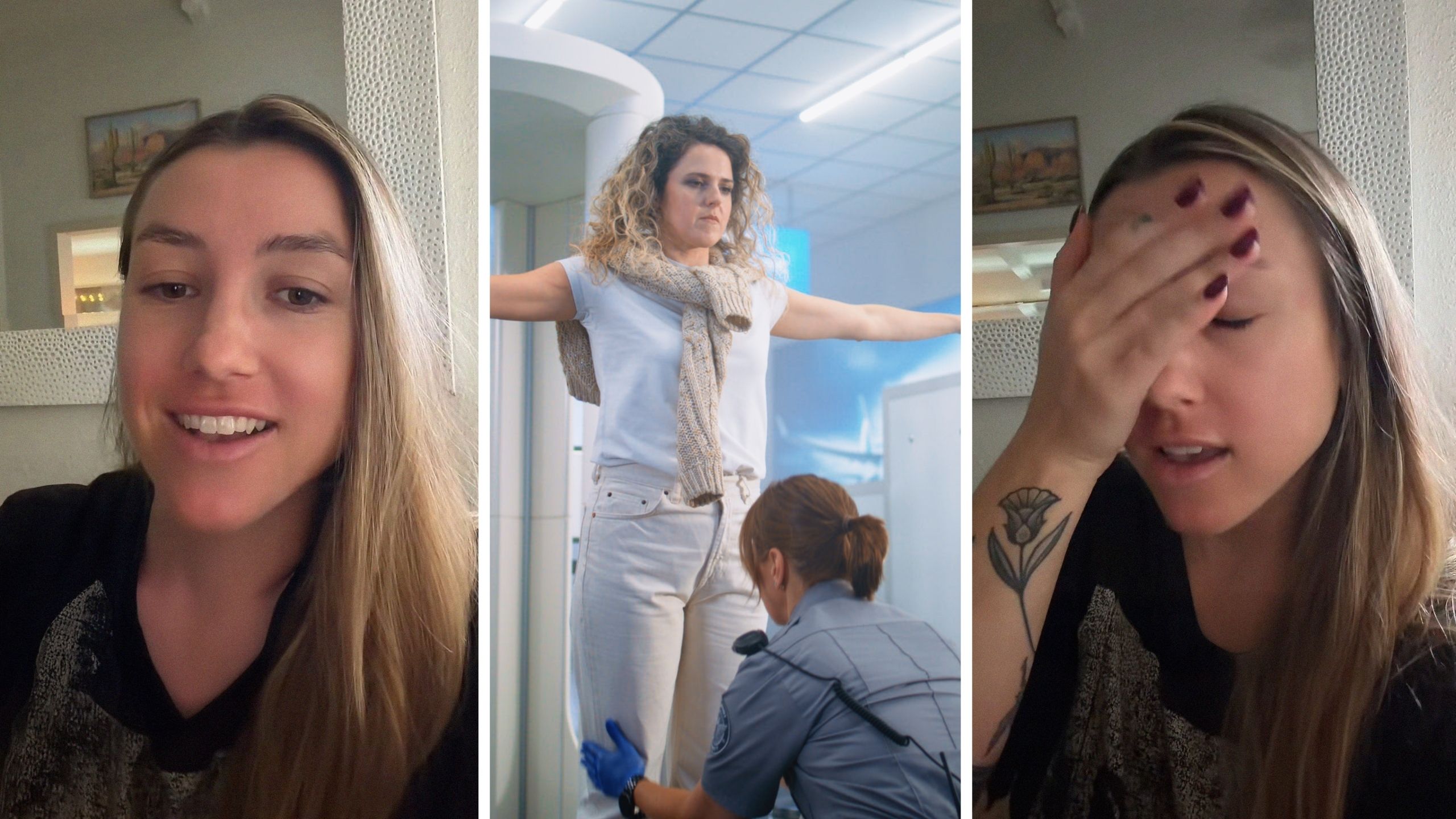
Over the years, airport security screening has become considerably more intense.
As late as the 1990s, going through airport security meant little more than simply walking through a metal detector and passing your bag through an X-ray. However, after the Sept. 11 attacks, and the resultant development of the Transportation Security Administration, airport security has significantly increased its severity and intrusiveness.
Today, one can expect questions, ID checks, comprehensive bag searches, and, unless you opt for a pat-down, full-body scans.
TikTok user Karli (@thetriggerfairy) says she recently asked for a pat-down at the airport instead of using the full-body scanner. Now, she wants answers.
What Happened During This Woman’s Full-Body Scan?
In a video with over 25,000 views, Karli says she recently traveled through the Denver airport. As she has TSA PreCheck, she says security was relatively fast and easy—until she got to the metal detector.
“Immediately the officer tells me to go back out and go round, because I’ve been ‘selected at random,’” she says. The officer then clarified that this meant Karli would have to walk through the full-body scanner.
Karli informed the officer that she wanted to opt out of the scan, instead requesting a pat-down. The TikToker states that she always does this, as she believes that the full-body scan is “a lot of radiation and not good for my body.” This is allowed under TSA protocol, though it should be noted that airport scanners are generally considered safe in terms of radiation.
The officer responded that a female agent would arrive soon. After a long wait, Karli asked if someone else could be “randomly” selected, as she both has TSA PreCheck and was now running late for her flight. The officer said that this was not possible.
Finally, the agent came and began the pat-down. However, Karli immediately realized something was amiss.
A Pat-Down Goes Wrong
According to Karli, the agent asked her if she’d rather have the pat-down in public or in private. Karli responded that she’d rather have it publicly.
“I am not new to pat downs, and I always get them publicly, because I would rather have eyewitnesses to me being patted down than [be] in a private room where—I’m a woman, you know, this is where my brain goes—where if someone tried to pull something sneaky, then it’s my word against theirs. Like, then I’m super f—–,” Karli states.
At first, the pat-down seemed normal. The officer explained that she would be using the front of her hands for some areas and the back for the other, more sensitive areas.
But when she started, Karli realized that this was not like the other pat-downs she had experienced.
“Note, I have skin-tight, skin-tight leggings on and a skin-tight long-sleeve shirt. You can see the rolls of my body in the clothing that I’m wearing right now,” she says. “I don’t even have a bra on.”
Despite this, Karli says the TSA agent used considerable force and pressure when running her hands over Karli’s body—significantly more than any other pat-down Karli received in the past.
“This woman is literally grabbing my body and rubbing her, running her hands across it,” Karli says. “And she’s, like, also standing very close to me. Like, I can feel her breath on me, and I’m uncomfortable.”
Things Get Worse
At this point, the agent asked Karli to spread her legs. Karli did so. In response, the agent ran her hang up Karli’s leg—and hit her “hard” in the groin.
“I was like, ‘Whoa!’” Karli recalls. “And she was like, ‘OK, hold on, I gotta get the back.’”
Then, Karli says the agent forcefully hit her groin once more.
“And I was like, ‘OK, whoa. That’s too much. Like, that hurt,’” Karli says. “And she’s like, ‘Look, ma’am, I’m just doing my job.’ And I was like, ‘No, no, no. That feels a bit excessive. I’ve gotten many pat-downs before—like, this is legit painful.’”
The agent then said they could call over a supervisor. When the supervisor came, Karli says that they were unhelpful and belittling of her situation. Karli says the supervisor also, in her view, made it seem as though the agent’s actions were Karli’s fault, as she chose the pat-down.
“What are officers supposed to do? They’re supposed to protect people. They’re supposed to make you feel safe. I’m literally saying, telling you, ‘I don’t feel … comfortable [or] safe here,’” Karli states. “Then, it’s gaslighting me and [turning] it around on me, like, ‘I chose this—this is my doing, this is my fault.’ They have no remorse for humiliating me.”
Karli says that, given a personal history of abuse, the experience was “triggering” for her. While she says she kept her composure at the time, she later cried about the incident, saying that she feels like she was “violated in public by an officer and nobody did … jack s—.”
Has The TSA Done This Before?
There are numerous allegations against TSA agents for taking pat-downs too far.
In response to a 2015 scandal, in which it was alleged that two TSA screeners manipulated full-body scanners in order to grope flyers, a former TSA worker wrote a piece for TIME Magazine identifying “the leveraging of rules and surveillance tools to abuse passengers” as “a daily checkpoint occurrence.”
A 2020 lawsuit also alleged that a TSA agent slid her hands up a woman’s shorts and made contact with her groin. After she flinched, the officer allegedly responded, “If you resist, I will do this again.”
It should be noted that these updated screening procedures have been controversial since the beginning—not only due to their invasiveness but their efficacy. Just weeks after the new pat-down system was implemented, the ACLU received hundreds of complaints from passengers who “reported feeling humiliated and traumatized by these searches.” Stories of intrusive patdowns can be seen all over sites like Reddit to this day.
While there’s little data about the efficacy of pat-downs, tests of general TSA practices found the agency has a failure rate of between 50% and 95% when it comes to detection of contraband. As for the scanners themselves, investigations have found them to be similarly ineffective.
In a comment, Karli says she has filed a complaint with the airline.
@thetriggerfairy I just hope this wakes ppl up who may be in positions of power to act differently to ask someone they know to act differently or to speak out if you have similar stories. #denverairportsecurity #securityunsecure #notsafe #protectyourself
BroBible reached out to Karli via Instagram and Facebook direct message, and the TSA and Denver Airport via email.