


iStockphoto
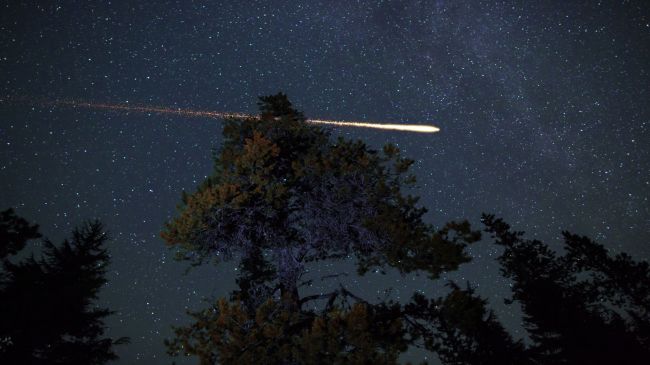
An incredible new video shot from the dash cam of a truck driver shows a mysterious bright light flying over Western Pennsylvania on Tuesday, followed by a loud boom shortly after.
The video, which was shot by trucker James Eaker, shows him driving west through Pennsylvania on what appears to be Interstate 80 just before 9 a.m. About eight seconds in, a bright light, followed by what looks like a vapor trail, appears in the sky, hurtling toward the ground.
Northeast Ohio: James Eaker caught the meter on his dash cam video. Explicit Language: pic.twitter.com/TYPVy9kBAQ
— Hank F in Akron 🏆🥇 (@HankF330ToGo) March 17, 2026
Eaker, caught off guard by the sight, immediately yells, “Woah, what a f— was that? Bro, did I get that on my f—ing dashcam?” Bro, something just burned up in the f—king sky.”
National Weather Service Claims Bright Light And Loud Boom Was Due To Meteor
But Eaker wasn’t the only one to notice the bright light, and shortly after he saw it, a loud boom rang through both Western Pennsylvania and Eastern Ohio.
“Heard the loudest boom just now in northeast OH. People heard it as far as Avon. What was that? Meteor?’ asked X user @jacecraftmiller.
Shortly after Miller’s question, the National Weather Service in Cleveland responded, claiming that satellites showed evidence of a meteor entering the atmosphere.
“The latest GLM imagery (1301Z) does suggest that the boom was a result of a meteor,” their post read.
The NWS in Pittsburgh then confirmed those suspicions.
“We’re receiving reports across western PA and eastern OH of a loud boom and a fireball in the sky,” they responded. “Our satellite data suggest it was possibly a meteor entering the atmosphere.”
The NWP Pittsburgh account also showed a second video of the meteor entering the atmosphere from another angle.
Further reports suggest that the meteor likely did not strike the ground. Instead, the loud noise was likely due to the meteor entering the atmosphere, followed by a phenomenon known as an “air burst,” causing a sonic boom.
An air burst occurs when the massive speed of the meteor forces pressure into its pores, causing it to explode well before striking a planet’s surface.