


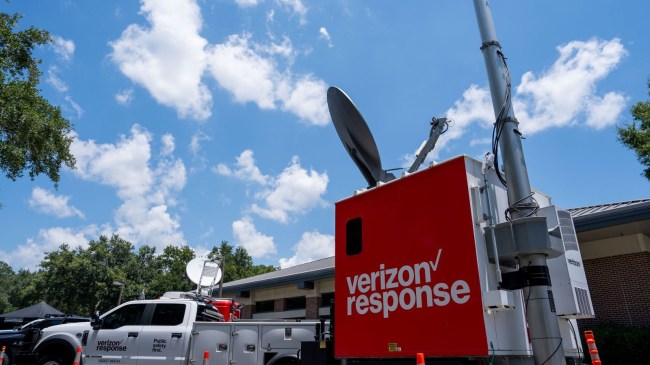
© Alicia Devine/Tallahassee Democrat / USA TODAY NETWORK via Imagn Images
On Wednesday, January 14, Verizon Wireless users were suddenly left without cell service and data for much of the day. The outage did not affect every customer; however, it did take out service in nearly the entire East Coast.
Major metro areas like New York City, Washington D.C., Boston, and even Chicago and large parts of California and Texas left staring at an “SOS” message where there service bars should have been.
The company has since tried to make things right, offering a $20 credit to users who were inconvenienced by the outage. But what exactly went wrong? And should Verizon customers be worried about another incident in the future or their cybersecurity?
Verizon Wireless Outage Likely Caused By A Feature Update Failure
The first thing that Verizon did after service resumed on Wednesday was to reassure customers that the failure did not come down to a cybersecurity threat.
“This was a software issue and we are conducting a full review of what happened. As of now, there is no indication that this was a cybersecurity issue,” the company said in a statement.
So, if not a hack in the security system, then what?
Roger Entner of Recon Analytics, a telecommunications research firm, told CNET that the outage likely came down to a failure while trying to launch a feature update.
“It looks like their 5G SA (Standalone) core went down during a minor feature change,” Entner said.
So, what made Entner think this was the case? And why didn’t it affect everyone?
The analyst pointed out that the outage was limited to new high-end devices in specific markets where Verizon uses its 5G SA core. The 5G SA core is a network that uses only 5G technology, rather than a combination of 5G and older 4G LTE infrastructure.
If it were a matter of a failed update, could it happen again?
“When carriers do massive upgrades, they do that between 2 a.m. and 4 a.m. in the morning,” Entner said. “A noon start for the crash indicates ‘fat fingers’ for a smaller change that cascaded through the system.”
That’s to say, a similar outage is unlikely to occur again without human error. But as we’ve seen, it’s clearly not impossible.