


U.S. consumers are familiar with grocery item phrasing that can be misleading. Many products on the shelf are marketed in ways that don’t always reflect what they actually are.
For example, wording such as “natural” or “superfood” isn’t defined or regulated by the Food and Drug Administration (FDA), giving food manufacturers the liberty to use them as they wish.
Still, when a product that has been a staple in customers’ homes for years comes under fire for potentially misrepresenting itself, people are going to be upset. That’s what’s been happening recently with Vital Farms eggs.
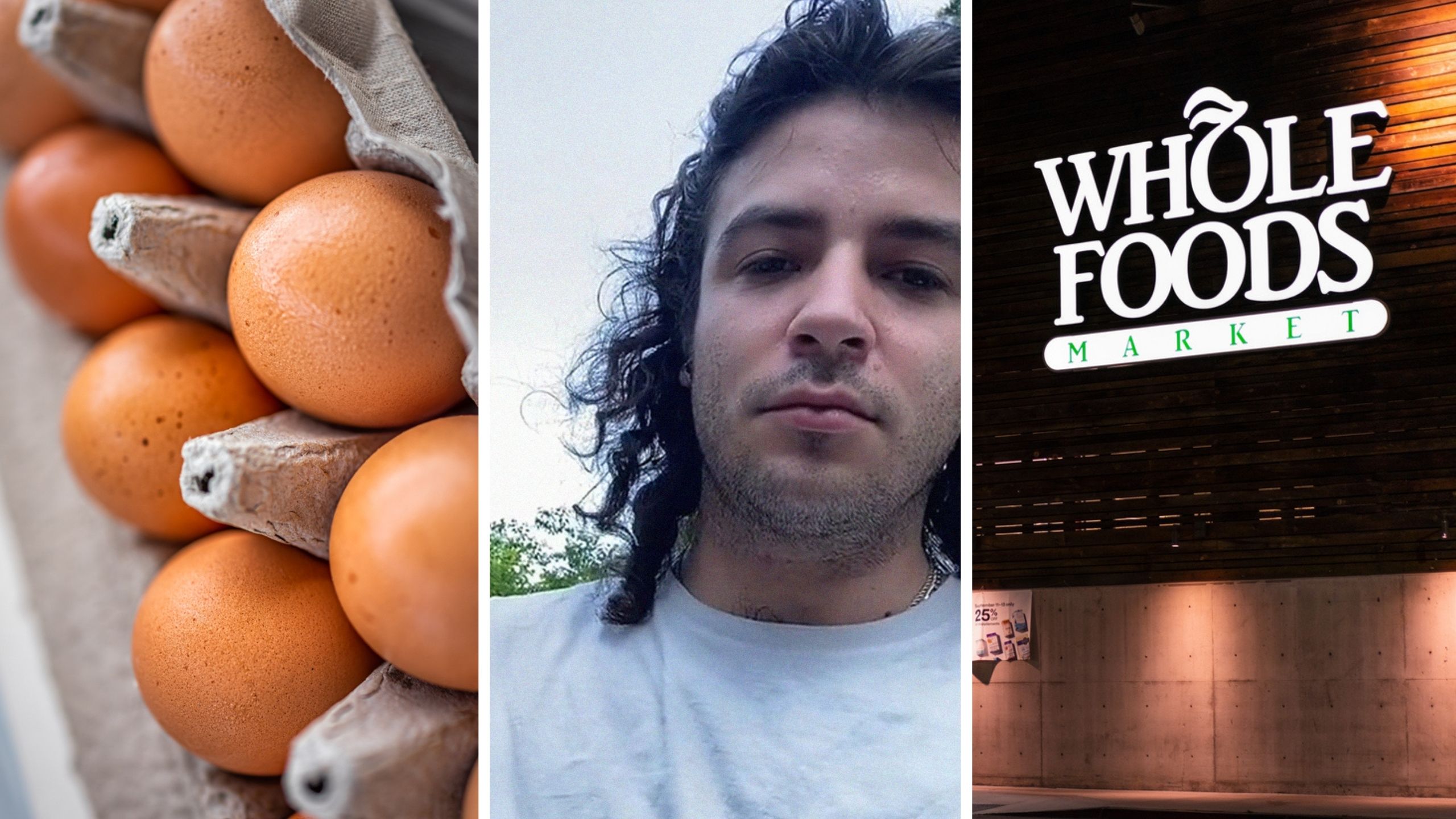
In a recent TikTok video that has garnered over 434,600 views, creator Gabriel (@gturek) pointed out how Whole Foods is stocking Vital Farms eggs.
As he walks towards the egg section, he shows an open-air refrigerator full of Vital Farms eggs in the middle of the floor. Meanwhile, the store placed other brands in other fridges along the perimeter.
“Whole Foods got Vital Farms in their own enclosure now smh,” Gabriel wrote in the video’s caption. He added in the caption, “Vital Farms is on timeout.”
What’s The Controversy Surrounding Vital Farms?
It all started when Nourish Food Club, a company that sells products like eggs, baked goods, meats, dairy, and cheeses marketed as “cleaner” alternatives, published results from an egg test.
According to a YouTube video posted recently, they sent three eggs to be tested for their linoleic acid content. They included one from Nourish Food Club, another from organic Vital Farms, and a third from a cage-free line sold by Meijer.
The results, the company claims, showed that Vital Farms contained 3.67 grams of linoleic acid per 100 grams. Nourish Food Club eggs, on the other hand, contained 0.87 grams, and Meijer eggs contained 3.57 grams per 100 grams.
Users online quickly started reposting the results, criticizing Vital Farms. The initial controversy seems to have started with a video by creator Zephyr Zoidis, founder of the Localize Food app.
As his video and others like it went viral, they brought a significant number of negative comments to the company’s social media accounts, primarily concerning what they feed their chickens.
After the backlash, the company shared a TikTok video in which they explained that their hens, while raised in pastures as the packaging claims, are supplemented with corn and soybean meal.
UPDATE: In an email correspondence with BroBible, a Vital Farms spokesperson provided material addressing customers’ questions.
“We take transparency seriously, and we believe our stakeholders should always know where their food comes from,” they wrote. “When claims suggest we’re misleading the public, we show up with the facts. This week, we’ve seen some misleading headlines and comments about Linoleic Acid in our eggs and what we feed our hens, so we posted content on our social channels and blog to set the record straight.”
Vital Farms shared responses to the main questions customers are asking at this link.
Commenters Blame Big Corporations
Under Gabriel’s TikTok video, users expressed frustration at the corporations behind the business.
“Dude Amazon OWNS Whole Foods and vital farms,” wrote one user. “Idk why people are surprised. It’s a dirty company who’s only goal is to make money. They know people who want healthy food will spend more, then they gut the company and turn it into a profit farm.”
“I loose taste buds when I find out something is owned by blackrock,” wrote another.
A correction is needed for these comments, as Amazon does not own Vital Farms, nor does BlackRock. It’s a public company where Amazon holds 3.42% of its shares, and BlackRock 6.60%.
“Sprouts trying to give them away,” said a third, sharing a photo of the eggs discounted for $1.99 from $8.99. “No one biting.”
“Let’s boycott more bad companies,” another wrote.
Is Linoleic Acid Bad For You?
Linoleic acid is an essential omega-6 fatty acid, and when consumed in moderate amounts, supports human health.
When consumed in large amounts, however, some studies have found it may be associated with an increased risk of chronic conditions. These include cardiovascular disease, Alzheimer’s onset, cancer, dementia, obesity, and diabetes.
According to a Harvard Health Publishing report, experts recommend that 5% to 10% of your daily diet should consist of omega-6. If your daily diet consists of 2000 calories, for example, that would be 11 to 22 grams.
Currently, though, Americans tend to consume 10 times more omega-6 than omega-3 fats. This is largely due to food manufacturers using oils rich in omega-6, such as sunflower oil and soybean oil.
Ultimately, research suggests that the issue has less to do with eggs. Rather, it’s the prevalence of ultra-processed food products or frequent meals outside of the home. To steer away from unhealthy levels of omega-6, nutrition experts recommend keeping the pantry full of fresh, whole foods.
@gturek #VitalFarms is on timeout
BroBible has reached out to Nourish Food Club and Whole Foods via email for comment. We’ve also contacted Gabriel via TikTok messages.