


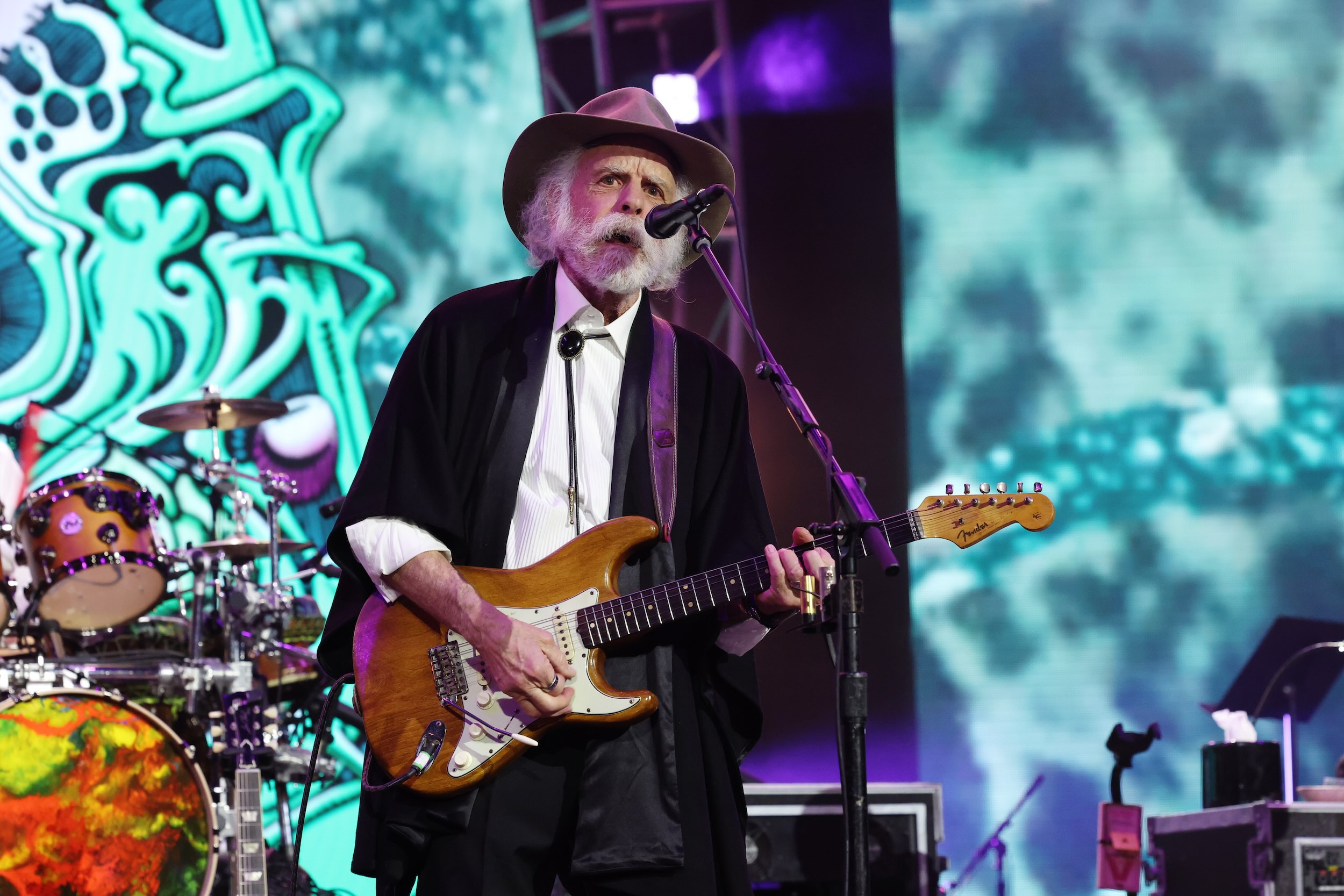
Photo by Matt Winkelmeyer/Getty Images for The Recording Academy
We Deadheads think we know all the lore about Bob Weir. The short shorts that defied the laws of physics. The bolo ties signaled serious business. The bushy “Lorax” mustache of the Dead & Company years. We know him as “The Other One,” the rhythmic engine who stood stage right for 50 years, anchoring the wildest musical experiment in American history.
But before he was the elder statesman of the jam scene, Bob Weir was just a 20-year-old kid trying not to get fired.
And in 1968, he failed.
I was driving back to LA from Mammoth the other night, a little after sunset, cruising down US-395 in the pitch black of the Owens Valley. I had the dial tuned to KRHV 93.3, a classic rock station out of Big Pine that always seems to be the only thing that comes in clear near Independence. The DJ was pay a tribute to the late, great Bob Weir.
Between tracks of Ace and staples like “Greatest Story Ever Told,” “Saint of Circumstance,” and “Cassidy,” the DJ dropped a tidbit that made me almost swerve into the sagebrush:
Bob Weir was once kicked out of the Grateful Dead.
Not “took a break,” or “went on hiatus.” Fired. Axed. Canned by Jerry Garcia and Phil Lesh.
I feel like I know my Grateful Dead history pretty well, and we’ve surfaced all kinds of Jerry Garcia lore here at BroBible over the years (this post about his AK-47 and this post about a grandma bringing him home to dinner are recent favorites), but I didn’t know that particular detail. My ears perked up.
If you’re a casual fan, or, like me, an ‘80s-baby Deadhead that never saw the Grateful Dead with Jerry but got to experience the bliss of Dead and Co with Bobby at the helm, you probably think the Dead was a singular, unbreakable unit from the Acid Tests until Jerry’s death in ’95.
But in the summer of 1968, the band was on the verge of imploding, and Bobby was the one on the chopping block.
What Actually Happened?
According to the incredible archive at the Grateful Dead Guide — which has done the heavy lifting in analyzing this specific period in a crazy-well-researched post from 2011 — this is a documented historical meltdown from the Dead’s tumultuous early years.
Here’s the shakedown:
It’s 1968. The band is living in that purple Victorian house at 710 Ashbury, but things are getting heavy. They are trying to pivot from a blues-based dance band into the psychedelic explorers of Anthem of the Sun. Jerry Garcia and Phil Lesh are obsessively practicing, pushing the envelope of time signatures and complex improvisation.
Meanwhile, Bob Weir (then just a kid, really) and Ron “Pigpen” McKernan are struggling to keep up.
As the research from Dead Essays highlights, Jerry and Phil felt that Bobby and Pigpen were slacking. The criticism was harsh: Garcia felt Weir was “still playing the electric guitar like an acoustic guitar,” cluttering up the sound with mid-range mush instead of locking in.
The Chemical Disconnect
It wasn’t just the music; the vibes were off chemically, too. You have to remember, this band was born in the Acid Tests. In ’65, they were the house band for Ken Kesey’s legendary LSD parties, forging their entire musical identity, that entire telepathic group improvisation they went on to become legendary for, while collectively hallucinating. It was the glue that held the whole experiment together.
By 1968, Jerry and Phil were still riding that wave, or to quote Lesh, “operating in an acid-fueled collective mind-meld.” They were using LSD as a tool for musical telepathy.
Bobby, however, had hopped off that bus two years prior. In later interviews, Weir admitted he stopped taking LSD regularly back in August 1966.
Why? Because he started “hearing voices” and getting “a little psychotic.”
So while Jerry and Phil were exploring the cosmos on 500 micrograms, Bobby had pivoted to become a “strict macrobiotic guy,” perhaps eating brown rice and staying relatively sober. Pigpen wasn’t into LSD or even marijuana at all, but was battling his demons with booze that would eventually take his life.
But Bobby… Bobby wasn’t just playing differently; he was on a completely different planet of consciousness than the band leaders. It became a quest for pranksters to try and dose him, but for the most part, the “mind-meld” was broken.
The Dyslexia Factor
For decades, Deadheads assumed Bobby was just too busy chasing girls or goofing off to practice. But a revelation at his recent celebration of life in San Francisco flips the script entirely.
In her eulogy, his daughter Monet spoke candidly about the challenges her father faced. “Born dyslexic like everything else, he never let it stop him,” she told the crowd. Bobby spoke frequently in interviews over the years about his struggle with dyslexia, so this isn’t a major revelation, but it frames the “why” in the context of October 1968.
Looking back at 1968, the dots connect in a major way. While Jerry and Phil were speaking the complex, mathematical language of music theory, Bobby was likely struggling to process those structures in the same way. He wasn’t lazy; he was lost in translation. His brain didn’t work the way theirs did, and in the high-pressure cooker of ’68, when the business stakes of what the Grateful Dead was doing were starting to snowball, that looked like incompetence.
The “Two From The Vault” Connection
According to Dead Essays, it all came to a head in late August 1968. The band sat down to listen to the tapes from their recent shows at the Shrine Auditorium in LA.
Here is the kicker: Those tapes eventually became the legendary album Two From The Vault.
While we listen to that release today and hear a masterpiece of Primal Dead, Jerry and Phil listened to it in ’68 and heard a trainwreck. They felt Bobby was lost in the mix. Owsley “Bear” Stanley taped the subsequent band meeting where Garcia laid it out: “You guys know that the gigs haven’t been any fun… we’re at different levels of playing.”
Phil Lesh was even more direct: “I really don’t want to work in that form, man… All four of us don’t want to work that way.”
The verdict? Bob and Pig were out.
The Fallout: Canceled Tours and The “Pigpen Revue”
The firing wrecked their schedule. The internal chaos became so toxic that the Dead reportedly canceled a planned European tour with Jefferson Airplane that October. As a Deadhead, this tidbit is mind-blowing. Imagine that—the ’68 Dead and Airplane tearing up London—lost to history because they couldn’t get along.
The rumors didn’t merely swirl; they made the freakin’ New York Times. In July 1969, rock critic legend Robert Christgau reported on what he called a “breakup with a difference.” The master plan was that Pigpen would be spun off into his own R&B outfit, the “Pigpen Revue,” which would tour with the Dead as their opening act.
In a way, it was the ultimate backhanded compliment—”You’re fired, but hey, you can still open for us.” Christgau noted the only reason this didn’t happen was because the band, “always in debt no matter how much money it earns,” couldn’t afford the separate payroll.
For Bobby, the reality was even grimmer. While the exact timeline is a bit hazy, he ended up living in drummer Bill Kreutzmann’s garage and later a warehouse at the Hamilton Air Force Base, just trying to stay out of the way. There is a heartbreaking (and slightly hilarious) story cited in Dennis McNally’s biography A Long Strange Trip where, on his 21st birthday in October ’68, a fired Bob Weir was hitchhiking in the rain to meet Pigpen for a drink and fell face-down into a mud ditch.
That is rock bottom.
Enter “Mickey and the Hartbeats”
For the next few months, the Grateful Dead ceased to exist. Instead, Jerry Garcia, Phil Lesh, Bill Kreutzmann, and Mickey Hart played a series of shows at The Matrix in San Francisco billed as “Mickey and the Hartbeats.”
Well, sometimes they were billed as that. According to a comprehensive 2018 essay on the wonderful Dead Thinking blog, to dodge contract disputes with rival promoter Chet Helms (who didn’t want the Dead playing a small club right before a big show at the Avalon), the band got creative. On at least one poster, they were billed simply as “Jerry Garrceeah & His Friends.”
These shows are legendary among tape traders, specifically the run on October 8-10, 1968. They are entirely instrumental, dense, jazzy, and cerebral. Mickey Hart later recalled the vibe with characteristic bluntness: “We played facing the wall—and it was long. These poor bastards sitting there drinking cappuccino had no idea what was about to hit them.”
The setlists from nights like October 10th tell the whole story. Instead of songs, you see titles like “Dark Star Jam,” “The Eleven Jam,” and technical oddities like “The Seven.” They brought in guests like Elvin Bishop or a harmonica player named Marvin to fill the void, jamming on “Turn on Your Lovelight” or “Look on Yonder Wall.”
But here’s the thing: The “Hartbeats” sounded incredible as a blues outfit, but they lacked soul. They could play a “Lovelight Jam” for 20 minutes, but without Pigpen working the crowd or Bobby’s rhythm glue, it was just a math rock exercise. They missed the cowboy songs. They missed the rock and roll.
You can listen to the show in full on GratefulDeadOfTheDay.com.
The Return of the Kid
Bob Weir didn’t sulk. Well, maybe he sulked a little in that mud ditch (poor Bobby), but mostly he went to the woodshed. He realized that if he wanted to play with a lead guitarist like Jerry (who played like a horn player) and a bassist like Phil (who played lead bass), he couldn’t just strum open chords. There was no sonic room for them.
During his “exile,” Bobby developed that unique, angular style of rhythm guitar he became famous for—playing weird inversions up the neck, cutting through the mix in the spaces Jerry left open.
This is where Bobby’s dyslexia turned into a superpower. Because he couldn’t learn the “standard” way, he invented a completely new way to play the instrument, a la jazz pianist Bill Evans and many of his other influences.
By late October 1968, he (and Pigpen) had clawed their way back in. The “Hartbeats” experiment proved that while Jerry and Phil were the brains of the band, Bobby and Pig were the heart and the blood.
The “Core Four” Wars: A Lifetime of Dysfunction
The 1968 firing served as the blueprint for the next 50 years of the “Core Four” (Weir, Lesh, Hart, Kreutzmann). That tension between the “serious musicians” (Phil) and the “wild cards” (the drummers and Bobby) never really went away; it just morphed into something else. Tiffs continued in almost every chapter of the Dead’s history—including, probably, some that we Heads have never even been made aware of, nor perhaps need to be aware of.
In the post-Jerry years, the infighting became legendary. There were allegedly battles over the “Vault” archives and rumors of deeply personal feuds involving management (message boards in the Dead world often finger-point at Phil’s wife, Jill Lesh). The hostility peaked around 2002 when Mickey Hart, allegedly frustrated with Phil’s isolation from the group and non-participation in a book on Grateful Dead history, quipped to the press about Phil’s transplant: “I think that liver transplant didn’t go so well. He might have gotten the liver of a jerk.”
Even at the “Fare Thee Well” 50th anniversary shows in 2015, the vibe backstage was rumored to be icy. There were whispers about separate dressing rooms, with signage explicitly separating Phil from the rest of the band.
But just like in 1968, they always came back in some way, shape, or form. The friction was the fuel. And the rest is Dead history.
Bobby knew that the only way to survive a band that constantly wanted to break itself apart was to just keep playing.
The Legacy
If Bob Weir hadn’t been fired in 1968, he might never have felt the pressure to evolve. He might have remained just a standard rhythm player.
Instead, that kick in the ass forced him to become the most unique rhythm guitarist in rock history, which became the perfect counterweight to Garcia’s brilliance.
So, next time you’re listening to a blistering “China Cat Sunflower > I Know You Rider” and you hear those snap-crackle-pop Bobby chords driving the jam, remember: There was a time when he had to fight for his spot on that stage.
Rest easy, Bobby. The music never stops.
If you enjoyed this article, tap here to read + subscribe to my Substack, where I just wrote about “Mourning The Mischief-Makers” about Bob Weir’s death. E-mail: brandon@brobible.com