


Week 14 of the college football season is commonly referred to as “Rivalry Week” thanks to the many teams with bad blood who traditionally face off at the end of November, and there are plenty of bragging rights on the line as well as plenty of trophies that will end up changing hands.

Getty Image
There are dozens of rivalry trophies up for grabs over the course of the college football season, but the lion’s share of those pieces of hardware will be played for during Week 14.
A lot of those trophies aren’t particularly special, but there are some very notable exceptions in the form of these ones that stand out from the rest of the pack.
The Illibuck

Getty Image
I don’t know if there’s any rivalry trophy with a more entertaining backstory than the Illibuck, which is presented to the winner of the showdown between Illinois and Ohio State.
In 1925, Illinois became the first team to secure the live turtle that was picked as the prize to be presented to the winning team that year. That particular animal was selected due to its lengthy average lifespan, but the new tradition hit a snag when it died less than six months later.
The powers that be wisely decided to replace it with a wooden turtle statue that’s been used ever since.
The Iron Skillet
Getty Image
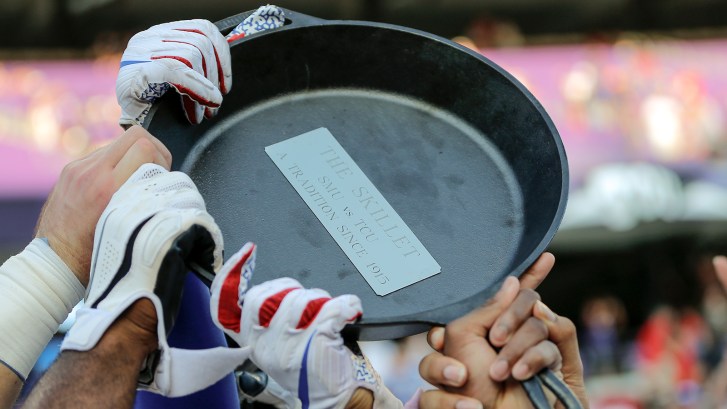
SMU and TCU have a rivalry stretching back to 1915, and no one is entirely sure who’s responsible for the literal iron skillet that has served as the trophy since 1946.
Why? Well, no one really knows.
With that said, there’s an apocryphal tale that asserts an SMU fan was using an iron skillet to fry up some frog legs before the game when a TCU fan who took exception to that gesture suggested they put it up for grabs in a wager hinging on the outcome of the contest.
A less exciting version asserts The Iron Skillet was the brainchild of a meeting between student councils at the two schools, but it fails to account for why the piece of cookware was chosen in the first place.
Paul Bunyan's Axe
Getty Image
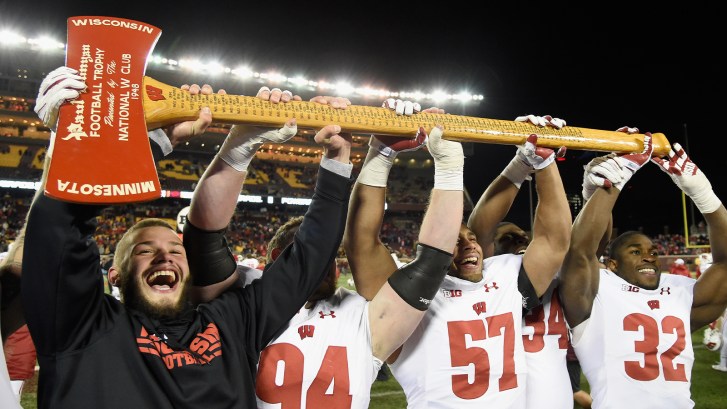
Minnesota and Wisconsin have been playing each other on a regular basis since 1890, and they had to replace their original rivalry trophy—the Slab of Bacon—after it went missing in the 1940s.
I’d argue we were treated to a major upgrade when the replacement was unveiled in 1948 in the form of Paul Bunyan’s Axe, the six-foot-long wooden trophy that was created by a Wisconsin athletic club and has been up for grabs ever since.
The original axe was retired when the handle that logged the results of games ran out of room, and the current version has been in use since it was swapped out in 2000.
The Fremont Cannon
Getty Image
The rivalry between Nevada and UNLV is a relatively new one when you consider they first played each other in 1969, but they didn’t waste any time dreaming up one of the best trophies college football has to offer.
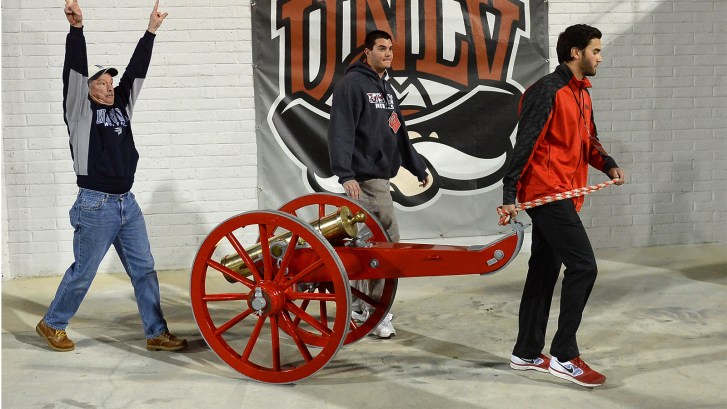
It cost $10,000 to produce a 545-pound replica of the Howitzer that explorer John C. Fremont dragged with him while trekking through the Sierra Nevadas in the 1840s, and it was presented for the first time in 1970.
The best part? It’s a fully functional cannon that used to be fired after the team with it in its possession scored a touchdown during their rivalry game, but that tradition has been discontinued since it was damaged when it was dropped during a postgame celebration in 2000.
The Floyd of Rosedale
Getty Image
The rivalry between Iowa and Minnesota stretches back to 1891, and it got especially heated in the 1930s when the Golden Gophers were accused of going out of their way to try to injure Ozzie Simmons, a Black running back on the Hawkeyes who was seemingly targeted due to his race when the two teams faced off in 1934.
Tensions were very high heading into the game in 1935, as the governor of Iowa implied fans would storm the field to deal with players if they crossed the line again.
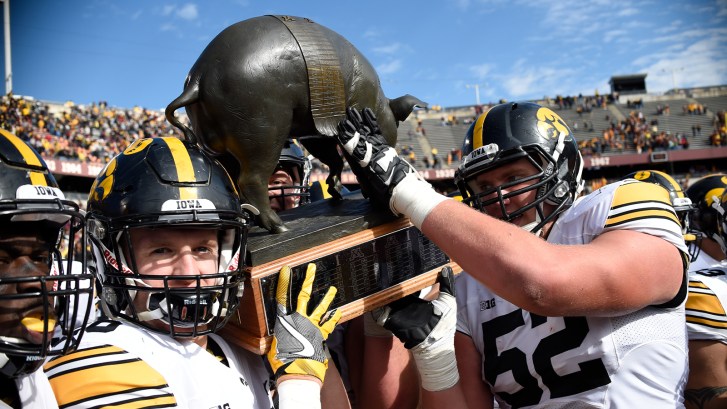
Minnesota’s governor tried to play peacemaker with a bet where the winner would receive a “prize hog” from the loser’s state, and a pig named Floyd from Rosedale Farms in Iowa was eventually shipped off to the Land of 10,000 Lakes.
Floyd was sent to a farm in Minnesota but died from disease before the two teams met again (I’m sensing a theme with the live animals), and a 98-pound bronze statue of his likeness has served as the trophy since 1936.
The Wagon Wheel

Getty Image
Akron and Kent State may not have the most high-profile college football rivalry, but the two schools that first met in 1923 do have one of its best rivalry trophies thanks to the Wagon Wheel.
A dean at Kent State was the mastermind of a trophy introduced in 1946 whose significance comes from what is believed to be an entirely made-up story: he claimed the founder of the college that would become Akron abandoned the wheel after getting stuck in the mud in a field where Kent State would eventually be built while scouting locations for a new school in the 1870s.
It may not be true, but the desire to secure the Wagon Wheel is very real.
The Old Brass Spittoon

Getty Image
The Wagon Wheel isn’t the only trophy with a suspect backstory, as Michigan State and Indiana have been playing for one with an equally fantastical mythos since 1950.
A Michigan State student (and class president) decided the team needed something to play for heading into its showdown with Indiana that year and came across the spittoon in an antique shop near campus before buying it for $25.
He asserted it was once used at a trading post in Michigan where travelers from Indiana frequently harnessed it while making their way up north despite no real evidence to prove that was the case, and just like that, a new rivalry trophy was born.
The Golden Hat
Getty Image
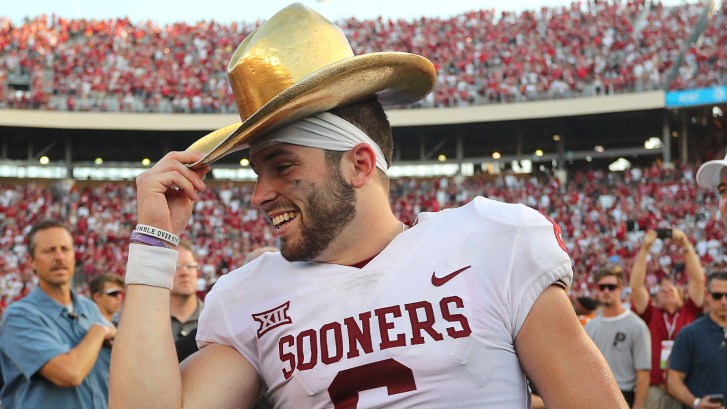
Texas and Oklahoma have been engaged in the Red River Rivalry since the start of the 20th century, and there are actually three trophies that are presented to the winner.
However, the Golden Hat is easily the most desirable (and unique) member of that trio thanks in no small part to its wearable nature.
The trophy was introduced in 1941 courtesy of the Texas State Fair, which had initially inked a deal with the two schools to play each other in Dallas for 10 years before the city became the default location for the matchup.
It was initially dubbed the Bronze Hat but has gone by its current moniker since it was refurbished in the 1970s.
The Golden Egg

Getty Image
Ole Miss and Mississippi State met for the first time in 1901 and welcomed a trophy into the fold in 1927 in the form of The Golden Egg (which is responsible for the contest being dubbed the Egg Bowl).
The trophy stems from an incident that unfolded when Ole Miss fans attempted to tear down the goalposts in enemy territory after their squad snapped a 13-game losing streak.
Members of the Mississippi State faithful understandably took exception to that move, and a trophy was commissioned to ensure the winning team would have a memento to take home with them going forward.
The “egg” in question is actually a football (based on how they looked when the trophy was made), but the moniker was eventually adopted as the ball evolved into the modern version used today.
The Old Oaken Bucket
Getty Image
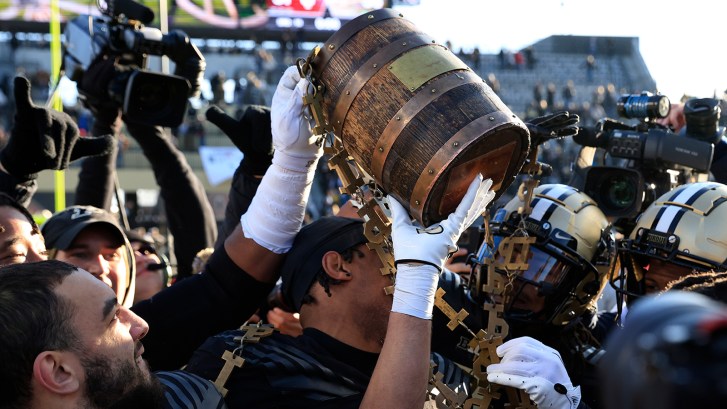
Purdue and Indiana have one of the oldest rivalries in the country with a history that goes back to 1891, and they also have one of the oldest rivalry trophies thanks to The Old Oaken Bucket.
In 1925, alumni from both schools met for a meeting where the topic was raised and decided they should go with what was described as the “most typical Hoosier form of trophy” in the form of a wooden bucket “taken from some well in Indiana.”
The trophy was eventually plucked from a farm owned by the Bruner family (located not too far away from Kent State) and remains one of the most iconic college football rivalry trophies close to 100 years after it was presented for the first time.
The Axe
Getty Image
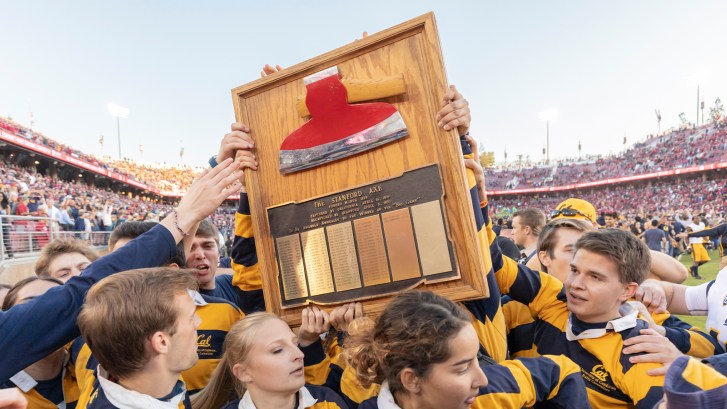
The Axe was officially adopted as the trophy for the Cal-Stanford rivalry in 1933 after ending up at the center of some shenanigans involving students at both schools.
The axe in question was initially used at a Stanford pep rally in 1899 to decapitate a straw effigy dressed in the opposing school’s colors. Later that week, Cal students stole it at a baseball game to spark a hectic chase through the streets of San Francisco where the handle was broken off.
The Golden Bears kept the axe as a spoil of war for 30 years, and with the exception of appearances at rivalry games and pep rallies, it was kept in a bank vault and transported to those events in armored cars.
However, Stanford students staged a dramatic heist in 1930 involving smoke bombs, multiple getaway cars, and saboteurs dressed as Cal students tasked with leading the ensuing search party in the wrong direction.
A few years later, the two sides agreed to a truce that led to The Axe becoming the center of a new rivalry trophy.