


© Kevin Whitlock / Massillon Independent / USA TODAY NETWORK via Imagn Images
In many pockets of this country, football under the Friday night lights just means more. It is where boys learn to be men and legends are made.
Here, we count down the 11 largest high school football stadiums in the country, stadiums so large the European mind simply cannot comprehend the fact that this is high school sports we are talking about and not professional teams.
The 11 Largest High School Football Stadiums In The United States
Half of the 11 largest high school football stadiums in the country can be found in Texas. Anyone from Texas or really anyone that has ever spent time in Texas will not be surprised at all by this.
It is where Friday Night Lights was both filmed and inspired. Small towns and cities alike have yards adorned with signs showcasing their star players. Texas takes high school sports more seriously than anywhere I’ve lived in my life and I only lived in Highland Park at SMU which isn’t at all representative of the diehard portions of the state. It just means more in the Lone Star State so don’t be surprised to see a handful of the largest high school football stadiums below in Texas!
11. Paul Brown Tiger Stadium: 16,600 Capacity
The 11th largest high school football stadium in the country is the Paul Brown Tiger Stadium in Massillon, Ohio with a seating capacity of 16,600. It is the home field of the Massillon Washington High School Tigers football team who can actually push the capacity to 19,000 when they need to.
Massillon Washginton’s claim to fame is they were named the AP High School Football National Champions nine times, in 1935, 1936, 1939, 1940, 1950, 1952, 1953, 1959, and 1961… It sure has been a long time though. But they ended a 53-year drought and won the state championship in 2023.
10. San Angelo Stadium: 17,550 Capacity
San Angelo Stadium in San Angelo, Texas is home to the Central High School Bobcats and the Lake View High School Chiefs but actually sits adjacent to a middle school. This stadium first opened in 1956 and has been an example of modern architecture through its history with photographs of the stadium being featured in a past exhibit at MoMA in NYC.
9. Ratliff Stadium: 17,931 Capacity
Ratliff Stadium in Odessa, Texas has a seating capacity of 17,931 and both Odessa and Permian High Schools call the stadium home on Friday night for high school football games.
This was, in fact, the stadium used for most of the football scenes in the 2004 movie Friday Night Lights. It was built in 1982 for $5.6 million which goes to show how much the cost of stadiums has changed in recent years.
8. Eagle Stadium: 18,000 Capacity
The Eagle Stadium in Allen, Texas is owned and operated by the Allen Independent School District. The Allen High School Eagles call Eagle Stadium home with an 18,000 seating capacity, making it one of the largest single high school stadiums around. It looks like a legitimate college football field both inside and out.
Eagle Stadium opened in August 2012 and cost $60 million to build. There’s a golf sim on the property, state-of-the-art weight room, and more. The Allen High School Eagles are 65–6 in the stadium since it opened and a perfect 8-0 in the playoffs. In this case, bigger is better.
7. Alamo Stadium: 18,500 Capacity
The Alamo Stadium in San Antonio, Texas is the third-largest high school football stadium in the Lone Star State. It has a seating capacity of 18,500 and hosted the annual ‘Chili Bowl’ between Fox Tech and Lanier until Fox Tech was disbanded. Nicknamed ‘The Rock Pile,’ this stadium is owned and operated by the San Antonio Independent School District and used for HS football games (and soccer) but also hosts concerts regularly.
6. Mesquite Memorial Stadium: 19,400 Capacity
The second-largest high school football stadium in Texas is the Mesquite Memorial Stadium on the East side of Dallas with a 19,400 seating capacity. The stadium is located on the campus of West Mesquite High School but it used by all five of the high schools in Mesquite, TX as their football stadium.
Back in 2014, a whopping $11 million was pumped into renovations making it one of the biggest and best stadiums in the land with improved concessions, a modern press box, massive concourse, and more.
5. Happy State Bank Stadium: 20,000 Capacity
The largest high school football stadium in the state of Texas is the Happy State Bank Stadium with a 20,000 seating capacity in Canyon, Texas up in the state’s panhandle. Three high school football teams call the Happy State Bank Stadium home: Canyon High School, Randall High School, and West Plains High School of Canyon Independent School District.
Happy State Bank bought the naming rights to the stadium in 2020 which is honestly kind of wild… Naming rights to a high school football stadium! The bank also donated $2 million to the stadium for renovations so they’ve made a sizable investment in the property.
4. BREC Memorial Stadium: 21,395 Capacity
The BREC Memorial Stadium in Baton Rouge, Louisiana has a seating capacity of 21,395, just 5 seats shy of the #3 spot on this list which feels like an incredibly shortcoming for whoever designed it. Just add 10 more, jump to #3 on the list. Get in a seating war, who is stopping you?!
The stadium has been used the bye Louisiana High School Athletic Association (LHSAA) since 1956, continuously operating it for high school football. Though there was the Grantland Rice Bowl college bowl game briefly from 1969-73.
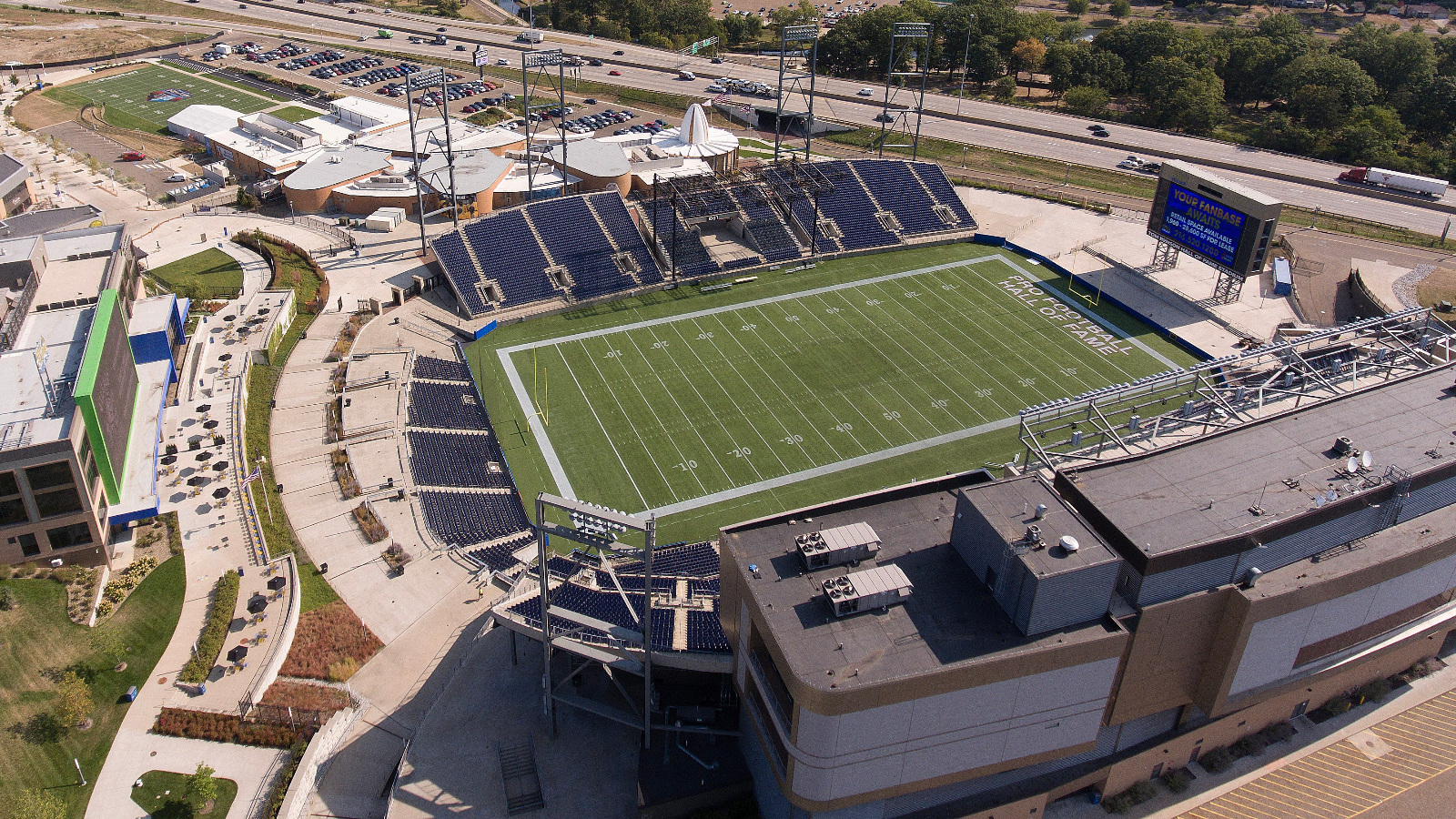
3. Tom Benson Hall of Fame Stadium: 22,400 Capacity
Ohio’s on the list! If the Tom Benson Hall of Fame Stadium sounds familiar that is likely because this is where the NFL’s Hall of Fame game is played each year in Canton, Ohio. Unless of course you are from Ohio and have been to a high school football game in this massive stadium with a 22,400 seating capacity.
It was built in 1938 (opened) and later renovated and reopened in 2016. Since the stadium broke ground in 1924, the Canton McKinley Bulldogs (OHSAA) claim the Tom Benson Hall of Fame Stadium as their home venue. The Bulldogs have won the state title thrice in the team’s history (1981, 1997, and 1998) and finished runner-up three times as well, most recently in 2004.
2. War Memorial Stadium: 23,000 Capacity
The War Memorial Stadium in Wailuku, Hawaii has a capacity of 23,000. It was originally built with a capacity of just 7,000 back in 1969 but expanded to its current size later.
Many claim this is the largest high school football stadium in the United States and not #1 below because the next stadium is mixed use and to that I’d say, Hawaii’s War Memorial Stadium has also hosted the college Hula Bowl all-star game in the past.
In defense of the War Memorial Stadium, it does abut the H. P. Baldwin High School and with a high school literally touching the boundaries as well as using the stadium for football it’s hard to argue that it isn’t a proper H.S. football stadium.
1. Tad Gormley Stadium: 26,500 Capacity
First opened in 1937, Tad Gormley Stadium in New Orleans, Louisiana is owned by the New Orleans City Park department. It was renovated in 2006 after Hurricane Katrina when then-Saints running back Reggie Bush donated $80,000 out of his own pocket to repair the turf and the field was then named in his honor.
Home to countless Louisiana high school football games, Tad Gormley Stadium set its attendance record way back in 1940 when 34,345 spectators came out to watch Jesuit High School of New Orleans face off against Holy Cross High School of New Orleans. The first game in the stadium after Hurricane Katrina was an LHSAA high school prep-football game on September 21, 2006 where Brother Martin HS faced L.W. Higgins HS.
As it is a multi-use stadium, many argue it is not strictly a high school football stadium but it is listed as the largest high school football stadium by Wikipedia and who am I do go against what the masses say?!
I did find it interesting that not a single one of the 11 largest high school football stadiums in the country were in Florida or California, two states known for producing top H.S. football talent alongside Texas.