


Lars Baron/Getty Images
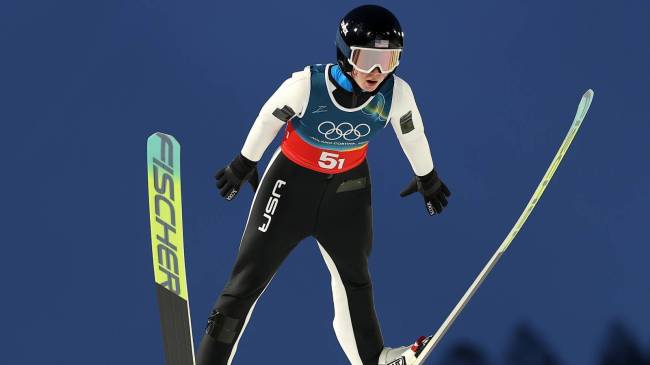
The equipment ski jumpers use has been a very hot topic of conversation at the Winter Olympics. Seemingly tiny advantages can give competitors a sizeable edge, and America’s Annika Belshaw was eliminated from an event over a violation that measured in at less than half an inch.
The 2026 Winter Olympics had already managed to end up at the center of a scandal before they even got underway courtesy of some Norwegian ski jumpers who were suspended for illegally altering the crotch of their suits ahead of the Nordic World Ski Championship last year.
Thanks to some rumors that swirled in the wake of that controversy, WADA was on the lookout for athletes who purportedly injected hyaluronic acid into a certain part of the male anatomy in pursuit of alterations with the potential to increase their hangtime.
As far as we know, no one who’s competed at Milano Cortano has gone that route, but there have been some ski jumpers who’ve been disqualified over some other equipment issues.
Austria’s Daniel Tschofenig suffered that fate after officials determined he wore oversized boots during the men’s large hill individual competition, and an American who was taking part in the same event on the women’s side also saw her (admittedly slim) hopes of winning a medal dashed over skis that committed a similar sin.
United States ski jumper Annika Belshaw was disqualified at the Winter Olympics because her skis were one centimeter over the permitted length
Ski jumping is an exercise in physics, as every single piece of equipment competitors don before barreling down the slope can play a crucial role in how far they end up sailing.
Their skis essentially work as wings that help them soar through the air, and longer ones give you an inherent advantage that can be canceled out by your weight. As a result, competitors are required to adhere to a formula that takes their height and the pounds they’re packing into consideration when it comes to determining ski length:
The maximum ski length in ski jumping is 145% of the athlete’s height, based on a minimum BMI of 21 for both men and women. Athletes with a BMI below this minimum must use shorter skis; for instance, a BMI of 20.875 corresponds to 144.5% of height, while a BMI of 20.750 corresponds to 144.0%, and so on.
The page where that rule is listed also notes “Athletes could inadvertently violate the rules if their body weight decreases during competitions,” and it seems like that could have played a role in the situation that led to Annika Belshaw being scratched from the first-ever women’s large individual hill competition at the Winter Olympics.
Belshaw was hoping to improve on her 21st-place finish in the normal hill (she was also part of an American squad that finished seventh in the team event) in her final event of The Games. She wasn’t expected to take home a medal, but a jump that measured in at 119 meters and received a score of 98.5 was enough to make her one of the 30 skiers to punch their ticket to the final round.
The Colorado native ended up with a total of 190.9 points after scoring a 92.4 on her second jump, but it did not end up counting due to the disqualification that was chalked up to illegal ski length, which was determined to be too long by just around one centimeter.
It ended up being a fairly moot point in the grand scheme of things, as Belshaw wouldn’t have made the podium even if her scores had stood. Norway’s Anna Odine Strøm and Eirin Maria Kvandal took home the gold and silver, respectively, with scores of 284.8 and 282.7, while Nika Prevc of Slovenia got the bronze with a 271.5.