


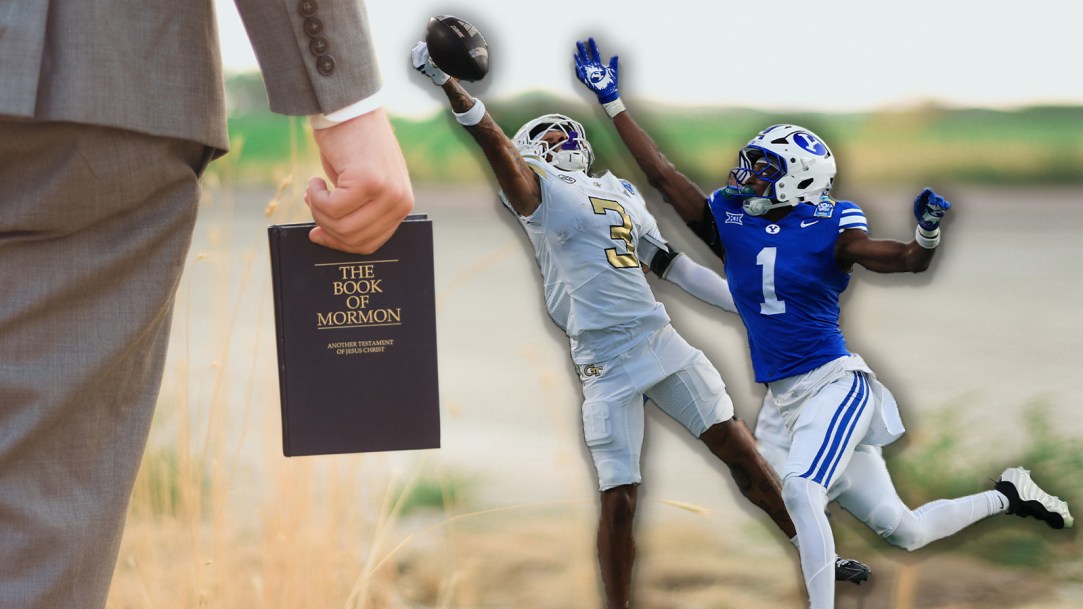
BYU defensive back Therrian Alexander III violated the university Honor Code during the Pop-Tarts Bowl. He was on the wrong end of an unfortunate hot mic on national television.
His language should technically warrant an investigation.
I do not know whether the rules apply to college football players and other student-athletes or if there is a double standard. I also don’t think anyone really cares, but the rules as they are written are the rules!
What is the BYU Honor Code?
The BYU Honor Code is a student conduct policy that applies only to students at Brigham Young University. It is written and enforced by the Church of Jesus Christ of Latter-day Saints, which aims to provide a Christ-centered education founded on strong Mormon principles.
Although enrollment is open to students and faculty of all backgrounds, they must agree to adhere to the Honor Code. And part of the Honor Code requires students to report any violations to the university or risk potential punishment.
“All participants are required to adhere to the BYU Honor Code. BYU is sponsored by the Church of Jesus-Christ of Latter-day Saints, and the honor code includes a few specific behavioral standards established by the church. Although certain behavioral standards are required, we emphasize that we welcome people of all faiths as well as those who are nonreligious. There is no requirement to participate in religious activities or to adhere to any particular set of beliefs.”
— Brigham Young University
You can read the full Church Educational System Honor Code here. The key points are as follow:
- Be honest
- Live a chaste and virtuous life, including abstaining from any sexual relations outside a marriage between a man and a woman
- Abstain from alcoholic beverages, tobacco, tea, coffee, vaping, marijuana, and other substance abuse
- Respect others, including the avoidance of profane and vulgar language
- Follow other campus policies established by the church educational system (CES) such as the dress and grooming standards and the student housing policy
- see the Dress and Grooming Principles and Expectations, e.g. no beards allowed for men unless an exemption is granted for religious or medical reasons
- see the Student Housing Policy, e.g. opposite sex visitors in single student apartments are only permitted in common areas and not in bedrooms
- For members of the Church of Jesus-Christ of Latter-day Saints only: church service attendance is expected
We’re going to focus here on the fourth bullet point. Students must avoid profane and vulgar language.
Therrian Alexander III did not avoid profane and vulgar language at the Pop-Tarts Bowl.
Alexander, a former three-star recruit, was named as a starting defensive back for BYU as a sophomore. He recorded 34 total tackles (27 solo) with five pass deflections, one sack and one interception in 2025.
The 6-foot-2, 175-pound corner made two tackles against Georgia Tech in the Pop-Tarts Bowl. The Cougars came back from a 21-10 deficit at halftime to defeat the Yellow Jackets by a final score of 25-21 and win their 12th game of the season. It was an impressive performance.
Alexander prevented a big play right before halftime. Haynes King missed his receiver, but the receiver was not open anyway because of the tight coverage.
The play came to an end right in front of an on-field microphone. The proximity to the microphone led to an awkward on-air moment. Therrian Alexander talked a lot of trash, which could be heard live on ABC.
His language was in violation of the Honor Code. It was profane.
"The fuck you talking about?"
— Carter Lowe (@cjlvideo) December 27, 2025
-BYU WR Therrien Alexander III
Don't think that one's in the honor code#BYU #StingEm #PopTartsBowl pic.twitter.com/oQsPuCSbKS
Awkward!
This is not the first time this kind of thing has happened. A leaked halftime speech in 2024 created a similar controversy among BYU fans. Some, if not most, do not care about the use of profanity. Others, those who are more traditional, do not want to hear any kind of cuss word.
If a regular BYU student was reported for vulgar language, he or she might be subject to consequences. A minor, first-time offense typically requires notice and/or counseling. That escalates to a formal warning. A third offense often triggers probation. And then suspension and/or expulsion.
According to the Honor Code Office, “Minor swearing is often handled gently, while frequent or offensive language escalates sanctions.” I would qualify Alexander’s trash talk as minor swearing so it should be handled gently.