


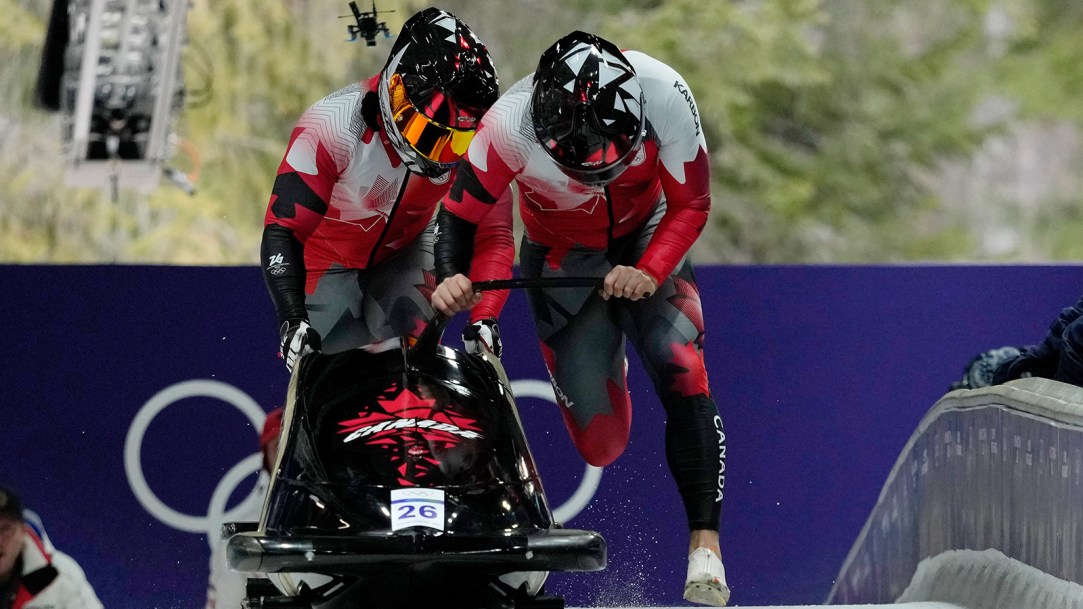
Canada is already at a major disadvantage in the bobsled competition at the Olympics. They’re broke!
The financial inferiority all but guarantees that Team Canada will not be on the podium before the first race even begins.
There is only one bobsleigh event at the Olympics in which the Canadians stand a chance. Otherwise they must hope for disaster amongst the other countries.
Team Canada does not have money for bobsled.
National sport organizations in Canada have been operating at a deficit for years. That includes but is not limited to bobsleigh. According to the CBC, Bobsleigh Canada Skeleton also lost more than $1 million in funding before the season on top of the preexisting pecuniary challenges. Not great.
The resulting budget cuts inflated the cost to suit up for bobsled training and competition in Canada. Each athlete was required to pay a fee of $25,000 — just to be on the team. That is in addition to the price of travel, coaching, ice time, etc. Olympic sports are not cheap and they becomes even more expensive when the team itself does not have enough money to cover the most basic needs.
Because federation funding has dried up, many Canadian sliders are forced to work full-time jobs outside of the sport or tap into personal savings and/or take on debt. Some athletes are fortunate enough to rely on family support. The lucky ones are able to secure private sponsors. Somebody has to pay.
Even though this kind of financial arrangement is not particularly uncommon for the more niche sports at the Olympics, where part-time athletes have to pay their way, the lack of funding has a more direct impact on success for Team Canada in the bobsled competition. It is an equipment issue.
Germany has the best sleds at the Olympics.
The sport of bobsleigh is highly dependent on technology. The athletes themselves do the majority of the work to get down the track as fast as possible but hundredths of a second can make the difference between a gold medal and sixth place.
Those crucial hundredths of a second do not come from training. They come from the technology.
More specifically, the sled.
Even the smallest of aerodynamic gains have a tangible impact on time. Countries that invest heavily in materials science and engineering typically tend to dominate. Germany is one of them. Canada is not.
In fact, Team Canada is using hand-me-down sleds from Team Germany at the Winter Olympics in 2026. The sleds are from 2018. They are eight years behind in terms of technology. That is an insurmountable difference.
Veteran brakeman Mike O’Higgins compared it to car racing. It is simply not possible to keep up.
“You can have a great driver in a Honda Civic,” he told CBC. “And the person in the Porsche is going to have to make some pretty serious mistakes.”
This creates a divide between the haves and the have nots. Team Canada is the latter. No matter how strong their athleticism might be compared to other countries, they are held back by the equipment. Their push does not matter if another country can make up that time with its sled.
The results speak to this disadvantage.
It is rare to see the Canadian bobsledders win a medal in bobsleigh.
However, women’s monobob mandates that every competitor drive the same model of sled to eliminate the technological edge for big-spending programs and there is a lot more parity in the event as a result. Otherwise Team Canada cannot keep up. They’re broke.