


Getty Image
Last week, the 2026 Winter Olympics in Italy were hit with a bizarre scandal involving the sport of men’s ski jumping. That controversy was directly related to competitors increasing the size of their private parts in order to gain an advantage.
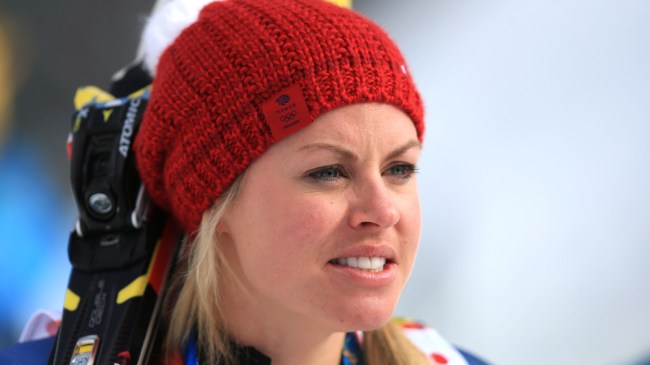
Former Great Britain skier Chemmy Alcott detailed the “female version” in a recent podcast appearance. While her experience was not nearly as weird, it did result in a near-ban from competition during the 2010 Games in Vancouver.
Alcott is now covering the Winter Olympics as a pundit for BBC. She discussed some of what she’s seen thus far at Milano Cortina on The Sports Agents show.
The viral ski jumping scandal became a topic of discussion. She weighed in.
Explaining the ski jumping scandal.
At the start of the Games, there were claims of performance enhancing efforts which sparked a World Anti-Doping Agency investigation. According to those claims, male skiers were receiving penile injections to bend the rules.
Those injections allowed them to add a bit more fabric to groin area of their form-fitted suits. There is a science behind the madness.
“It comes down to, basically, physics,” said Jonathan Lambert of NPR. “Essentially, gravity, drag, and lift. In ski jumping, the whole point it to try to maximize the amount of time you’re in the air…
“Once they leave the ramp, they’re fighting gravity. Air is their friend. It’s pushing them up… providing a little bit of lift. The amount that the air pushes them up depends on their overall surface area. The more the skier can maximize that surface area, the farther they can go.”
The alterations, though slight, can make a difference. It’s been tested.
Scientific journal Frontiers reports that just a two-centimeter change in a suit represented as much as an extra 5.8 meters in the length of a jump.
It could be the difference between medaling and going home empty-handed.
Chemmy Alcott experienced the “female version.”
While her incident at the 2010 Winter Olympics in Canada was a bit different, it still almost had major repercussions.
Alcott had broken her ribs, which required her to get fitted for a chest plate by team doctors. Oversized protection resulted in a near-ban related to competition regulations.
“I went to Vancouver to race with broken ribs,” she recalled. “The Team GB doctors were worried, so they sent me to get a synthetic chest plate made.
“I happened to be wearing a Wonderbra that day, so the plate was quite a lot larger than my natural sizing. When I tried to race in it, they banned it because it didn’t let air through properly for aerodynamics.”
Alcott eventually ditched the protective gear to compete in all five alpine skiing disciplines during what was her third of four straight Olympic appearances.
In both of these cases, oversized equipment was the cause for concern. For Alcott, the enlargements were strictly precautionary. For the ski jumpers, measures were aimed purely at creating competitive advantage.