



© Jasen Vinlove/Imagn
Despite the entire motorsports world expecting the two sides to settle, Michael Jordan and his 23XI Racing team began its antitrust lawsuit against NASCAR on Monday, alongside fellow team owner Bob Jenkins of Front Row Motorsports.
The two teams allege that NASCAR is operating as a monopoly and used monopolistic practices in an attempt to bully teams to sign its latest charter agreement in 2024.
Both 23XI Racing and Front Row refused to sign said agreement, and ran much of the 2025 season as unchartered teams after losing a preliminary injunction.
While it’s difficult to suggest an outcome after the first four days of trial, there have been several key takeaways.
Michael Jordan’s Lawsuit Against NASCAR Is Getting Spicy
Jordan, co-owners Curtis Polk and Denny Hamlin, and Jenkins, retained the services of famed lawyer Jeffrey Kessler, who famously led the charge to NCAA Division I athletes to secure financial compensation in a case that went all the way to the U.S. Supreme Court.
Now, he’s backing perhaps the world’s most famous athlete in a case that could change the racing world forever. Through the first four days of the trial, these are the biggest storylines.
5) Denny Hamlin Calls Out NASCAR Owner Jim France
© Mark J. Rebilas/Imagn
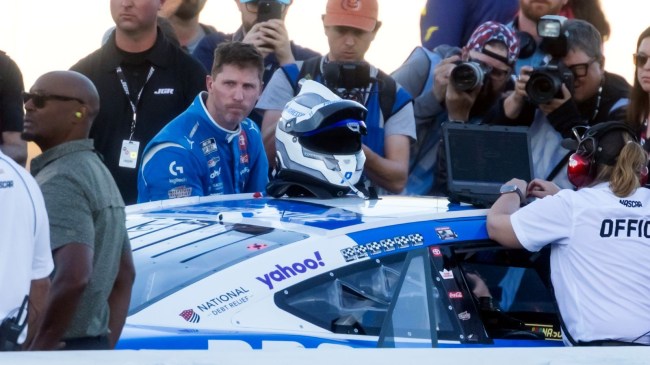
Jordan and Polk co-owner 23XI Racing with future Hall of Fame driver Denny Hamlin, who currently drives for Joe Gibbs Racing.
On day two of the trial, Hamlin took the stand and recalled a discussion he had with NASCAR owner Jim France, where France alleged that teams were underwater due to their own spending issues. This is despite documents that show the France family takes in payments in excess of $100M each year from NASCAR revenues that are separate from the league’s reported earnings.
“He told me directly the problem in NASCAR is teams spend too much money,” Hamlin said via The Athletic. France allegedly told Hamlin teams should only be spending $10 million per season to run their cars, rather than the current $20 million average.
“We’ve cut this grass so short, we’re down to the dirt,” Hamlin then said.
Hamlin ultimately told the jury that he did not sign the 2025 charter agreement because he believed it was a “death certificate” for his team’s future.
4) Hamlin Claims NASCAR Forces Drivers And Teams Into Talking Points
Upon cross-examination, Lawrence Buterman, the lead attorney representing NASCAR, asked Hamlin about a podcast appearance during which he spoke glowingly about the current generation of NASCAR vehicles and how it’s a positive for the sport.
Hamlin, however, stated that his answer was dictated by the sport’s ownership and leadership.
“All my public (comments) are out of context,” Hamlin said. “You guys have an issue with that,” he said of potential critiques, noting there would be repercussions for him at the racetrack if he spoke out. “You’re able to essentially dictate how I do.
“That’s nonsense,” Hamlin said. “What I do publicly is put out (positive messages). That’s my job. You give me talking points, I say it to make fans feel happy.”
3) Bob Jenkins Says He’s Losing Millions Running Team Despite ‘Frugal’ Ways

© Gary A. Vasquez/Imagn
While Jordan and Hamlin receive all the headlines, understandably, Jenkins’s role in the case cannot be overstated. His Front Row Motorsports team is considered one of NASCAR’s “smaller” teams, and we learned more about their operations on Wednesday when he took the stand.
Jenkins told the court that he lost $8 million in 2022, followed by another $5.7 million loss the next year.
He said he remains in the sport because he is a lifelong fan, but can only do so due to his success in other businesses and that Front Row Motorsports has become known as “the team that has done the most with the least.”
“I can assure you it’s not from malpractice,” he said in response to claims that he’s losing money due to overspending. “We’re very frugal.”
He added that he believes that NASCAR can be profitable for all owners moving forward, but not under the current financial regulations.
“If we ever do get it right, NASCAR teams will be valuable,” Jenkins said.
Buterman then asked Jenkins why other owners signed the new charter agreement despite only two teams deciding not to.
“They knew they had to blindly sign it or not … They can’t walk away from (their investments),” Jenkins said. “You can’t turn a race shop into a warehouse.”
2) Jeffrey Kessler Presses NASCAR Executive On Alleged Monopolistic Practices
Also on Wednesday, NASCAR strategy chief Scott Prime took the stand. Prior to working for the series, Prime worked for consulting firm McKinsey. In 2014, McKinsey and Prime led a study that showed “concerns over the longevity of the sport” if NASCAR did not step in to help race teams.
That study led to the initial charter agreement in 2016.
However, when asked about the latest charter agreement, Prime said, “We presented the offer and they accepted it,” to which an animated Kessler replied, “You’re a monopoly. There’s no place else to compete. There was no place else for them to go, correct?”
“NASCAR is the premier stock car racing series today, yes,” Prime responded.
When asked to further clarify where teams could go, Prime pointed to several tracks NASCAR had explored operating at in the coming years or had recently begun racing at. One of them, he said, was the Chicago Street Race, which was run from 2023-25.
However, it was later revealed that the series lost $55 million on the three street races it held in Chicago from 2023-25. In 2026, the series is set to return to nearby Chicagoland Speedway, which is owned by the series itself.
1) Kessler Goes After NASCAR President Steve O’Donnell And Owner Jim France
© Brady Klain/The Republic, Arizona Republic via Imagn Content Services, LLC
On Thursday, NASCAR president Steve O’Donnell took the stand and Kessler pressed him on several email exchanges between he and former president (and current commissioner Steve Phelps). In those exchanges, O’Donnell seemed to imply that France was preventing teams from receiving a larger portion of revenue or a larger stake in the series.
O’Donnell wrote that France proposed a deal that would “take us back to a comfortable, 1996, f– the teams, dictatorship, motorsport, redneck, Southern, tiny sport.”
“Poor choice of words,” O’Donnell told Kessler. “I was very frustrated.”
Kessler also asked O’Donnell about NASCAR using an exclusivity clause with Speedway Motorsports Incorporated, the largest owner of major racetracks in the country, to block the upstart SRX series from racing at a Speedway Motorsports track.
O’Donnell told Kessler this was because “we were in a major negotiation” for a new media rights deal and “we wanted to retain as much revenue as possible for the teams.”
However, in text messages submitted into evidence, O’Donnell wrote “This is NASCAR. Pure and simple. Enough. We need legal to take a shot at this,” regarding SRX.
“(We) need to put a knife in this trash series,” Phelps responded.