


Mariners TV
Through the first week of the 2026 MLB season, fans are absolutely loving the new ABS challenge system.
The automated balls and strikes system has not only given fans a new reason to cheer during games, but it has also exposed some of Major League Baseball’s worst umpires when it comes to calling balls and strikes.
Just ask highly scrutinized veteran ump C.B Bucknor.
But just because fans like the new system doesn’t mean that it’s not without its flaws. For one, the new system is based on a player’s measured height when standing straight up and down. However, it does not account for players who have a crouched batting stance.
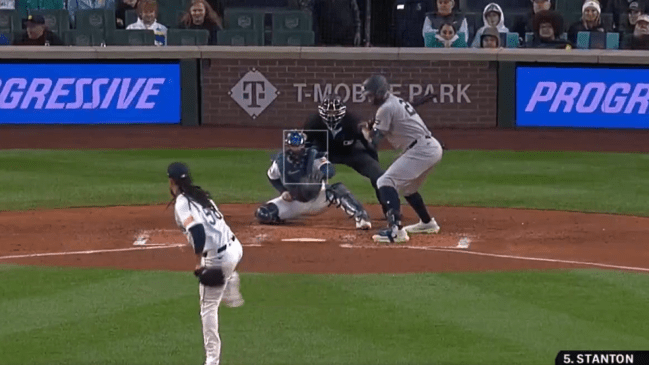
Additionally, New York Yankees star Giancarlo Stanton revealed another glaring hole in the system with a successful challenge against Seattle Mariners ace Luis Castillo.
New MLB ABS System Changes The Definition Of What Is Considered A Strike
By definition, the strike zone is a three-dimensional dox according to the official MLB rulebook.
“The official strike zone is the area over home plate from the midpoint between a batter’s shoulders and the top of the uniform pants — when the batter is in his stance and prepared to swing at a pitched ball — and a point just below the kneecap. In order to get a strike call, part of the ball must cross over part of home plate while in the aforementioned area,” the rule states.
However, the ABS system uses a two-dimension zone measured exactly at the middle of the plate.
Umpire incompetence or a Rulebook/ABS Mismatch issue? 🤔
This pitch may have been both:
-a Strike according the rulebook strike zone (3 dimensional/starting at the front of the plate), and
-a Ball, according to ABS (2 dimensional/measured at the middle of the plate). pic.twitter.com/LwMGaoSo9h
— Rob Friedman (@PitchingNinja) March 31, 2026
As baseball analyst Rob Friedman, better known at @PitchingNinja on X, pointed out, this creates a scenario where a pitch can be both a strike according to the MLB rules and a ball according to the ABS system.
That scenario appeared to occur in Stanton’s at-bat against Castillo, when home plate umpire Mike Estabrook rung Stanton up on a called third strike, only for the challenge system to show the pitch missed the strike zone by less than 0.1 of an inch.
However, given the fact that Castillo’s pitch was sinking, it’s extremely likely that it entered the strike zone, at the front of the plate, as a strike. That would mean Estabrook was correct to rule Stanton out by the official definition of the rule.
Either Major League Baseball needs to redefine the strike zone, or it has to change the way the ABS system measures pitches to use a three-dimensional plane. Otherwise, the ABS system is entirely invalid by the league’s own rules.