


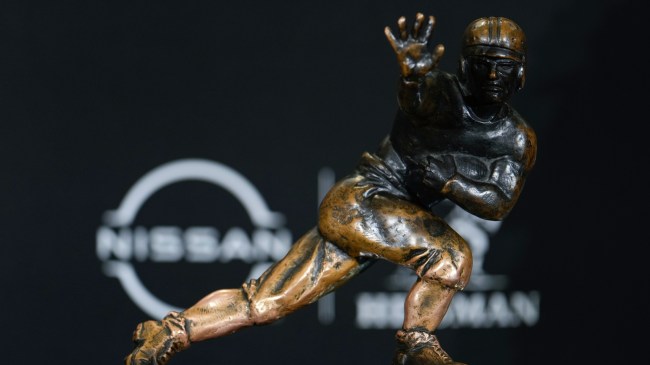
Lucas Boland-Imagn Images
There have been plenty of occasions where there was no question who was going to walk away with the Heisman Trophy before it was actually presented. However, there have also been more than a few situations where the winner eked out a victory over another candidate who gave them a serious run for their money.
No players have won the Heisman Trophy by a tighter margin than these players
No player has ever won the Heisman Trophy via a unanimous first-place vote (Joe Burrow came the closest when he was at the top of 93.8% of the ballots submitted in 2019), and there are a number of college football legends who had to know they were going to receive the hallowed award before their name was announced based on their superior play that season.
However, we’ve also been treated to plenty of nail-biters where the winner was by no means a foregone conclusion, including the years responsible for the smallest margins of victory in the history of the award.
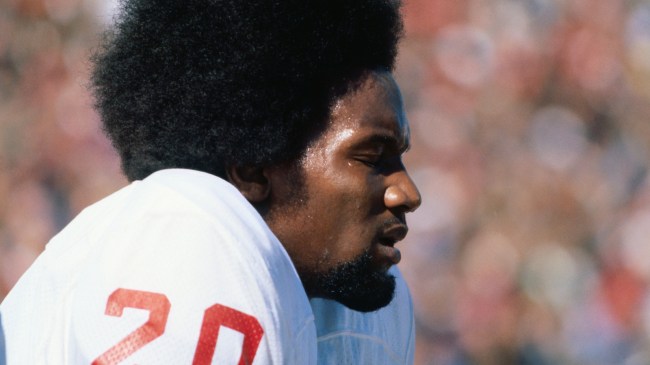
Billy Sims, RB, Oklahoma—77 Votes (1978)
Getty Image / Bettman
College football has come a long way since 1978, as evidenced by the fact that a quarterback who threw for less than 2,000 yards was not only a top candidate for the Heisman Trophy but received more first-place votes than anyone else.
That QB was Penn State’s Chuck Fusina, who passed for 1,859 yards and threw 11 touchdowns (as well as 12 interceptions) during his senior season. However, he ultimately lost to Billy Simms, who made up for lost ground with the second-place votes that propelled him to victory on the back of his 1,726 rushing yards (with an absurd 7.6 yards per carry) and 20 TDs on the ground.
Chris Weinke, QB, Florida State—76 Votes (2000)

Robert Deutsch / USA TODAY NETWORK via Imagn Images
Chris Weinke is one of the more fascinating players on this list, as he initially spent six years playing minor league baseball in the Blue Jays farm system before deciding to pivot to college football at the age of 25.
Weinke rode the bench during his freshman season in 1997 before earning the starting job the following year. He bounced back from a neck injury that brought his sophomore campaign to an end by leading Florida State to a national championship in 1999, and he subsequently capped off his time in college by passing for 4.167 yards and throwing 33 touchdowns.
The Seminoles ended up facing off against Oklahoma in the national championship game that year in what turned out to be a revenge game for Josh Heupel, the Sooners QB who came in second place to Weinke by 76 votes but got a consolation prize in the form of a title.
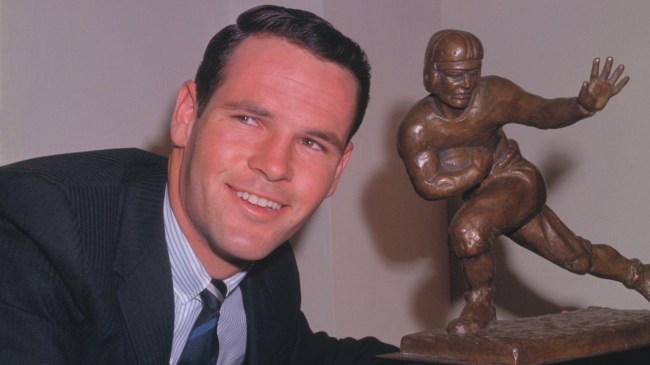
John Huarte, QB, Notre Dame—74 Votes (1964)
Getty Image / Bettman
Notre Dame has produced seven Heisman Trophy winners, and three of them ended up winning by less than a hundred votes.
The first one we’ll be mentioning is John Huarte, who had 2,062 passing yards, 16 touchdowns, and 11 interceptions as a senior in 1964—the last year Heisman voters only listed a single player.
He ended up winning by 74 votes, but it’s pretty easy to argue Tulsa’s Jeremy Rhome got robbed despite playing an easier schedule when you consider he had 2,870 yards, 32 TDs, and just four picks.
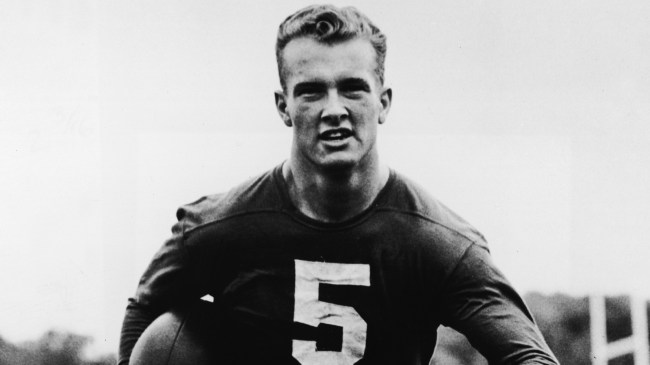
Paul Hornung, QB/HB/S, Notre Dame—72 Votes (1956)
Pictorial Parade/Getty Images
We’re jumping straight to another Notre Dame player thanks to Paul Hornung, who was basically the Fighting Irish’s equivalent of Travis Hunter—and then some—in 1958.
Notre Dame ended up going 2-8 that year, but the fact that Hornung was their leading passer, rusher, punter, kick returner, and pass defender was enough to give him the edge over Johnny Majors, the Tennessee running back who had 549 yards and seven rushing touchdowns.
Hornung is still the only player to win the Heisman while playing for a team that finished under .500.
Andre Ware, QB, Houston—70 Votes (1989)

Jo Patronite/Allsport/Getty Images
Andre Ware had himself a year during his junior season at Houston in 1989 while setting a slew of records during a campaign where he threw for 4,699 yards and had 46 touchdown passes (the former set a new mark to beat during the regular season before BYU’s Ty Detmer and David Klingler, the man who replaced Ware, becaem the first QBs to surpass 5,000 yards in 1990).
However, the same could be said for Anthony Thompson, the Indiana running back who ran for 1,793 yards and had 24 touchdowns on the ground. Unfortunately, it wasn’t enough to beat Ware when everything was said and done.
Eric Crouch, QB, Nebraska—62 Votes (2001)

RVR Photos-Imagn Images
The Heisman Trophy kicked off the new millennium with a couple of tight races, as Eric Crouch and Rex Grossman were also neck and neck a year after Weinke edged out Heupel.
Grossman was angling to become the first underclassman to win the award after racking up 3,896 yards and 34 TDs as a sophomore quarterback at Florida. However, it ultimately went to Crouch, the dual-threat QB who had 1,510 yards and seven TDs in the air at Nebraska in addition to 1,115 and 15 on the ground.
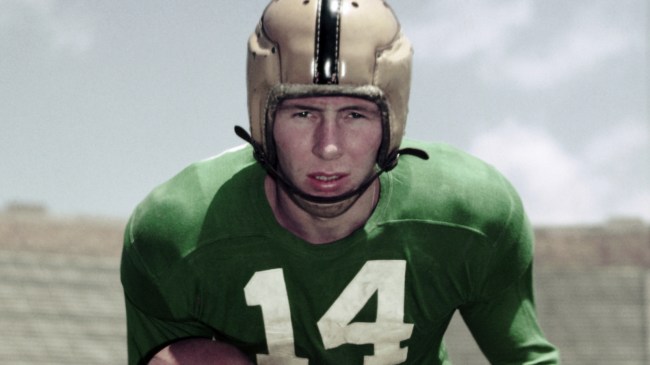
John Lattner, HB, Notre Dame—56 Votes (1953)
Getty Image / Bettman
We’ve got our final appearance from a member of the Fighting Irish courtesy of John Lattner, the halfback who beat out Minnesota dual-threat Paul Giel in 1954.
There are somehow no individual stats available for Giel that season, so I can only tell you the College Football Hall of Famer (who ended up pitching in the MLB) had 2,188 rushing yards and 1,922 passing yards during his three seasons with the Golden Gophers.
Lattner, on the other hand, ended up with the trophy with the 651 yards he ran for that year. I’m assuming there were also some touchdowns in the mix, but they are not tabulated in the record books.
Ernie Davis, HB, Syracuse—53 Votes (1961)

Getty Image / Bettman
We thankfully do have some stats we can use to make sense of the 1961 Heisman Trophy race between Syracuse HB Ernie Davis and Ohio State FB Bill Ferguson.
It was about as tight as they get. The former had 823 yards and 12 TDs while averaging 5.5 per carry, while the latter finished with 938 yards, 11 TDs, and an average carry of 4.6 yards.
Ferguson did win the Maxwell Award, but Davis ended up with the Heisman.
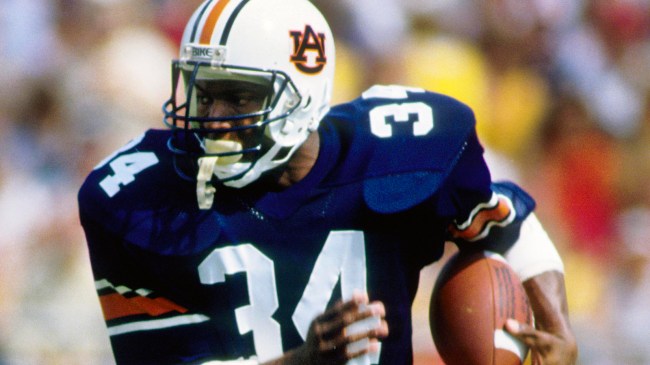
Bo Jackson, RB, Auburn—45 (1985)
Manny Rubio-Imagn Images
You might think Bo Jackson won the Heisman Trophy in decisive fashion given his reputation as one of the greatest athletes of all time. However, the running back actually got a serious run for his money in 1985.
Jackson finished his senior season with 1,786 yards (averaging 6.4 per carry) and 17 TDs rushing but had some stiff competition from Iowa QB Chuck Long, who posted 2,978 yards and 26 TDs on the passing front. Long also won the Maxwell due to the stellar play that helped the Hawkeyes get their first-ever 10-win season, but it wasn’t enough to beat Bo.
Mark Ingram, RB, Alabama—28 (2009)

John David Mercer-Imagn Images
We’re closing things out with another instance where a well-known running back had some serious competition from a player who’s largely been forgotten, and no one has ever won the Heisman Trophy by fewer votes than Mark Ingram.
Tim Tebow became the first sophomore to win the Heisman Trophy in 2007, which marked the start of a three-year run for guys in their second season. Sam Bradford became the second in 2008, while Mark Ingram capped off the three-peat with 1,658 yards and 17 TDs—using his SEC boost to beat fellow RB and Stanford standout Toby Gerhart, who lost by just 28 votes after putting up 1,871 yards and 28 TDs.