


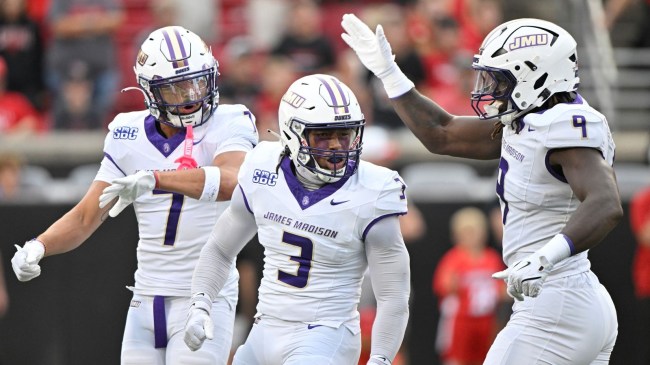
© Jamie Rhodes/Imagn
Just five years ago, James Madison was playing at the FCS level of Division I college football. Now, the Dukes are one of the premier Group of 5 programs in the country and just qualified for the College Football Playoff against all odds.
So, how did the relatively unknown school from Harrisonburg, Virginia, make it happen? Especially without a big-name mega-donor funding their rapid ascent?
Well, having two superstar coaches in Curt Cignetti and Bob Chesney didn’t hurt. But there’s also another reason, one that takes a toll on JMU’s approximately 23,000 students: massive student athletic fees.
James Madison’s Student Athletic Fees Are Gigantic
So, what exactly is a student athletic fee?
A number of schools in the College Football Playoff don’t have one at all.
But in Virginia, which allows for schools to include mandatory student fees, it is a portion of a student’s total payment to the school, on top of tuition, that goes toward funding athletics.
Other student fees are used to cover parking, student health services, intramural sports, and student union and recreational fees.
But only certain schools had mandatory student athletic fees. And no school in the CFP has a student athletic fee anywhere nearly as high as that of James Madison.
Dwayne Yancey, a JMU alum and reporter for Cardinal News, revealed that James Madison’s $3,026 intercolegiate athletics fee was the most among the College Football Playoff teams by a stunning margin.
In fact, JMU’s first round opponent, Oregon, did away with similar fees entirely in 2021.
Per Yancey’s report, none of Alabama, Indiana, Mississippi, Ohio State, Oklahoma, Oregon, or Texas A&M have student athletic fees. The four other schools that do, Texas Tech, Georgia, Miami, and Tulane, combine to charge just $698.40.
“Let’s put this another way: JMU’s mandatory student fees for athletics are more than four times higher than all the other College Football Playoff schools combined,” Yancey writes.
Sure, those other schools have built-in advantages. They have larger enrollment numbers, larger donor bases, massive TV contracts from Power 4 conferences, and big-time boosters. But JMU is able to stand out above the rest among the Group of 5 teams due to its massive annual fees to fund student athletics.
However, if the Dukes continue to succeed on the football field, it’s hard to imagine students being too upset with how their money is spent.