

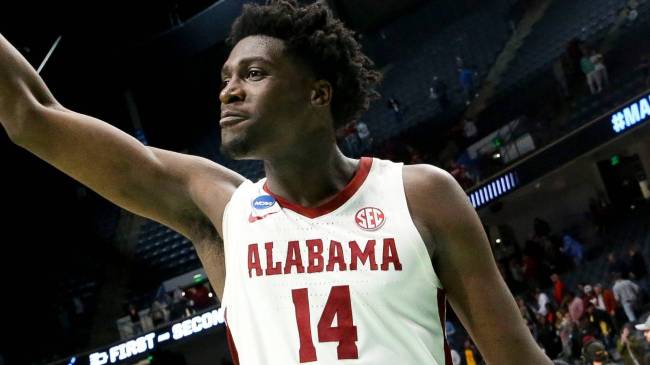
Gary Cosby Jr. / USA TODAY NETWORK / USA TODAY NETWORK via Imagn Images
College basketball has started to lose the plot this season due to a growing wave of players who have attempted to come back after playing in the G-League and other professional circuits. That includes Charles Bediako, who was given permission to suit back up for Alabama by Jim Roberts, the judge who signed a temporary restraining order facilitating his return and appears to be a major donor.
The NCAA was forced to chuck its long-held tradition of amateurism out of the window when the NIL Era began in 2021, and the governing body has spent close to five years watching college sports skidding down a slippery slope that’s become increasingly frictionless thanks to legal challenges that threaten to weaken its authority.
College basketball has emerged as the most recent battleground due to a rise in the number of players who’ve been signed to a roster after spending time playing in a professional league.
That includes a handful of guys who got a taste of the G-League before deciding to head back to college to take advantage of the NIL money that’s now available to them, including Louisville’s London Johnson and Santa Clara’s Thierry Darlan, both of whom were cleared to play by the NCAA.
Baylor also recently made waves when it landed James Nnaji, who was drafted by the Pistons with the 31st overall pick in the 2023 NBA Draft and saw his contract rights change hands while playing overseas in the trade that sent Karl-Anthony Towns to the Knicks in 2024.
Now, we’ve got another controversy on our hands courtesy of Charles Bediako and the judge who ruled he can play for Alabama.
The judge who signed the temporary restraining order allowing Charles Bediako to suit up for Alabama appears to have donated a six-figure sum to the school
It’s worth noting the NCAA doesn’t explicitly prohibit players who have played professionally from forfeiting their eligibility.
The organization’s handbook contains some bylaws addressing that scenario, including one that states “An individual who participates in a sport as a member of a team may receive actual and necessary expenses for competition and practice” and another allowing them to be compensated in the same manner by a “professional sports organization.”
However, those rules are designed to cover expenses like lodging, meals, apparel, and travel. Receiving a salary on top of them seems like it should be a disqualifying factor based on the letter of the law, but the NCAA has largely declined to press the issue.
That brings us to the case of Charles Bediako, who was named to the SEC All-Freshman Team in 2022 following his first year at Alabama before declaring for the 2023 NBA Draft in the wake of his sophomore season.
He was not selected, but he signed a two-way contract with the Spurs before joining their G-League affiliate in Austin to kick off a pro career where he played 46 games between that squad, the Grand Rapids Gold, and the Motor City Cruise.
On Wednesday, Bediako was cleared to return to the Crimson Tide after a judge in Alabama signed a temporary 10-day restraining order that said he was “immediately eligible” to join the team, adding the NCAA is “restrained from threatening, imposing, attempting to impose, suggesting or implying any penalties or sanctions” against him or the program.
That organization voiced its displeasure with the ruling while stressing it has no plans to allow players who have signed contracts with an NBA team to return to college, saying:
“A judge ordering the NCAA let a former NBA player take the court Saturday against actual college student-athletes is exactly why Congress must step in and empower college sports to enforce our eligibility rules.”
The person who issued that ruling was Tuscaloosa County Circuit Judge Jim Roberts, and as one Reddit detective pointed out, there is some very strong evidence that suggests he is the same “Honorable Jim Roberts” who, along with his wife Mary, has donated between $100,000 and $249,000 to the University of Alabama over the years.
Is there a chance that there is another judge named Jim Roberts who just so happens to be married to someone named Mary who has donated a six-figure sum to the school located in the county where he presides? Sure, but a quick search failed to identify any other likely culprits aside from the man who is also cited as a “frequent guest lecturer at The University of Alabama School of Law” on that learning institution’s website.
A hearing concerning Bediako’s injunction is scheduled to be held on the morning of January 27th, and something tells me the NCAA’s lawyers will be lobbying for a recusal.