


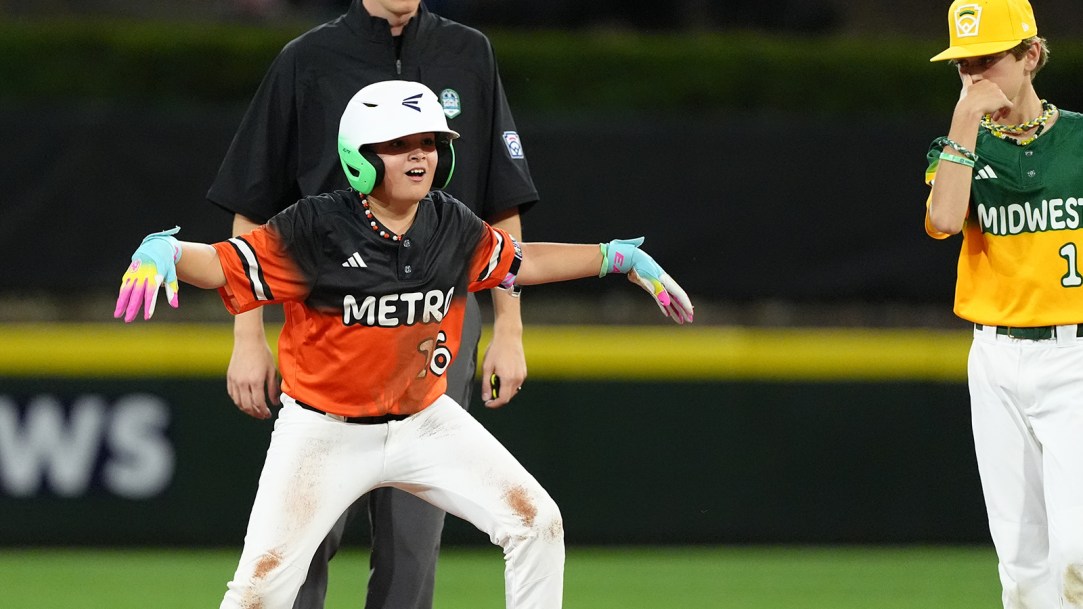
Fairfield will play for an American championship at the Little League World Series as the undefeated representative from the Metro region. The Connecticut-based baseball program got to this point, in part, through the use of a controversial baserunning strategy that takes full advantage of the rules as they are written.
Other teams have tried (and failed) to emulate this unique approach but only one prevails.
It is very possible that Little League could choose to rewrite some of its guidelines in the future as a direct result of Fairfield’s completely legal shenanigans. In the meantime, there is nothing to stop the Connecticut from running wild — literally.
How did Fairfield get to the Little League World Series?
Fairfield, Connecticut sits next to the Long Island Sound, approximately 57 miles north of New York City. Its top little league program is split into two different teams: National and American
The National team boundary consists of all residences that are in the Stratfield, North Stratfield, Jennings, Holland Hill, McKinley and Burr school districts. Players for this year’s roster must not reach their 13th birthday before the final day of August.
Although a team from Connecticut has not won the United States Championship since 1989, Fairfield National has been a powerhouse out of the Metropolitan Region over the last decade or so. This season is no different.
Fairfield dominated its way through the regional tournament. It has yet to lose a game since it arrived in Williamsport for the Little League World Series.
Metro is 4-0 with wins over Texas, Hawaii, South Dakota and Nevada.
The most recent win over Nevada punched a ticket to the U.S. Championship. The winner of the U.S. Championship will play the winner of the International Championship to crown a world champion.
Baserunning scores runs.
Fairfield practiced three hours per day, seven days per week over the summer to prepare for the Little League World Series. Baserunning was a primary focus. They found something of a loophole.
According to Little League rules, “Once the ball is returned to the pitcher, the pitcher is on the mound, and the Catcher is in the Catcher’s box, the base runner is not permitted to advance further.”
Lets look at this from a different perspective.
In other words, the only way for the defensive side to stop a baserunner from advancing to second base after he reaches first is to get the ball back to the pitcher and to get the pitcher back on the mound. That creates an advantage for the offense— especially when there is a runner already on third.
Fairfield intentionally puts pressure on its opponent to get the ball to pitcher, on the mound, by dancing somewhere between first and second base.
If the defense tries to get the runner on his way to second, the runner on third has a free path to home. If the defense tries to keep the runner at third, the runner on first has a free path to second.
The contentious baserunning strategy led to an onslaught of runs scored during the sixth (and final) inning against South Dakota. Fairfield kept advancing its runners on first and third to second and third. Six consecutive base knocks set up the same first and third scenario.
South Dakota was unwilling to look off the runner at third. Fairfield took second uncontested. Rinse, repeat.
This is something the Metro representative had been doing all season when possible.
Other teams have tried — and failed.
South Dakota tried to emulate Fairfield’s baserunning scheme during an elimination game. It is not as easy as it looks!
A hitter for South Dakota immediately took an aggressive lead around first base after he drew a walk in the second inning. He tried to bait a throw from Washington’s pitcher but Washington diffused the threat without the runner on first advancing to second or the runner on third advancing home.
South Dakota later got itself in trouble by trying to get too cute in the fifth inning. Same thing.
— – (@Spicoli_____) August 21, 2025
Former Little League World Series champion and two-time MLB All-Star Todd Frazier made sure to give Fairfield its flowers. Its baserunning strategy does not always work, clearly.
“If you don’t do it all the time, it’s very hard to understand,” he said. “You saw [South Dakota] over there looking a little indecisive running those bases.”
As of right now, Fairfield is the only team that does this consistently and successfully. Little League might be forced to make a change to its rules to close this completely legal loophole in the future!