


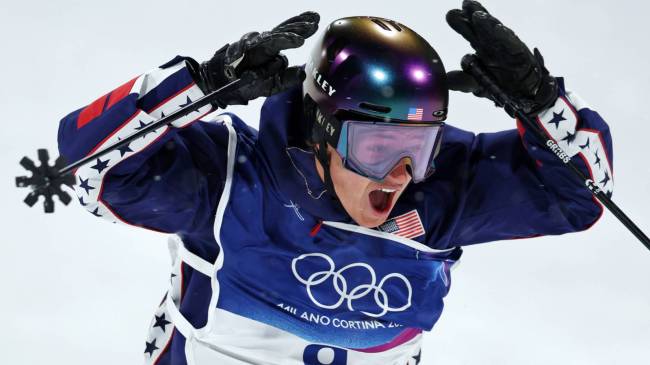
Nathan Ray Seebeck-Imagn Images
Mac Forehand seemed to be in prime position to win a gold medal in the freeski big air at the Winter Olympics after nailing a trick that had never been landed in competition. However, he had to settle for silver after his competitor answered with a move that didn’t look as difficult at first glance, and he’s pushed back against people who think the judges robbed him of the top spot on the podium.
There are a number of events at the Winter Olympics that are going to inevitably attract some controversy due to a scoring system that incorporates the opinion of human judges. That’s not an issue in sports where you’re tasked with traveling from Point A to Point B as quickly as possible (like luge and speed skating), but it’s routinely a hot topic of conversation in disciplines like figure skating and certain events under the skiing and snowboarding umbrellas.
The judges who are tasked with evaluating the tricks the competitors pull off in those competitions are obviously a bit more informed than the average observer, but it can still be difficult not to discount their opinion in situations where it looks like someone failed to get the score they appeared to deserve.
We were treated to one of those cases in the men’s freeski big air on Tuesday, but an American who many people thought was at the center of a screwjob took the high road after falling painfully short of a gold medal.
Mac Forehand doesn’t think he got robbed of the gold medal that Tormod Frostad ultimately won in the freeski big at the Winter Olympics
Anyone who watched the men’s freeski big air final unfold in Livigno on Wednesday got quite the treat, as the guy who competed pulled out all the stops during what turned out to be an absolutely electric showdown.
All three medals were still up for grabs when the final three skiers geared up for their last run, and Austria’s Matej Svancer set the tone with a 96.00 that put him in position to win a silver medal with an overall score of 191.25.
America’s Mac Forehand needed at least a 96.5 to surpass him. He not only did that but ended up with what was a record-high score of 98.25 with the left nose butter triple cork 2160 with a safety grab, a move that had never been landed in a competition, that put him in position for the gold with a total score of 193.25.
Mac Forehand dropped a stunning 98.25 in his final run to secure SILVER in snowy Livigno. 👏#WinterOlympics pic.twitter.com/BExoNDgmhu
— NBC Olympics & Paralympics (@NBCOlympics) February 17, 2026
That put plenty of pressure on Tormod Frostad of Norway, who needed a 96.5 to take the top spot after posting a 97.00 in his second run. He also ended up doing that, as he broke the record Forehand had just set with a right nose butter double bio 1620 safety that was awarded a 98.50 and a grand total of 195.50.
He needed a huge score… and he GOT IT. Norway’s Tormod Frostad delivers a 98.50 on his final run to take home the Gold. 🥇#WinterOlympics pic.twitter.com/HfUXmgK8qo
— NBC Olympics & Paralympics (@NBCOlympics) February 17, 2026
That result didn’t sit well with plenty of casual (and American) viewers who felt Forehand had at the very least outdone his opponent on the final run and possibly deserved the gold. With that said, Frostad’s trick may not have included as many rotations, but it boasted a higher level of difficulty on the technical front.
According to Yahoo Sports, Forehand went out of his way to shut down the notion he was robbed, saying:
“I’ve seen it so many times before: I got robbed, someone I beat got robbed, rob this, rob that. But we know so much about our sport. We know what scores well, what should do well. The guys that are out here tonight know what the podium is going to be at all times.
People on the outside perspective might not really understand that, but that’s just how it’s going to be. And, you know, judged sports—like I’m sure in figure skating—it’s the same way. But what do they really know about our sport?”
He went on to give Frostad props for what he was able to pull off, adding:
“He does the butter and then pushes against what his skis and body are doing —that’s why it’s so hard. It’s pushing the boundaries in a different way. It’s so cool and so unique. That’s good for our sport.”
If you’re lost in the weeds about all this talk of butter, here’s a solid explainer.
That should settle that.