


Richard Lautens/Toronto Star via Getty Images
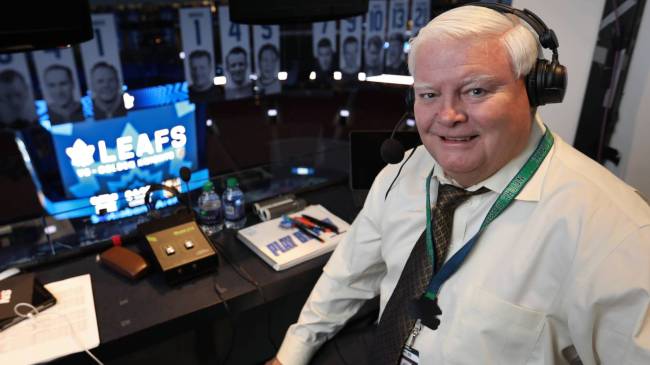
Joe Bowen has spent more than four decades doing play-by-play for the thousands of Maple Leafs games he’s covered, and he’s just a handful of contests away from a well-earned retirement. However, it sounds like there’s a chance he would have stuck around for longer if the team hadn’t decided to cheap out when it came to its approach to covering road games.
Most hockey fans who tune into an NHL game watch the action unfold on television, but there’s still a sizeable contingent of people who rely on the radio to get their fix.
Maple Leafs fans who go that route have spent the past 44 years getting the action relayed over the airwaves by Joe Bowen, who was hired to become their play-by-play guy ahead of the 1982 season.
However, with Toronto eliminated from playoff contention, next week will mark the end of an era. Last summer, Bowen announced his plans to hang up his headset upon the conclusion of the current season, and he’ll take his curtain call when the Maple Leafs face off against the Senators on April 15th.
Sinatra said it best
And now the end is near
And so I face the final curtain
My friend I’ll say it clear
I’ll state my case of which I’m certainI’ve lived a life that’s full
I traveled each and every highway
And more, much more than this
I did it my way!!
THX LEAF NATION! pic.twitter.com/70ogU4BMqX— Joe Bowen (@Bonsie1951) June 13, 2025
The 75-year-old has certainly earned the right to ride into the sunset after working more than 3,800 games, but he took a parting shot at the team’s parent company while revealing one of the factors that played a role in his decision.
Maple Leafs radio legend Joe Bowen says the team’s refusal to pay for him to travel to road games played a role in his retirement
NHL teams had to scramble to adjust to the new reality they found themselves facing when the COVID-19 pandemic derailed the season in 2020, and the vast majority of broadcasters were forced to cover games remotely as opposed to calling them while sitting high above the ice in the arenas where they were being played.
Most of the networks affiliated with those organizations eventually pivoted back to how things were, but some realized they could save some money by sticking with a formula that allowed them to avoid paying for broadcasters to travel to other cities by plopping them in front of a monitor and having them call a game as it unfolded hundreds (if not thousands) of miles away.
Many fans may not even realize that’s the case, but it’s pretty hard to argue that it doesn’t have an impact on the product. Broadcasters frequently benefit from the intel they pick up from conversations with players, coaches, and other personnel before games, and they are limited by the information and camera angles that are served to them when they’re doing things remotely.
The list of teams that are still going that route includes the Maple Leafs, who are primarily owned by Rogers Communications. The massive Canadian media conglomerate boasts a portfolio that also includes Sportsnet, which operates one of the two radio stations where Maple Leafs games are broadcast (the other, TSN, has also stuck with the remote approach; the Jets and Oilers are the only franchises in Canada that send a radio team on the road).
In 2022, Bowen voiced his displeasure with the arrangement he seemed to think would revert back to the norm at some point, saying:
“It’s not perfect, far from it, I’m somewhat embarrassed that we’re not there. But that’s the situation that it is. So we’re trying to do the best we can under what we feel are some difficult circumstances.”
That did not end up being the case, and earlier this week, he cited the penny-pinching as a reason he decided to call it quits.
Maple Leafs broadcaster Joe Bowen (@Bonsie1951) says another reason he’s retiring is the landscape of radio has changed.
“For the last 5 years we’ve had to (broadcast) road games off TV monitors. That’s not what I signed up for.” pic.twitter.com/3TeHUdlqPf
— Simon Dingley Media (@SimonDingleyTV) April 6, 2026
It’s good to know the same organization that is charging fans close to $100 to take pictures on the ice after a game has its priorities straight.