


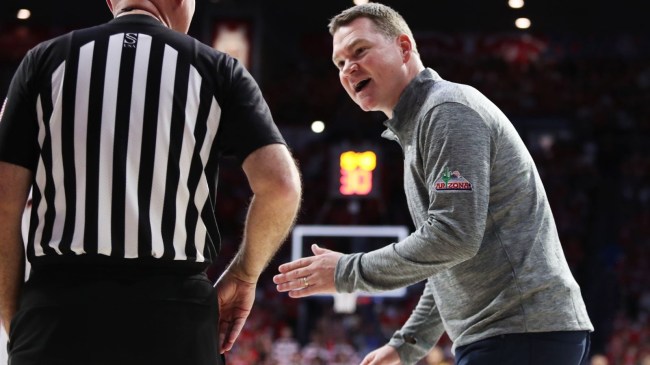
© Zachary BonDurant/Imagn
The NCAA Tournament is one of the biggest sports betting events of the year in the United States, falling only behind the Super Bowl in terms of money wagered at sports books across the country.
Unfortunately for the NCAA, given recent events, that means that the sport’s governing body has to be on its toes. Not only is the NCAA concerned about the potential for athletes betting on games, but it’s also worried about referees getting in on the action.
David Purdum of ESPN reports that the NCAA has agreed to a deal with tech company Integrity Compliance 360 to monitor the activity of referees and umpires involved with the men’s and women’s NCAA Tournaments, as well as the NCAA baseball and softball tournaments.
NCAA To Track Refs And Umpires To Ensure They’re Not Gambling On Games
The company works with sports leagues across the world by cross-checking anonymized identification data with sportsbooks to flag particular bettors.
“Implementing ProhiBet is a major step in increasing integrity protections for college sports,” NCAA managing director of enforcement Mark Hicks said. “This platform adds another layer to the NCAA’s robust integrity monitoring program as we work to keep competition integrity and student-athlete well-being paramount in a rapidly evolving sports betting environment.”
The technology is not new in college sports. In fact, the ACC agreed to a deal with the same company in June of 2024 to monitor student-athletes, coaches, and staff.
Officials, like athletes, coaches, and staff, are strictly barred from wagering on games. According to Purdum, over 220 officials, including alternates, will work the men’s and women’s basketball tournaments. Each will undergo background checks, and their names will be uploaded into the ProhiBet system. The system will then cross-check them with customer data at participating sportsbooks.
However, the NCAA did not explicitly state what the punishment would be if an official is found to have violated the pre-agreed terms.
Of course, there are always ways around these types of things, whether it’s via offshore sportsbooks or by using another person to place bets for you.
Regardless, the move shows the NCAA is hypervigilant about protecting the integrity of its events.