


iStockphoto
You need to be a pretty talented golfer to earn a spot on a college golf team, but skill only does so much when it comes to increasing your chances of getting a hole-in-one. With that said, a DIII player competing at a tournament in Georgia recently had two of them on the same hole in back-to-back rounds.
The PGA of America is responsible for overseeing the National Hole-in-One Registry that’s home to the data that helped the organization determine the average golfer has a 1-in-12,500 chance of recording an ace at some point.

There are various factors that can cause that number to increase or decrease, and skill is somewhat obviously the biggest one; the odds decrease to 1-in-5,000 if you’re a “low handicapper,” and it’s 1-in-3,000 for the guys who are talented enough to play on the PGA Tour.
Niel Phillips firmly falls under the Low Handicapper umbrella, as the sophomore at Sewanee (a.k.a. The University of the South) is a member of the school’s DIII golf team and currently boasts a handicap of +2.7 according to his GHIN profile.
Phillips recently headed down to Georgia to compete with his teammates at the Chick-fil-A Invitational at Stonebridge Golf Club at Rome, and while they didn’t come close to walking away with a win, he did manage to get the achievement of a lifetime thanks to the wildly unlikely feat he was responsible for on the first day of play.
Sewanee golfer Niel Phillips had two holes in ones on the same hole in the same day
The Chick-fil-A Invitational harnesses a shotgun start that resulted in Phillips kicking off his first round on Monday on the par-3 eighth that was playing 182 yards, and he kicked off the tournament with a bang after pulling out a six iron for the shot that made its way into the hole for the ace.
The New Orleans native ended up finishing at even par after wrapping up his first 18 holes in the morning, and he opted for a 7-iron when he returned to the 8th to start the second round that afternoon—a decision that worked out pretty well for him when you consider he recorded another hole-in-one en route to posting a score of -1.
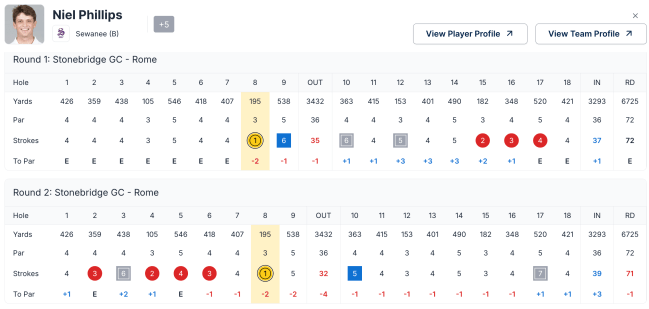
The PGA of America says the odds of a golfer getting two holes-in-one in the same round sit at 1-in-67 million, and while he technically did it in back-to-back ones, it’s safe to assume the chances of what he did are similarly astronomical.
Must be nice.