


Getty Image
While the Tour de France is, by far, the most famous cycling race in the world, the most famous one-day race is the famed classic Paris-Roubaix.
Ridden since 1896, Paris-Roubaix is the second-oldest of the cycling “monuments,” five one-day races that are the crown jewels of the yearly calendar.
The brutal race, nicknamed “The Hell of the North,” takes riders over 250 kilometers (around 160 miles) from Paris to the iconic Roubaix Velodrome, which has hosted the finish to the race since 1943.
It traverses several cobbled roads and dirt sectors that take not only skill, but also plenty of grit for riders to complete, let alone.
But they also have a secret weapon.
Meet The Goats Of Paris-Roubaix
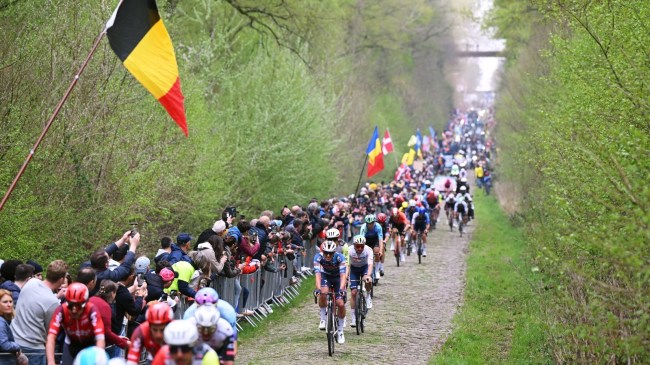
The most famous paved sector of the race takes riders through the Trouée d’Arenberg, a 2.3-kilometer-long cobbled road through the Arenberg forest. Not only is it one of the longest cobbled sectors of the race, but it’s also one of the most uneven and dangerous for riders.
Because of the race’s history, the finicky nature of taking care of the course, a volunteer group named Les Amis des Paris-Roubaix (The Friends of Paris-Roubaix) is entrusted with taking care of not only the Arenberg sector, but all the cobbled sectors in the race.
But they also have some help.
The queens are back 🐐
📍 Trouée d’Arenberg pic.twitter.com/qEcu078kj7— Les Amis de Paris-Roubaix (@A_ParisRoubaix) March 27, 2026
Because the Trouée d’Arenberg literally splits a large forest, it’s prone to grass and weeds growing up through the cobbles. These often slippery, slimy weeds are dangerous to riders.
But rather than clearing them by hand or using pesticides that could damage the forest around the road, they call in a little help from some animal friends. More specifically, herds of goats.
Weeks before the race starts, Les Mis des Paris-Roubaix bring in goats, place them inside a temporarily fenced-in area, and allow them to graze on all grass, weeds, and vegetation up and down the road.
The goats are happy and well fed, the path is cleared, and the riders are safe. It’s truly a win-win-win. But even given the practical nature of it all, it’s still a hilarious sight to see.