


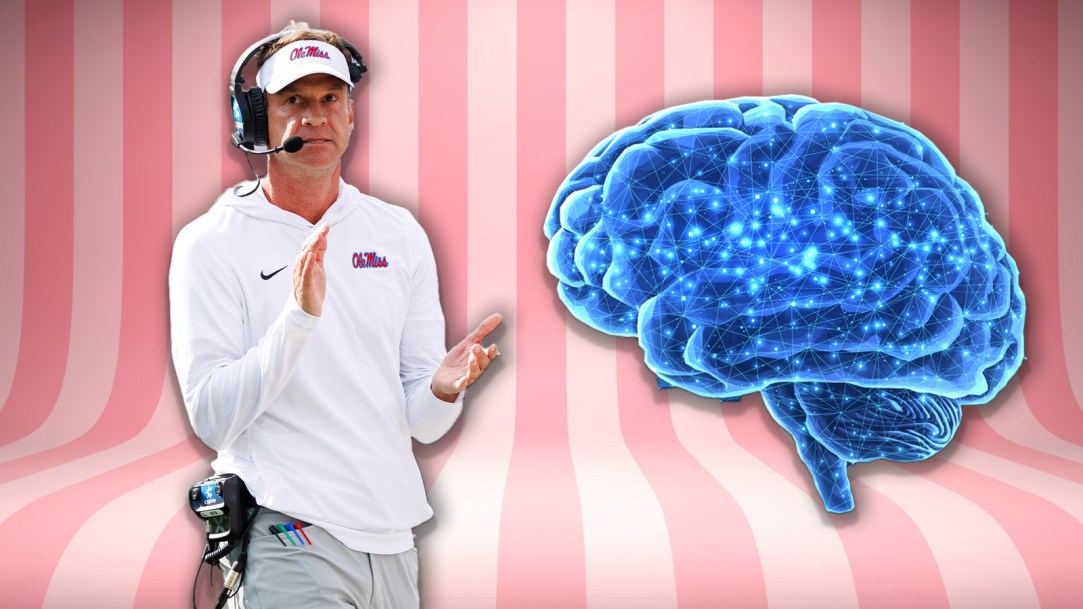
Ole Miss painted its visitor’s locker room with a very specific shade of pink to create a psychological advantage over its college football opponents. The goal is to lull them to sleep.
Iowa did it first!
This unique look is based entirely on a study from the 1960s. It made its way to college football for the first time in the late 1970s.
Ole Miss painted its visitor’s locker room pink.
Some of the most important games in college football take place in Oxford, Mississippi. Lane Kiffin completely transformed the program over the last six years.
Although the Rebels were not a perennial basement dweller, per say, they were not expected to win 10 games every season. Eight wins was a solid year. Not anymore!
Kiffin wants to compete for national titles.
As a result, it is not uncommon for top-25 games to be played at Vaught-Hemingway Stadium. No. 3 LSU will be in the Dirty ‘Sip this weekend!
Upon arrival, the Tigers — or any visiting team — are greeted by a monotonous shade of pink. The entire locker room (which is already small and minimalistic to begin with) is painted with a very specific shade of pink. Every wall. Every door. Everything. Every inch.
The away locker room at Ole Miss is true home field advantage pic.twitter.com/A2UAJnV6nZ
— Snapback Sports (@snapback_sports) September 20, 2025
This is new to the Kiffin era. The visitor’s locker room was repainted at some point over the last six years, if not even more recently.
It creates a psychological advantage, just ask Iowa.
The pink locker room was actually the brainchild of legendary Iowa Hawkeyes football coach Hayden Fry. Fry graduated from Baylor University with a degree in psychology before he got into coaching.
He, at some point, read a study about the color pink and how it can have a calming effect on people.
Thus, upon arrival to campus in 1979, Fry called for the visitor’s locker room at Kinnick Stadium to be painted pink. And not just any pink… Baker-Miller Pink, which is also known as P-618, Schauss pink or drunk tank pink.
This very specific shade of pink, #FF91AF, was studied extensively in the late 1960s. The studies proved how Baker-Miller Pink temporarily reduces hostile, violent and/or aggressive behavior.
Alexander Schauss found that by merely staring at an index card printed with this P-618 color results in a “marked effect on lowering the heart rate, pulse and respiration as compared to other colors.” Especially before and after exercise.
He later convinced a correctional facility to paint the interior of its confinement cells with this specific shade of pink. Erratic and hostile behavior instantly plummeted after just 15 minutes of exposure.
Fry took that proven science to college football and the visitor’s locker room at Kinnick Stadium. Lane Kiffin took that proven science to the visitor’s locker room at Vaught-Hemingway Stadium.