


Malcolm Emmons-Imagn Images
The Heisman trophy is the most prestigious award in college football. Handed out annually, it rewards production to recognize the sport’s best player.
The first Heisman winner was named in 1935. There are only 89 players in NCAA history to take home the trophy. Just one player, Archie Griffin, has won the award twice.
Each season, the Heisman ceremony takes place in New York City. Three players are invited, but only one can leave with the honor.
Players with the most Heisman runner-up finishes.
There are 14 players that have finished either second or third in the Heisman voting on multiple occasions. Some have gone onto eventually win the award in a third season while others were left trophy-less.
Let’s take a look at each starting with a player that was a finalist two different times while starring at Pitt.
Marshall Goldberg
Goldberg was a running back for the Pitt Panthers in the late 1930s. In 1937, he ran for 701 yards 115 carries. He scored five touchdowns in nine games.
The Panthers went 9-0-1 and finished 1st in the final AP Poll. Goldberg finished third in the Heisman voting behind Clinton Frank and Bryon White.
The next year, his rushing total dipped to 375 yards. His Heisman standing, however, was elevated to second as he lost out narrowly to Davey O’Brien.
He’d go onto become a second-round draft pick after the 1938 season.
Glenn Davis
Davis was a Heisman finalist three different times as a running back at Army. He twice finished runner-up before winning the award in his final season.
Davis totaled 888 yards rushing and receiving in 1944 to lead the Black Knights to a perfect 9-0 mark. He finished second in the Heisman voting to Les Horvath.
The following year, he posted a career-best 1,143 yards from scrimmage to go along with 17 touchdowns. It still wasn’t enough to earn him the award. Davis finished second to teammate Doc Blanchard before finally breaking through in 1946.
His final season at West Point ended with another 1,000-yard season and a Heisman trophy. He squeaked by Georgia’s Charley Trippi to win.
Davis never lost a game at Army. His teams went 27-0-1 while winning two national championships.
Doak Walker
Walker, like Glenn Davis, was a three-time Heisman trophy finalist. At SMU, he had two runner-up finishes sandwiched around a Heisman win.
In 1947, Walker was a third-place finisher, losing out to winner John Lujack of Notre Dame. The next year, he won the award in a do-it-all season.
The running back ran for 532 yards, racked up 277 receiving yards, and threw for 304 yards. He totaled 17 touchdowns in a 9-win campaign.
In 1949, Walker finished third again behind Notre Dame’s Leon Hart and the next player on our list.
Charlie Justice
Justice was the second-place finisher in back-to-back seasons for the University of North Carolina. He remains the highest vote getter in program history.
In 1948, the running back was a consensus All-American while leading the Tar Heels to a 9-1-1 season. They went undefeated in the Southern Conference to earn a spot in the Cotton Bowl.
Justice finished second behind previously mentioned Doak Walker. The following year, he bested Walker in votes but finished behind Heisman winner Leon Hart. As a consolation, Justice did get a conference championship ring.
Paul Giel
The Minnesota running back was the third-place vote getter in 1952 after a strong season in Minneapolis. He finished behind both Maryland QB Jack Scarbath and Heisman winner Billy Vessels of Oklahoma.
The next year, Giel was a consensus All-American. He received more Heisman hype, but ultimately finished second to Notre Dame’s John Lattner.
Despite Giel’s performance, the Golden Gophers were relatively average as a program. His teams finished with a combined record of 8-7-3 in his two stellar seasons.
Leroy Keyes
Keyes was a star running back at Purdue in the 1960s. He twice was a finalist for the Heisman trophy, and twice, he fell short.
The Boilermaker burst onto the scene in 1967 totaling 1,744 yards from scrimmage. He led the Big Ten in rushing scores, total touchdowns, and receiving yards.
Despite the production, Keyes finished third in the voting behind OJ Simpson and Gary Beban of UCLA. The next year, his production dipped, but the Heisman hype remained.
Keyes ran for 1,000 yards to finish second behind Simpson in the ’68 voting.
Greg Pruitt
Pruitt posted huge numbers as a running back at Oklahoma in the 1970s. In his 1971 campaign, he led the Big 8 in rushing with 1,665 yards and touchdowns at 17 while guiding the Sooners to a 2nd place finish in the AP Poll.
As a result, he finished third in the Heisman voting to Pat Sullivan of Auburn and Ed Marinaro of Pitt.
The following year, he again led the conference in rushing scores and again, the Sooners finished at No. 2 in the final AP Poll. Pruitt received the second-most votes behind Nebraska’s Johnny Rodgers.
Ricky Bell
Bell suited up in the backfield for the USC Trojans between 1974 and 1976. He twice received Heisman recognition only to finish second and third.
In 1975, Bell led the PAC-8 in carries and rushing yards while helping USC win eight games. He finished third in the voting behind Chuck Muncie and two-time Heisman winner Archie Griffin.
The following season, Bell racked up a league-high 14 rushing scores while posting a 1,400-yard campaign. The Trojans won 11 games to finish No. 2 in the AP Poll. Their running back was the runner-up to Tony Dorsett in the Heisman race.
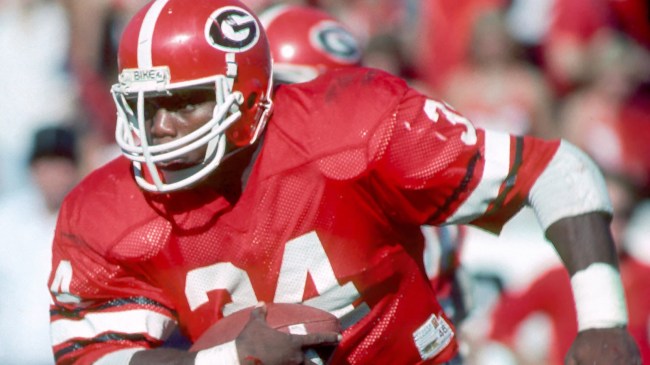
Herschel Walker
Walker is one of three players on this list to own three Heisman invites. He lost out on two occasions before winning the award in his final season.
At Georgia, the running back was an immediate star. He is considered one of the best players in college football history – and for good reason!
As a freshman, he set an NCAA rookie record with 1,616 yards to help the Bulldogs win a national title. The following year, he bested that total with a career-best 1,891 yards.
He lost out on the 1980 Heisman to South Carolina’s George Rogers, finishing third in the race. He finished second in 1981 to Marcus Allen.
Walker finally broke through as a junior, racking up a third straight 1,600-yard season while adding 16 touchdowns. He led the SEC in touches, rushing yards, and scores each of his three college seasons.
Robbie Bosco
Bosco twice finished as a top three Heisman trophy finisher, but he never secured the honor. In both instances, he got the third-most votes.
In 1984, the BYU quarterback lost out to Doug Flutie while also finishing behind Keith Byars. The next season, he watched Bo Jackson win the award while also finishing behind Chuck Long.
Bosco paced the nation in passing yards and touchdowns both of those seasons. He led the Cougars to their only national title in ’84.
He also became the fourth BYU passer in a six-year span to finish as a Heisman runner-up.
Darren McFadden
McFadden was part of a three-headed Arkansas rushing attack that also featured Felix Jones and Peyton Hillis. He gained the most attention of the ball carriers thanks to a pair of incredible seasons.
In 2006, McFadden ran for 1,647 yards and 14 scores, both of which led the SEC. He would finish second to Ohio State’s Troy Smith in the Heisman race while leading the Razorbacks to their third conference title game.
The next year, he bested those numbers with an 1,830-yard season rushing output and career-high 17 touchdowns. He again finished second in Heisman voting, this time to Tim Tebow.
Colt McCoy
The year after McFadden’s two-year run, Colt McCoy received back-to-back Heisman trophy ceremony invites. Like the player mentioned before him on this list, he was unable to win the award.
The Texas quarterback finished second in the voting as a junior, losing out to Sam Bradford of rival Oklahoma. He posted career-best totals in passing yards and touchdowns while leading the nation in completion percentage.
The next season, he finished third in the Heisman trophy race behind a pair of running backs in Mark Ingram and Toby Gerhart. McCoy led the Longhorns to a national championship appearance as a senior but lost to Alabama to finish 13-1.
Andrew Luck
Before Luck was the No. 1 overall NFL Draft pick, he spent three seasons under center at Stanford. In two of those campaigns, he finished as a Heisman runner-up.
Luck guided the Cardinal to a 12-1 season as a sophomore, throwing for a PAC 12 high 3,338 yards and 32 touchdowns. The output was nearly good enough to win the Heisman. Unfortunately, there was one player better.
Cam Newton’s championship season at Auburn proved more impactful. Luck would later best his numbers as a junior but would again finish second in the voting to Robert Griffin III.
Deshaun Watson
Watson spent three seasons at Clemson, leading the Tigers to a national title in 2016. The year before that championship run, he became a household name.
The passer threw for 4,104 yards as a sophomore along with 35 touchdowns. Both totals led the ACC. Despite the production, he finished third in the voting behind running backs Derrick Henry and Christian McCaffrey.
The next season, he was even better. He again led the conference in passing and scores in a 4,500-yard campaign. He fell, however, to league rival Lamar Jackson in the 2016 race.
While he wouldn’t land the Heisman hardware, he would go on to become a first round NFL Draft pick after his title win.