


© Petre Thomas-Imagn Images
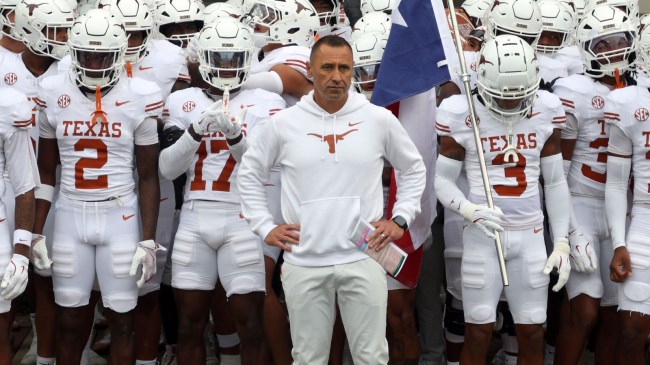
Steve Sarkisian is not thrilled with scheduling discrepancies seen within the SEC. He believes his Texas football team is at a disadvantage.
The Longhorns‘ slate is not the same as other league rivals, including Texas A&M. Sarkisian would prefer more continuity.
That opinion, however, contradicted previous opinion. Just last year, he was heard commenting on this very issue, voicing his preference for Texas’s unique setup.
His change of tune has many talking.
Texas does not play a non-conference football opponent in November.
Many others in the SEC do. It’s become a running joke amongst SEC haters. All too often, conference members play buy games the week before the season finale. This year is no different.
Below is a glimpse at a few games from the Week 13 slate.
Alabama vs. Eastern Illinois
Auburn vs. Mercer
Georgia vs. Charlotte
LSU vs. Western Kentucky
South Carolina vs. Coastal Carolina
Texas A&M vs. Samford
Others have weak non-conference November foes, too. Ole Miss beat The Citadel last week. Tennessee faces New Mexico State this coming Saturday.
Texas does not enjoy that luxury. The front of the Longhorns’ schedule was loaded with non-conference opponents. Their last eight games are against teams from the SEC.
Steve Sarkisian believes it puts his team at a disadvantage. There are a few reasons as to why.
“No, I am not comfortable. I don’t think there’s enough continuity from a scheduling standpoint in the SEC… I just think there’s some distinct advantages that some people have, where they spread out their nonconference games throughout the season.
“They play nonconference games the second-to-last game of the season, and we’re playing all of ours in the front end. They’re playing conference games earlier in the year, when their team’s 100% healthy. And so, I don’t love our schedule.”
-Steve Sarkisian
The late non-conference game is beneficial for two reasons. One, it gives teams an opportunity to start the SEC slate earlier while healthy. Teams are more likely to be banged up in Week 13 than Week 3.
Secondly, it provides an opportunity for extra preparation.
In the case of Texas, it will have to focus on Arkansas before playing Texas A&M to end the year. The Aggies, meanwhile, get two weeks to gameplan for the Longhorns while having an essential bye week to rest star players in what should be a blowout.
That undoubtedly plays in Texas A&M’s favor.
Steve Sarkisian liked his schedule last year…
The Texas football coach makes a point in his argument. There’s no secret the November buy games are strategically scheduled.
Unfortunately, he contradicted himself. Last September, he said he preferred to play his non-conference games early.
“I know there’s some rationale to why you have that nonconference game late in the year, but I’ve lived that life where that nonconference late in the year sometimes is like pulling teeth with your players in November, and the game’s always closer than everybody wants it to be, and everybody’s kind of kicking the tires a little bit because it didn’t go the way they wanted.
“I’m more for the mindset of, ‘Play these four (nonconference games) early.’ You can play a lot of players, you can get a lot of development done with a lot of your newcomers on your roster to get them ready for what I would call the regular season, which is conference play.”
-Steve Sarkisian
There are pros and cons to both sides. Starting the season with non-conference opponents can allow a team to shake off the rust before entering the SEC race.
Texas certainly needed the extra time this fall as its quarterback struggled with the likes of UTEP and San Jose State before losing the SEC opener to Florida.
Sarkisian already mentioned the downside relating to the conference grind. In reality, every season plays out differently.
Things happen each week that impact games – for example, John Mateer’s injury in a September matchup with Auburn which had direct impacts on Texas’s Red River Rivalry win. Oklahoma started its SEC schedule two weeks before Texas.
In the end, the schedule is the schedule. Texas liked the hand it was dealt in 2024. It doesn’t in 2025.