


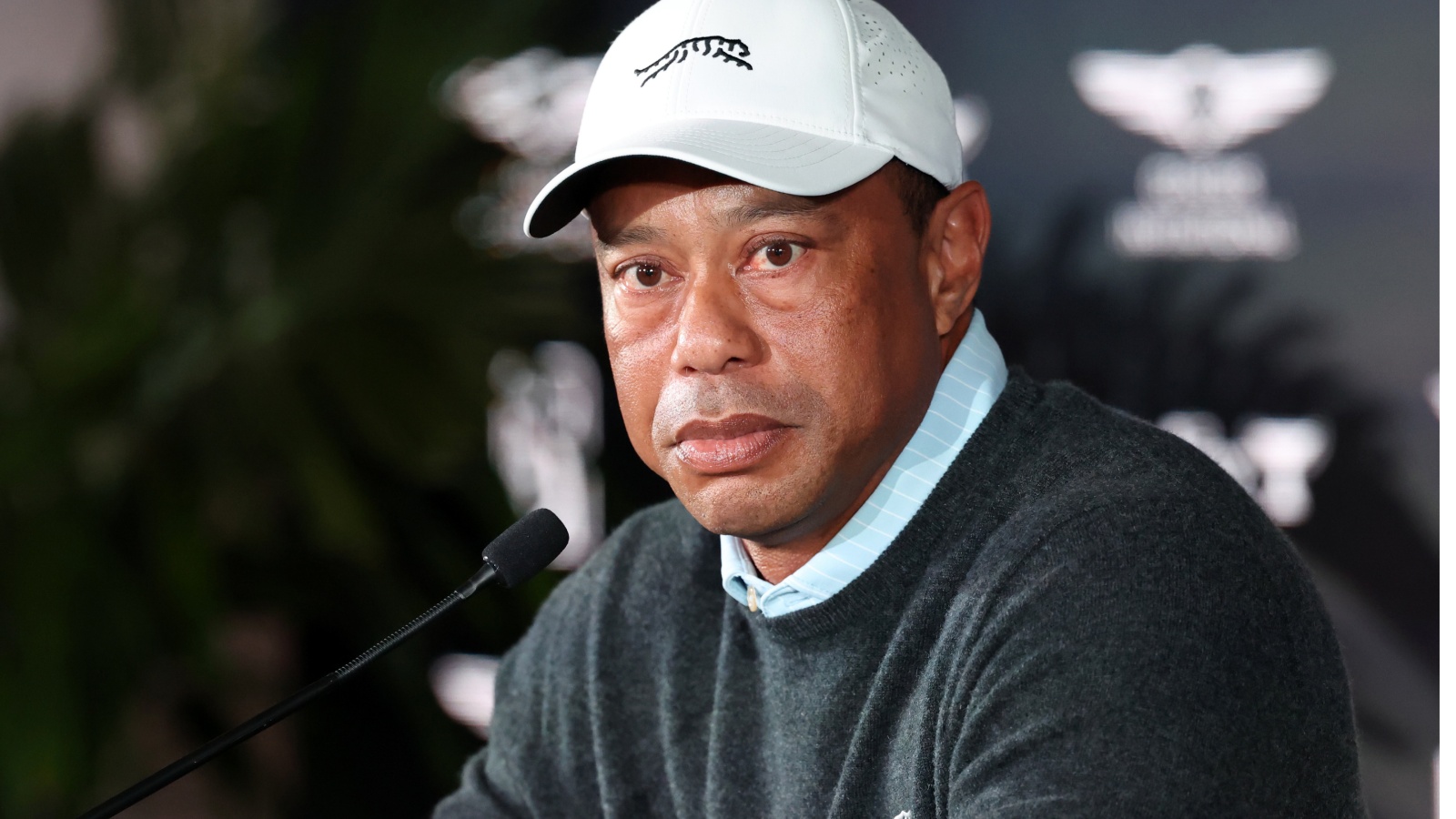
© Kiyoshi Mio-Imagn Images
A South Florida lawyer has broken down the Tiger Woods case.
On Friday, Woods flipped over his car and was arrested after failing several field sobriety tests, even though he tested 0.0 percent for alcohol in a breathalyzer. After being brought into the police station, Woods refused to take a urinalysis test, and held for eight hours in jail.
Via TMZ
Deputies quickly observed Tiger appeared impaired and lethargic. They conducted an alcohol test and it registered 0.00%. Sheriff John Budensiek said, during the news conference, he believes Tiger was not under the influence of alcohol, but rather medication.
Tiger was placed under arrest and taken to the station, where he refused a urine test. He was booked on DUI and refusal to submit to the urinalysis.
The driver of the pickup truck tried to turn into a driveway. Still, the Range Rover was going at such a high speed that the pickup truck could not fully enter the driveway, and Tiger clipped that vehicle, causing the Range Rover to flip over on the driver’s side.
Martin County Sheriff’s Office John Budensiek says Tiger Woods did “exemplify signs of impairment” and was placed under arrest at Martin County jail. Been charged with DUI with property damage.
— Adam Stanley (@adam_stanley) March 27, 2026
Tarlika Nunez-Navarro, a former Florida judge and the dean and professor of Law at St. Thomas University in Miami Gardens, spoke to WBPF News, and she believes the prosecution will have a tough time proving a DUI charge against Woods because they have no definitive proof he was impaired.
“Florida DUI law requires proof of impairment — not just signs of impairment. Without a urine test, there is no chemical evidence of what substance was in his system or at what level. The prosecution will have to rely entirely on the officer’s observations — lethargic appearance, field sobriety test performance — and Woods’ lawyers will counter every single one of those observations with his documented medical history.”
Nunez-Navarro also notes that the police may have made a mistake by holding Woods in jail for eight hours.
“Florida law requires that a DUI suspect be held for eight hours OR until they register under 0.05 on a breathalyzer — whichever comes first. Woods blew 0.00. He should have been released within hours, not held the full eight hours. His lawyers may file a motion challenging the lawfulness of the detention itself. If the detention was unlawful, anything that happened during that time — statements, observations — could be suppressed.”
She goes on to say Woods’ refusal to take the urine test “carries less weight than a positive drug test.”
“Refusing a urine test in Florida triggers an automatic one-year license suspension and a separate criminal charge. But — it may have been the strategically correct decision. If Woods had taken the test and it showed prescription medication at therapeutic levels, prosecutors could still argue impairment. By refusing, his lawyers created reasonable doubt on the substance question entirely. The refusal charge carries less weight than a positive drug test in a DUI conviction.”
Nunez-Navarro believes a plea deal for Woods is possible, similar to 2017, when his DUI charge was reduced to reckless driving.