


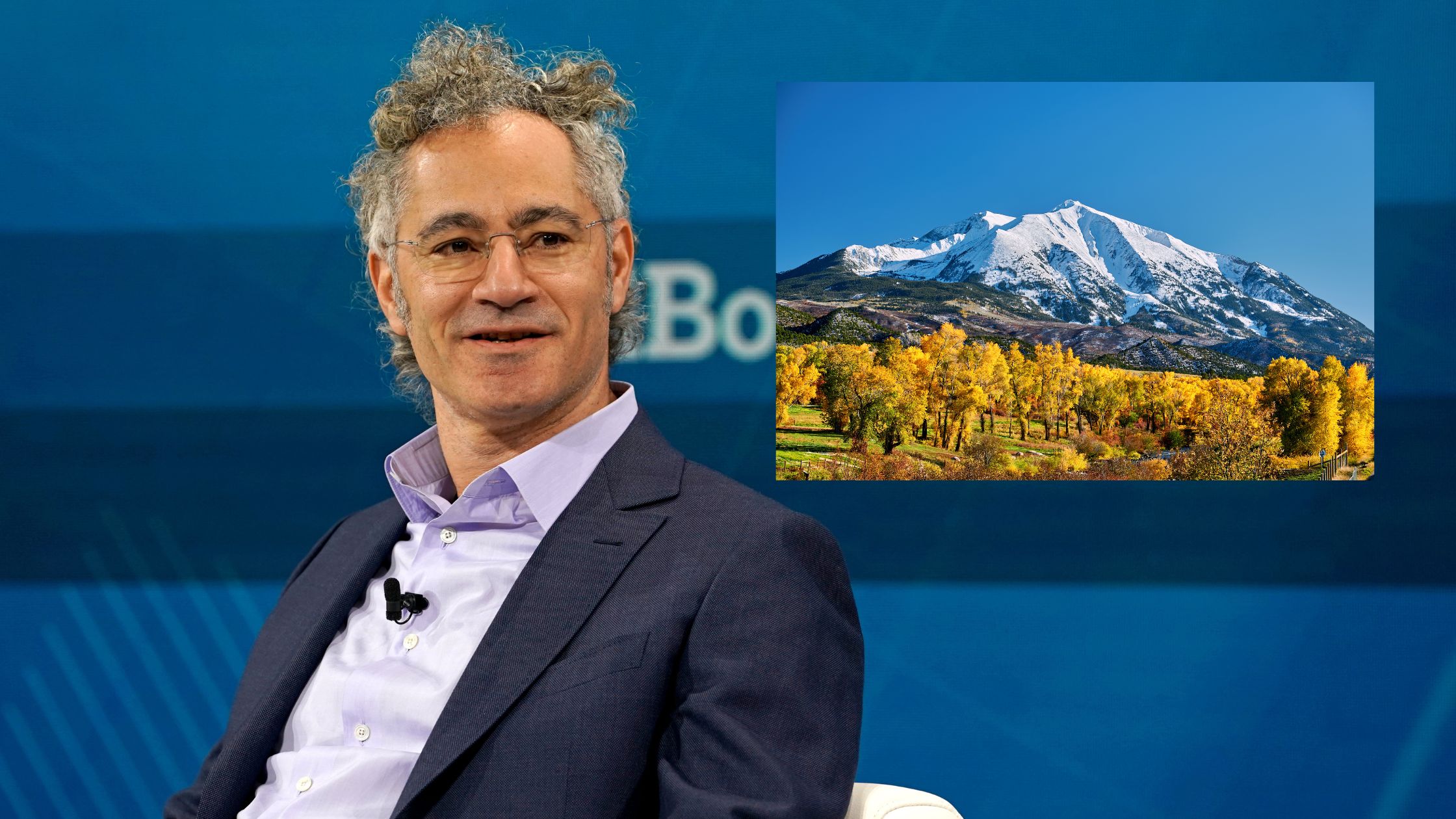
via Getty Images / Canva
In what might be the most “Main Character Energy” move of 2025, Alex Karp, the eccentric and ski-obsessed CEO of data giant Palantir, has just purchased St. Benedict’s Monastery in Snowmass, Colorado. The reported price tag is a cool $120 million.
According to reporting from the Wall Street Journal, this sale is a record-breaker for Colorado’s Pitkin County, home to Aspen, which is already home to some of the most expensive real estate transactions in North America. While the deal was technically closed by a limited liability company called “Espen LLC,” sources confirmed to the Journal that the buyer is indeed Karp, who plans to use the 3,700-acre ranch as a private home.
A previous attempt to buy the monastery fell through back in June 2025.
Karp joins a neighborhood roster that reads like a Davos guest list, including Jeff Bezos, Michael Dell, the Walton family, and billionaire hedge fund titans John Paulson and Ken Griffin. Russian oligarch Roman Abramovich’s Wildcat Ranch property, worth an estimated $50 million in 2022, is also nearby in Snowmass. Then there’s oil tycoon Bill Koch, who listed his nearby 52-acre Elk Mountain Lodge compound for a staggering $125 million earlier this year. The list of neighbors is truly dizzying, featuring everyone from Starbucks tycoon Howard Schultz and Victoria’s Secret billionaire Leslie Wexner to the Crown family, heirs to the General Dynamics fortune, who literally own the mountains Karp skis on (via their ownership of the Aspen Skiing Company).
For a guy worth an estimated $18 billion who co-founded a company named after the all-seeing “Palantir” stones from Lord of the Rings, buying a literal sanctuary for silent monks is poetic, ironic, and absolute peak Aspen all at once.
I speak with some authority here because I used to live this beat. Back in the day, before BroBible fully launched, I lived at Hunter S. Thompson’s legendary Owl Farm and blogged for Aspen.com. I spent half a year chronicling the unique ecosystem of the Roaring Fork Valley. In addition to being breathtakingly beautiful and having some of the best skiing in the world (which I love), there is nowhere like it in America. It’s a place where, as the locals say, “the billionaires push out the millionaires.”
I got to tour some incredible trophy properties in that gig, and I thought I’d seen the absolute peak of capitalist flexing. Karp taking over a 70-year-old monastery blows my mind. The valley longtimers always whispered about St. Benedict’s with a spiritual reverence, specifically because it stood apart from the real estate feeding frenzy that drove the local economy. It’s a popular place for cyclists to ride a bike to in the summer. Check out how it’s tagged on Instagram.
Seeing it acquired as a private compound feels like a definitive mile marker for the stage of capitalism we’re in now. It is a level of “Main Character” behavior that even the wildest Aspen lore couldn’t have predicted.
Here is everything you need to know about the sale, the sacred ground, and why this is the craziest real estate transaction of the year
The Real Estate Flex
Let’s talk stats. For $120 million, Karp bypassed the standard McMansion glass-and-steel ski chalet entirely.
He’s basically acquiring a spiritual fortress with deep roots in the history and development of Colorado’s Roaring Fork Valley. You can actually get a pretty good sense of the property by checking out the St. Benedict Monastery’s website:
- 3,700 acres in Old Snowmass, just 30 minutes from downtown Aspen.
- A 24,000-square-foot main monastery (built in the 1950s), a 6,000-square-foot retreat center, and a handful of cabins.
- Arched windows, peaked cupolas, and views of Mt. Sopris that would make a grown man cry.
It’s a spectacular property with deep lore in the Rockies. Here’s a video tour from the original real estate listing.
According to Kaya Williams’ excellent reporting at Aspen Journalism, the property was listed for $150 million last year, so Karp saved himself $20 million on the deal. The monastery has been the home of the Order of Cistercians of the Strict Observance (Trappist monks) for roughly 70 years. But with the order aging and numbers dwindling. Only about five monks still live there, and it’s presumably quite expensive and difficult to maintain such a massive property in the Rockies, so they decided it was time to sell.
The listing agent, Ken Mirr, told the WSJ they were looking for someone who “prized it for what it is.” Apparently, that person is the guy who builds the software used by the U.S. military and intelligence agencies.
The “Crazy” Doctrinal Context
To really understand the flex here, you have to understand what this place was before it became the ultimate tech mogul ski crash pad.
I dug into the monastery’s archives and found a pamphlet titled “Come to the Mountain,” featuring text by the legendary monk and writer Thomas Merton. You can read it here as a PDF.
It outlines the specific doctrines of the monks who lived here, and reading it against the context of a Tech CEO buyer is wild.
The “Anti-World” Doctrine
Palantir is a company deeply embedded in the geopolitical gears of the world. But St. Benedict’s was built on the exact opposite premise.
“The monastery is so radically different from the ‘world!’… The monk is valuable to the world precisely in so far as he is not part of it.” — Come to the Mountain
Karp is now the landlord of a property designed specifically to be “useless” to modern society. As Merton wrote, the monastery’s apparent pointlessness “is exactly what gives it a real reason for existing.”
The Mystery of Silence
Trappist monks are famous for their vow of silence. The monastery was engineered for “Monastic Silence,” which Merton described as extending beyond the simple act of ‘not talking.’ It is a deep, structural separation from noise.
“In a world of noise, confusion and conflict it is necessary that there be places of silence… Silence is the mystery of the world to come.” — Come to the Mountain
Now, the property belongs to a tech titan whose industry is often blamed for the noise, confusion, and “conflict” of the modern information age. Whether that’s a fair assessment or not is up to debate, depending on what your opinions of Palantir are. The irony of the Palantir chief owning the House of Silence is thick enough to cut with a ski edge.
The “Life Long Exile”
The monks didn’t view this land as real estate; they viewed it as a final destination.
“When someone enters St. Benedict’s Monastery at Snowmass, he intends to live and die in this one mountain valley.” — Thomas Merton
And they meant it. The Aspen Daily News reports that the sale includes a special easement allowing the monks (and families of the deceased) to visit the on-site cemetery. Buried there are spiritual heavyweights like Father Thomas Keating, a giant in the world of contemplative prayer. So, while Karp owns the dirt, the spiritual tenants are there to stay.
Why Karp?
At first glance, a tech billionaire buying a monastery sounds like the setup to a bad joke. But for Alex Karp, 3,700 acres of consecrated ground transcends the typical billionaire flex. It is a lifestyle necessity.
First, there’s the skiing. The WSJ calls him an “avid skier,” but that’s an understatement. According to Fortune, Karp is an absolute machine who skis five hours a day, often cross-country, and maintains a shredded 7% body fat (statistically identical to peak Michael Phelps). He famously recorded a 2021 holiday greeting decked out in ski gear on the slopes and claims his secret is to “run like a deer” by training at a snail’s pace for 90% of the time. With Snowmass boasting the second-largest skiable terrain in Colorado, he now has the ultimate private backyard to clock his miles.
Then there’s the need for isolation. When you run a data analytics firm deeply entwined with the CIA and the Pentagon, “privacy” takes on a heavier meaning. A property defined by its separation from the world, literally built for men sworn to silence and seclusion, is the ultimate fortress for a man whose business relies on government secrets.
The “Philosopher-King” of Silicon Valley
Beyond the logistics, this purchase cements Karp’s status as the industry’s most fascinating outlier. Far removed from the typical Patagonia-vest-wearing tech bro, he is a philosopher-king with Einstein hair and a backstory that reads like a screenplay. Born in New York City and raised by activist parents in Philadelphia, he met co-founder Peter Thiel at Stanford Law, where the self-described “crazy leftist” and the libertarian Thiel argued like “feral animals,” according to the New York Times.
His eccentricities are legendary. He literally can’t drive, claiming he’s too rich and afraid he’ll zone out dreaming at the wheel. He teaches meditation to his employees, practices Qigong, and openly admits, “I don’t fit in.”
Recently, he leaned into a recent PR disaster where a fidgety interview sparked rumors about his energy levels; Palantir’s official account tweeted a video of him squirming with a caption about “cross-country skiing,” a cheeky nod to internet slang for Bolivian marching powder, and announced a “Neurodivergent Fellowship” for talent that “thinks faster than they can speak.” The company says its already received over 2000 applications.
But his most defining trait is his bombastic honesty. While other defense moguls hide behind sanitized PR-speak, Karp argues that legalizing controversial military actions like war crimes would be good for business because it drives demand for precision technology. He quotes political scientist Samuel Huntington to shareholders, reminding them that Western dominance is built on “superiority in applying organized violence.” For a man who named his company after a Lord of the Rings seeing-stone and trolls his own critics, taking over a monastery feels less like a pivot and more like the only logical next step.
A funny thought…
While Karp is measuring the walls for his ski racks, I can’t stop thinking about the other side of this transaction. There are five elderly Trappist monks who just liquidated their assets for $120 million. When the news broke, I jokingly posted on X that we “Need a reality show about the Snowmass monks going to Las Vegas after selling their monastery for $120m to Palantir CEO Alex Karp.”
The pitch writes itself. Imagine five guys who have taken a vow of silence hitting the High Limit room at the Bellagio. Think: The Hangover meets Into Great Silence.
In reality, the money will likely go toward supporting the Order of Cistercians’ other monasteries or charitable causes (boring, I know). But for now, let’s just imagine Brother Thomas throwing down a stack of chips at the roulette table, breaking 40 years of silence just to yell, “Red 23, baby! Daddy needs a new pair of sandals!”
The End of an Era
The Aspen Times reports that the final public Mass will be held on January 11, 2025. After that, the “sacred valley” becomes private property.
For 70 years, men came to this valley to, as Merton put it, “surrender our lives into the hands of God and never take them back.”
Now, the keys are being surrendered to the hands of Espen LLC.
I know a certain kind of person will be enraged by all this, crying foul about wealth inequality between sips of a $10 matcha. If I’m being brutally honest, these are the kinds of stories that make me cackle. On one hand, it rocks that Karp gets to live out his eccentric dreams with such a splashy purchase. That is the American Dream in action. If you hit the jackpot in life with the serendipity of your vision, hard work, and luck, it’s a waste of a dream if you don’t manifest what you really want in life into action.
In Aspen, everyone is continually trying to “manifest” something, like a powder day or a primetime reservation at Matsuhisa. Karp just operated on a higher frequency. To have $18 billion and not use it to turn a monastery into the ultimate ski bum hideout would be a waste of a dream.
It’s such a classic Aspen story: A place built for poverty, silence, and prayer becomes the crown jewel of a multi-billion-dollar tech fortune.
You couldn’t write a better script.
Note: If you enjoyed reading this, subscribe to my Substack, The Wenerd Weekly, for more thoughts on 15+ years of BroBible, culture, and lots of Phish and Grateful Dead jam band references. Or drop me an email at brandon@brobible.com