


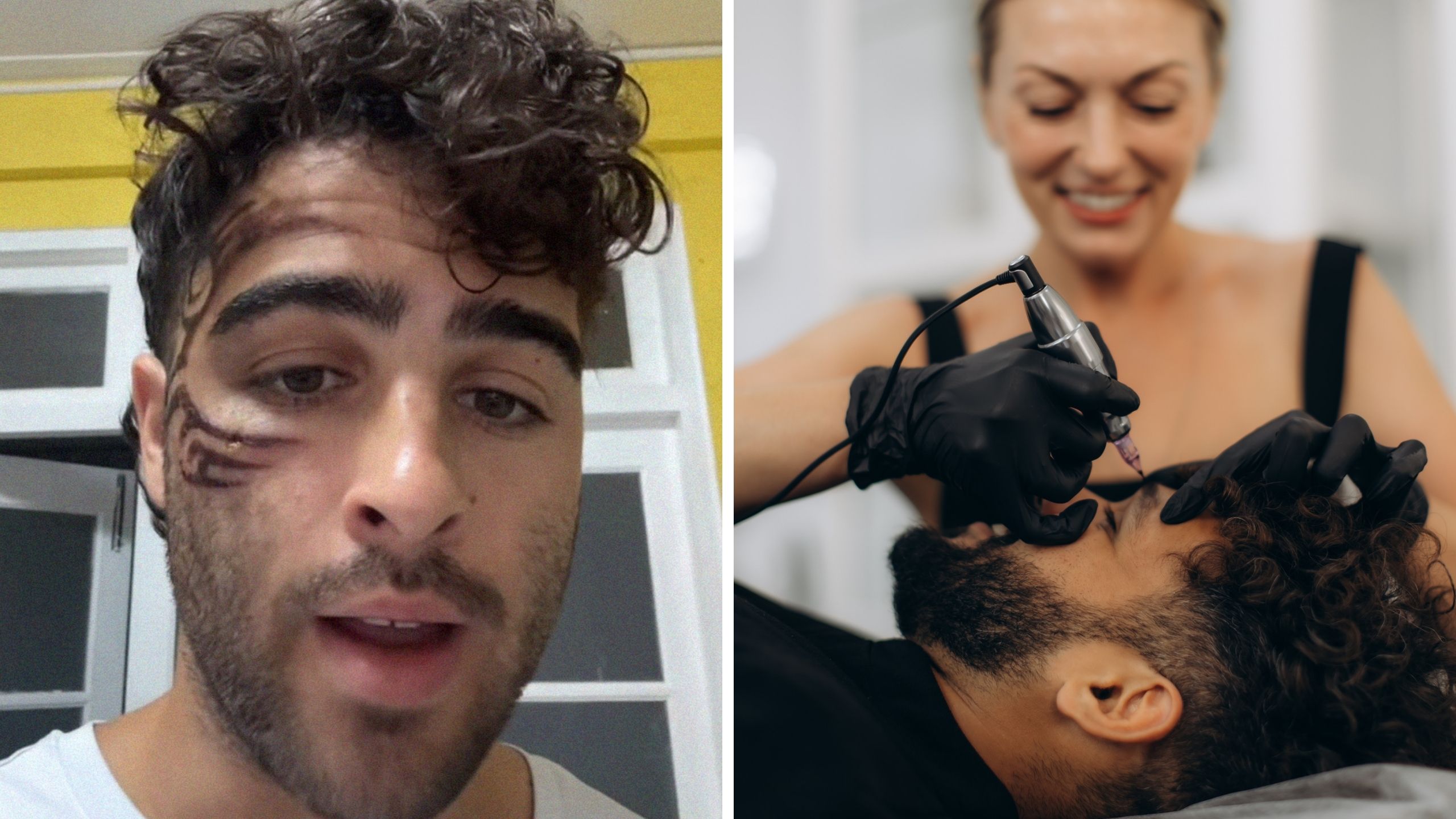
A night out in Bangkok turned into a nightmare scenario for one man whose drunken decision to get what he thought was a temporary tattoo spiraled into a medical emergency.
In a plot twist straight out of “The Hangover”—what started as a fun guys’ trip moment became a very real cautionary tale about the hidden dangers of black henna.
Man Gets Mike Tyson-Style Face Tattoo In Bangkok
In a viral TikTok, content creator Nick Nayersina (@nicknayersina) appeared with a dark brown Mike Tyson-style face tattoo on the side of his face. He explains how a night of drinking led to a potentially life-altering mistake. His clip has more than 4.2 million views.
“Guys, we’re in Bangkok. Last night, we went out and for some reason had the great idea of all getting black henna Mike Tyson tattoos,” Nayersina says in the video.
He quickly realized the decision was far worse than just a regrettable drunken choice.
“I didn’t know that black henna is illegal in the U.S. and can lead to permanent scarring and infection on your face,” he explains.
Temporary Tattoo Goes Wrong
Nayersina’s tattoo wasn’t just fading like a typical temporary design. It was actively causing damage to his skin.
“My whole tattoo is blistering and oozing. And we just looked up everywhere that there are a lot of people who’ve gotten this from the same spot that we got it at and have had permanent scarring,” he says.
The realization that his tattoo could become permanent sent him into a panic.
“I might have a permanent Mike Tyson tattoo on my face. It is starting to blister and scar and ooze. And I’m kinda freaking out. But keeping my cool as much as I can right now. I’m about to go to urgent care,” Nayersina says. “But this shit is no joke.”
He issues a warning to others considering similar temporary tattoos while traveling.
“Don’t come to Bangkok and get a black henna tattoo really drunk with your friends because it could lead to this. By tomorrow morning, it’s saying, I’m going to have a full blistered scar of this tattoo,” he says. “Fuck me.”
In a follow-up video on day three, the tattoo appeared to have significantly faded. Though some viewers speculated he might be faking the whole thing for views.
Is Henna Banned In The U.S.?
The answer is nuanced. According to the FDA, henna itself—a coloring made from a plant—is approved only for use as a hair dye. It is not approved for direct application to the skin, as in the body-decorating process known as mehndi.
Henna has been used for centuries in cultural and religious ceremonies, particularly in South Asian, Middle Eastern, and North African communities, where mehndi body art is a traditional practice for weddings and other celebrations.
Pure, natural henna applied to skin is generally safe and has been used this way for thousands of years.
However, the real danger comes from “black henna.” Because henna typically produces a brown, orange-brown, or reddish-brown tint, the extra ingredient used to blacken henna is often PPD. By law, PPD is not permitted in cosmetics intended to be applied to the skin.
The FDA has an Import Alert in effect for henna intended for use on the skin because it is an unapproved use of the color additive.
While the FDA regulates the sale of these products, the practice of tattooing itself is generally regulated by state and local officials. Some states have laws and regulations for temporary tattooing. Others don’t. This means that depending on where you are, it’s possible no one is checking to make sure the artist is following safe practices or even knows what may be harmful to consumers.
The Hidden Dangers Of Black Henna
According to DermNet NZ, black henna contains para-phenylenediamine (PPD), a chemical added to make temporary tattoos look darker and last longer.
Natural pure henna doesn’t cause allergic reactions, but PPD is a potent skin sensitizer.
The allergic reaction typically appears 7-14 days after first exposure, presenting as severe itching, burning sensation, blistering, and oozing, exactly what Nayersina described.
The reaction can leave either increased pigmentation or a white outline of the original tattoo, and keloid scarring has been reported in some cases.
McCready Law notes that black henna uses PPD in much stronger concentrations than hair dye, making reactions more likely and severe. Research has found that an estimated 2.5% of people who get a black henna tattoo will experience an allergic reaction. The concentration of PPD in black henna has been found to be as high as 15.7%—much stronger than the concentrations used in hair dyes.
Most reports of allergic reactions have come from tourists visiting Southeast Asia or the Middle East, especially Turkey, Egypt, Bali, and Morocco, though reactions to tattoos from street artists in Europe and the U.S. are increasingly common.
Perhaps most concerning is the long-term impact. Live Science reports that a single black henna tattoo can lead to lifelong sensitivity to PPD.
Once sensitized, a person will suffer reactions to many products that contain certain chemicals, including most hair dyes, some medications, black clothing dyes, and certain sunscreens. Black henna tattoos can have PPD levels as high as 30%, while PPD is only approved for use in hair dyes at 6% concentration—and neither the U.S. nor Europe permits PPD in any skin product at any concentration.
Commenters React
“This is literally the plot of hangover,” a top comment read.
“Make a dermatologist appointment ASAP. Urgent care will only focus on reducing infections, not cosmetological reasons,” a person advised.
“my buddy got a henna tattoo on his arm on a trip to Mexico in 2006…still has the scar today,” another shared.
@nicknayersina Getting henna tattoos in Bangkok goes extremely wrong 👀😳 #fyp #blackhenna #miketyson
BroBible reached out to Nayersina for comment via TikTok direct message and Instagram direct message. We’ll be sure to update this if he responds.