


Via iStockphoto / @melanatedexperience TikTok
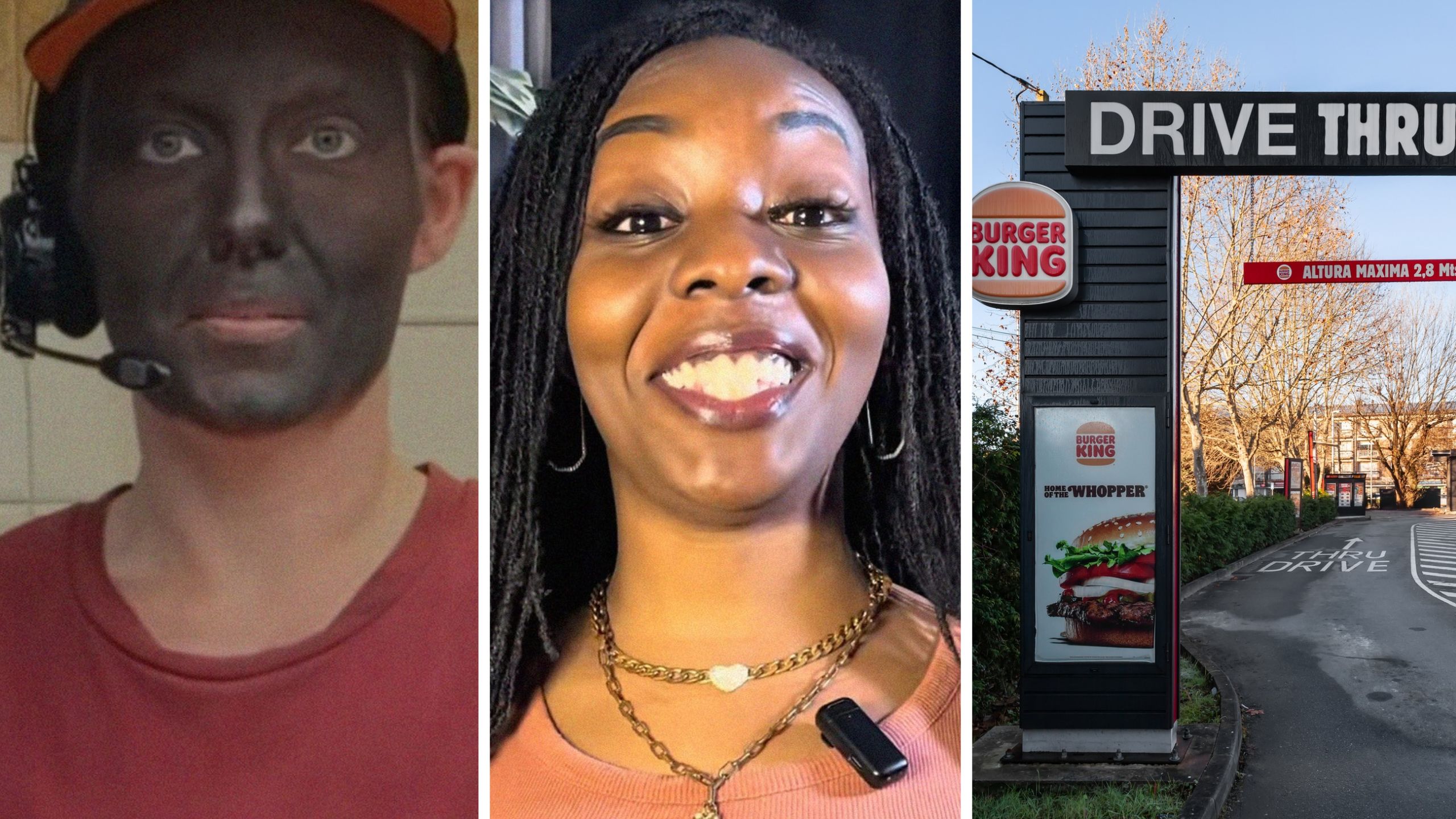
A woman pulled up to the Burger King drive-thru and was astonished to see the worker in blackface.
Blackface has a long, dark history in the United States.
Politicians were canceled for the practice. Stars have been criticized, and brands have had to apologize for it. Yet, in 2026, people still have to be told that blackface is not OK. Despite there always being backlash, astonishingly, it continues.
On Halloween, at a Burger King in Faribault, Minnesota, a white drive-thru employee showed up to work in her uniform and her face painted completely black. When Shavelle Devine, a customer, questioned the choice, the employee nonchalantly stated, “I’m just Black today.”
For understanding, Devine continued the line of questioning. She asked the employee if she thought wearing blackface was OK. The employee responded, “As long as you have a good heart.”
“So your intentions [are] good?” The employee nods yes. Then Devine asks, “So you’re black lives matter?”
The employee thinks about it and then says, “Well, no, I just want to be Black.”
“Why would you want to be Black? Do you know the struggles that we go through as Black people?” Devine asks.
“Sorry, you’re making me laugh. Sorry, no, yes, I do. Or I mean, no, I don’t. No, I don’t,” replies the employee.
The exchange, along with the blackface, set the internet ablaze.
Devine’s original video has been viewed more than 13 million times. It is in circulation on TikTok, Twitter, Instagram Snapchat. There have been countless comments, commentaries, and news pieces. The story was also picked up by TMZ.
Burger King And The People Respond
After 48 hours of consistent online backlash, Burger King sent out a press statement regarding the matter.
“We are aware of the video and take the matter very seriously. The Franchisee of this location is addressing the situation with his team, manager, and Team Member to ensure everyone involved understands why this is not acceptable and won’t happen again.”
It is unclear if there has been any disciplinary action taken against the employee.
However, dissenters on social media were rife. They demanded her firing. Others urged people to boycott Burger King. And there were some who believed the employee meant no harm. Some were in such disbelief that they claimed the video was AI. “The fact that they allowed her to work is CRAZY,” said a commenter.
The History Of Blackface
The practice of blackface goes hand-in-hand with minstrelsy. Blackface is the act of wearing shoe polish or burnt cork on the skin to mimic Black people. Minstrelsy is the show that features blackface performers that caricature African Americans.
Feeling ostracized from wealthy whites, poor and working-class whites created minstrelsy in order to distance themselves from their own lower social, political, and economic status. The practice became more popular post-Civil War when former enslaved people demanded full rights to include voting rights.
But no one mastered the reductive performance better than Thomas Dartmouth Rice—the father of American minstrelsy. Minstrelsy demeaned and dehumanized African Americans by distorting and exaggerating their features, language and culture. They often portrayed characters as lazy, ignorant, clumsy, criminal, loud, and hypersexual. Rice was the creator of the most popular minstrel, Jim Crow (this is where Jim Crow laws got their name). Played by Rice, the blackface character was buffoonish, had an exaggerated accent, wore tattered clothing, and popularized the slave song “Jump Jim Crow.”
Minstrelsy Takes Over Entertainment
Popularized between 1830 and 1840, minstrelsy is the United States’ first native theatrical entertainment. Over time, it became family entertainment. As media evolved, the genre crossed over. It crossed over from the stage to radio to news and eventually made its way to Hollywood. Shirley Temple, Judy Garland, and Mickey Rooney all appeared in blackface on the big screen. The popular film “Birth of a Nation” portrayed the blackface characters as unprincipled and rapists. The movie was so effective that it was recruitment material for the Ku Klux Klan. The popularity of blackface finally cooled during the Civil Rights era.
However, the mainstream success of minstrelsy and blackface cannot be overstated. Together, they helped codify social hierarchy, normalize racial prejudice, solidify African American stereotypes, and justify the denial of civil rights.
So when people are outraged that blackface is brushed off as just a costume, remember, there is an entire race of people who were dehumanized by the practice and another race of people who profited from perpetuating the practice. And the effects of both still linger.
BroBible reached out to Devine for comment.