


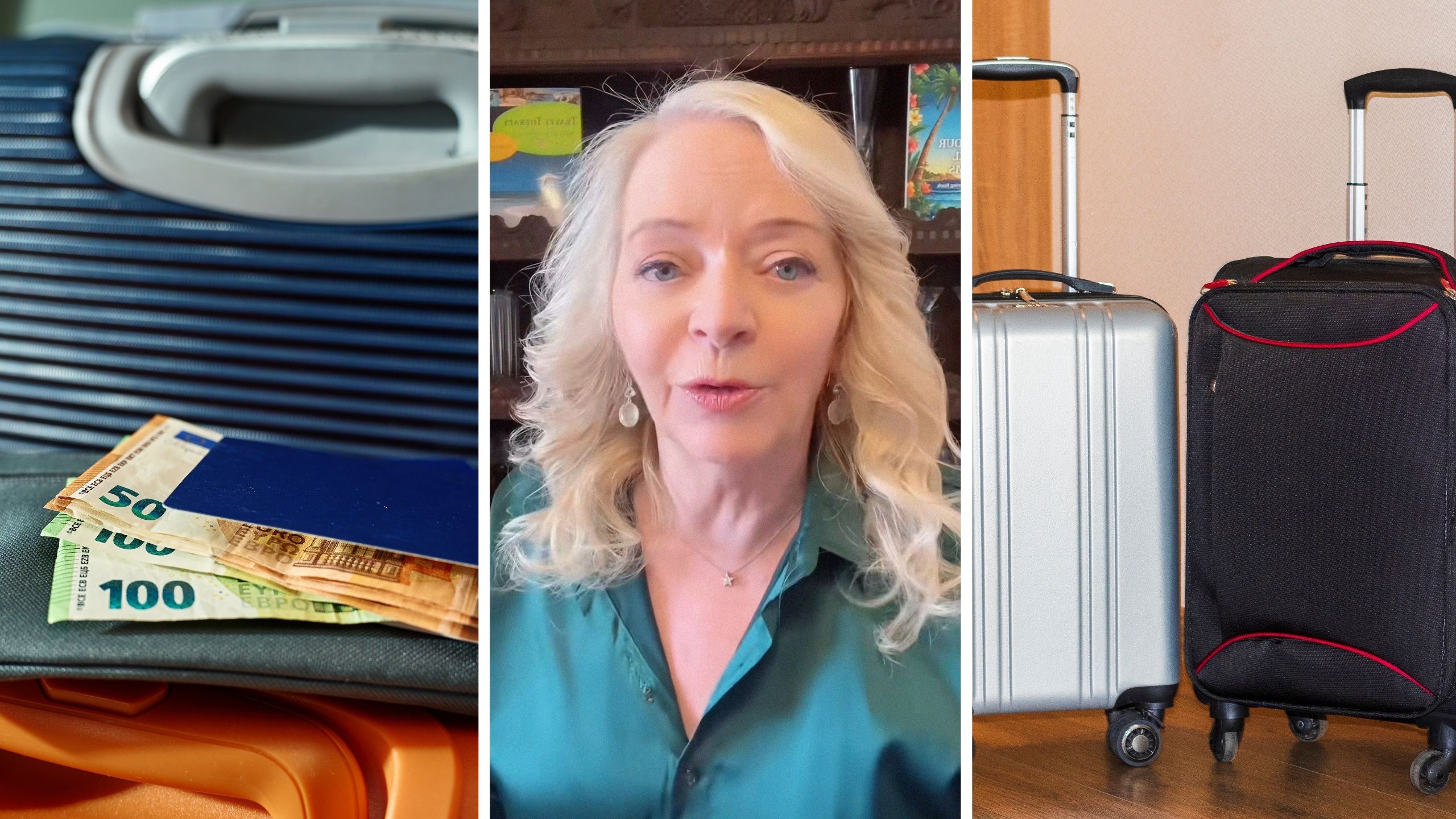
Your trusty carry-on that’s sailed through security for years might suddenly become a $30 problem at the gate.
As it turns out, airlines are cracking down on bag sizes in 2026. And travelers are paying the price.
Some are saying that airlines are exploiting passengers as they keep raising prices, limiting what you can bring on board, and generally making the flying experience more uncomfortable (bye-bye free blankets and real meals) and expensive for everyday consumers.
2026 Carry-On PSA
In a viral video with more than 602,000 views, Emmy Award-winning journalist and travel expert Karen Schaler (@karenschaler) issued an urgent warning to travelers. Those carry-on bags that worked fine last year might not cut it anymore.
“There’s a really good chance that your carry-on bag will not make the new 2026 requirements,” Schaler says in the TikTok.
Airlines have always required that carry-on measurements include wheels and handles. But until now, they weren’t strictly enforcing it. Schaler says that’s changing in 2026. And travelers are getting hit with surprise fees at the gate.
“So many carry-on bags that used to get through fine are now getting pulled, gate-checked, you’re being charged, especially hardcover bags,” Schaler explains.
The problem has gotten worse because many retailers still advertise bags as “carry-on approved” without including wheels and handles in their measurements. When travelers show up to the airport with these bags, they’re learning the hard way that their purchase doesn’t actually meet airline requirements.
“A lot of places who have sold carry-on bags that are still advertising them as carry-ons are not including the handle and the wheels. So they’re getting pulled now in 2026. And it’s costing a lot of people time and money,” she says.
Advice
Schaler recommends measuring your luggage the old-fashioned way: standing it up on the ground with an actual ruler, measuring all the way to the top handle.
Hard-shell luggage is getting targeted first.
“The problem with the hard shell baggage, the luggage that we’re seeing, is that they’re at the max size or a little over. They’re the ones that are being tagged first and being checked where you’re being charged,” she explains.
For five major U.S. airlines—Delta, United, JetBlue, Alaska, and American Airlines—the standard carry-on size is 22 inches by 14 inches by 9 inches, including wheels and handles.
The ones who might have more trouble are international travelers since the measurements for international airlines are a lot smaller.
“So if you’re flying overseas, you’re gonna wanna look up those airlines and use the smallest size,” she explains.
And if you’re shopping for a new carry-on, you need to be extra careful. “A lot of advertisements are saying ‘carry-on,’ but when you actually dig deeper, they are not carry-on size anymore,” she further explains.
Her advice: If you buy luggage online, make sure it’s returnable. Otherwise, you could be stuck paying $30 or $40 to check it on top of losing money on a bag you can’t use.
The 2026 Carry-On Crackdown
Airlines aren’t introducing new size restrictions in 2026. They’re just finally enforcing them to the chagrin of 2026 travelers.
According to Travel Noire, most major U.S. carriers now uniformly enforce the standard carry-on size of 22 inches long, 14 inches wide, and 9 inches deep, including wheels and handles. Southwest Airlines is a notable exception. It allows slightly larger bags at 24x16x10 inches.
But here’s the problem: For years, that “including wheels and handles” part wasn’t strictly enforced. Many retailers capitalized on this by advertising bags as “carry-on approved” while only measuring the main compartment. Now that gate agents are actually checking, travelers are getting caught off guard.
The enforcement has become systematic rather than random. Gate agents are increasingly counting bags and scrutinizing dimensions, with many airlines installing bag sizers at check-in and security areas. According to Travel Noire, Basic Economy tickets face particularly strict scrutiny. Air Canada, for example, charges passengers $65 to gate-check oversized bags versus $35 if checked before security.
For travelers caught with oversized bags, the fees add up fast. And these rules come directly from airlines, not the TSA, meaning each carrier sets its own policies and enforcement standards.
Commenters React
“The Calpak Ambeur is 21.5x14x9 including the wheels and handle <3 just fyi,” a top comment read.
“Lowkey look at Vera Bradley for carryons. Just measured mine and it fits the requirements and is crazy durable. going on 5 years with it and it’s good as new,” a person said.
“These airlines are robbing us blind,” another wrote.
“Everybody in the comments blaming other passengers for ‘taking advantage’ or more than their fair share of the overhead bins. Y’all. The problem is the airlines charging a fortune for checking bags and losing things- if that wasn’t the case, more people would be checking bags for the convenience. Let’s put the blame where it belongs!” a commenter added.
BroBible reached out to Schaler for comment via email and Instagram direct message.