



iStockphoto
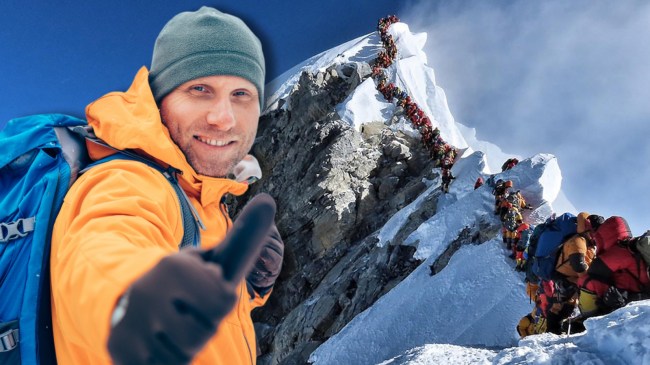
Mountain climber giving a thumbs-up next to Mount Everest
Each year, close to 1,000 people make the trek to the border of Nepal and Tibet to attempt to conquer Mount Everest. Those who prepare for the trek in the former set up shop in a base camp situated on a glacier, one that’s gradually shrinking thanks in no small part to the amount of pee that’s being deposited on it each year.
It’s been close to 75 years since Edmund Hillary and Tenzing Norgay became the first recognized climbers to make it to the top of the tallest mountain in the world after reaching the summit of Mount Everest, which sits 29,031 feet above sea level.
The duo geared up for the expedition after establishing a base camp on the Khumbu Glacier, which is located in Nepal on the eastern side of Everest. Their accommodations were anything but glamorous, and while it would be a stretch to use that word to describe the ones climbers have access to today, most people tend to be a bit more comfortable.
Climbing Mount Everest is not a cheap endeavor (the average person spends over $60,000 on travel, equipment, guides, and other costs when everything is said and done), and some people splurge for a relatively luxurious base camp experience that can involve heated tents and hot showers.
However, a new report has outlined the toll those amenities are taking on the glacier, as well as the impact of a more natural source of warmth.
Urine is being blamed for melting nearly over 150 metric tons of water from the Khumbu Glacier at the base of Mount Everest each year
Mount Everest and the surrounding region have not been immune to climate change, and rising global temperatures are the primary reason the Khumbu Glacier has been slowly but surely shrinking in recent years.
According to The Independent, the humans who set up shop there have also been contributing in more than a few ways, but there isn’t a single factor that sticks out more than the massive amount of urine that has been flagged as an issue.
The revelations were shared in a paper that was recently published in the journal Regional Environmental Change, which details the findings of a team of experts who attempted to track the human impact while analyzing data that was collected at the base camp during the spring climbing season in 2023.
There were approximately 1,600 tents set up on the glacier, and the researcher chronicled the amount of fuel that was used for various heating purposes along with other factors they said were responsible for melting between 1,964 and 3,020 metric tons of ice and snow (pegging the actual number at close to 2,492).
However, there was one somewhat surprising culprit: the urine of the overhydrated climbers, who produce an estimated 6,000 liters (158 gallons) per day. Most of that is “discharged” right onto the ground, and the paper says the heat that’s collectively generated is responsible for melting 154 metric tons of water (~40,680 gallons) off the glacier each climbing season.
The paper recommended “relocating the base camp from the glacier to a stable nearby area,” although it seems unlikely there will be a scramble to do so in the near future.