



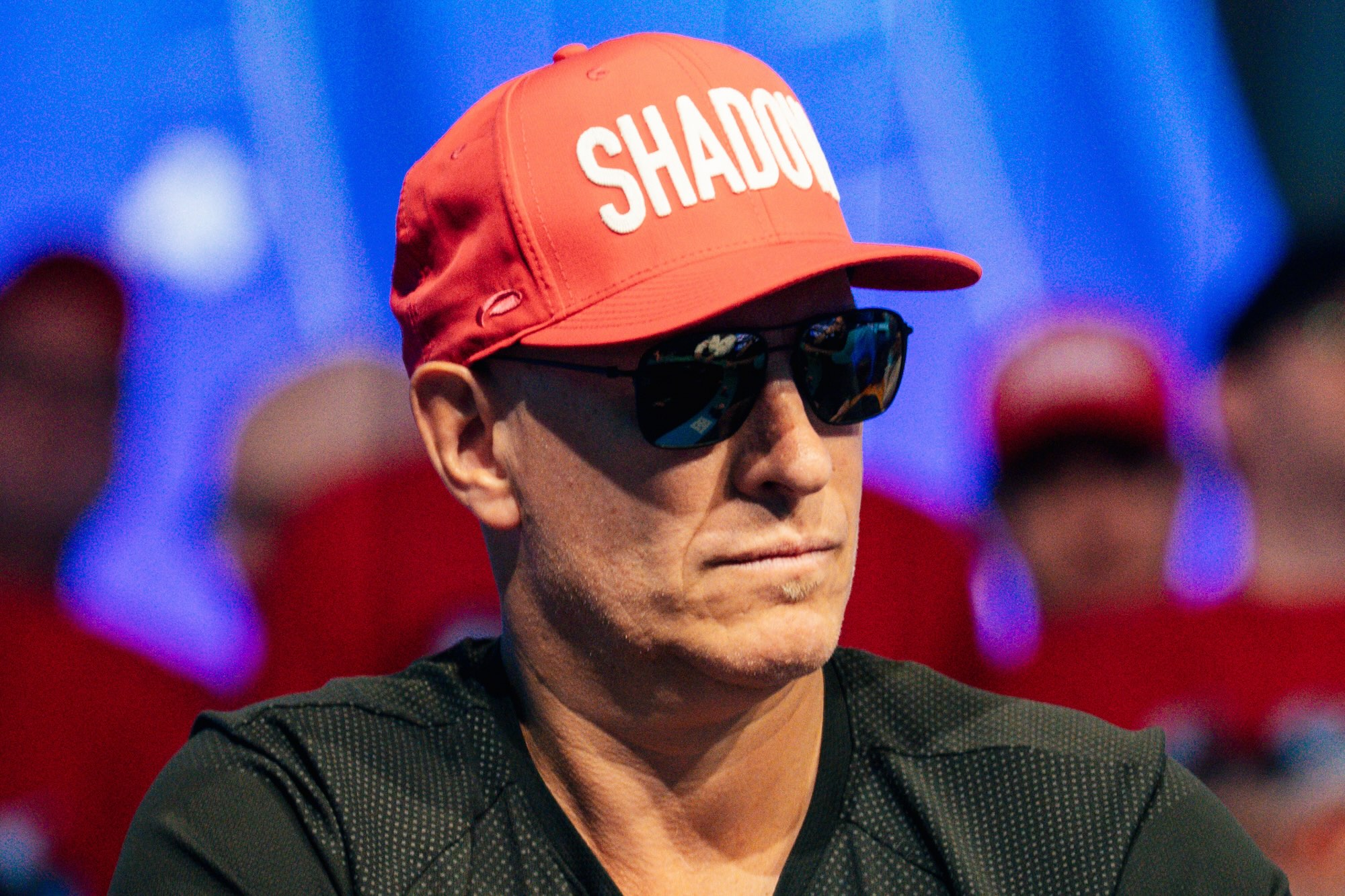
via PokerGo
Greg Mueller at the 2026 WSOP
There is a hand from the first night of the World Series of Poker Main Event final table that the ESPN cameras caught in full, and it still isn’t the whole story.
Lauri Saaskilahti min-raised to 4 million out of the hijack holding the queen and eight of spades. Greg Mueller called from the small blind with the king of spades and the jack of diamonds. The flop came king, six, four, giving Mueller top pair. He checked. Saaskilahti bet 3 million with absolutely nothing and Mueller called. The turn was a five, Mueller checked again, Saaskilahti fired 11 million still holding queen high, and Mueller called again. Then Mueller checked dark; the six of hearts paired the board, and Saaskilahti pushed 35 million into a pot he had no business being anywhere near.
Mueller folded the best hand.
Every recap of that session wrote it up as a monster bluff by the Finn, which it absolutely was.
What none of them had is the part Mueller told me on a call a couple of weeks after it was all over: the checks were the plan. All of them. He wasn’t lost in that hand. He was building a trap and then he stepped out of it at the last possible second.
For a stretch in the mid-2000s, this tournament was the most accessible dream in American sports. An accountant from Tennessee named Chris Moneymaker turned an $86 online satellite into a world championship in 2003; ESPN ran the thing on a loop, and within a year every dorm common room and finished basement in the country had a felt tabletop, a case of clacking plastic chips, and somebody doing a Norman Chad impression. The pitch was that anybody could do this. For a few years it was close enough to true that millions of people believed it. Then came April 15, 2011. The Justice Department seized the domains of PokerStars, Full Tilt, and Absolute Poker on a single morning, froze the money sitting in American accounts on those sites, and effectively switched off online poker in this country. Poker people still just call it Black Friday.
The recreational money went home, most of those chip cases ended up in a closet, and the players who stayed had to get very, very good at a much meaner game.
Twenty-three years later the buy-in is still $10,000, and the field is now 9,208 people deep, which is how you end up with an $85.6 million prize pool, a 22-year-old from Spokane named Lucas Jumalon holding the trophy, and two of the most experienced pros in the building finishing third and fourth with a combined $6.5 million and two regrets that point in opposite directions.
Mueller took $3,750,000 for third.
Michael “Gags” Gagliano took $2,750,000 for fourth.
Between them, they have seven WSOP bracelets and something like four decades of professional poker.
The reason I had both of them on the same call is Christina Lindley. She played for a living during the boom years and won nearly $2 million herself in online and live tournament winnings. She knew both of these guys from the other side of the felt, and she has been in Las Vegas ever since, running VPRG Consulting instead of a bankroll.
The official line there is strategic partnerships and revenue growth, which in practice means getting growth-stage companies into rooms with the people who sign the checks. She hadn’t seen either of them in something like fifteen years. Mueller opened by telling her she looks identical, which is the highest compliment available in a business where everybody ages in dog years.
Then she spent an hour asking them the questions a former pro asks, which are not the questions a reporter asks.
I went in expecting the usual postmortem about coolers, bad beats, and the kid who ran over the table. Instead, Lindley asked both of them what they wished they had played differently, and they both landed on the same street.
The river.
The 90 Ways Greg Mueller Could Have Won That Hand
Mueller has been doing this a long time. He grew up in Canada, played professional hockey in Germany on a German passport his parents made him keep, and got into poker in the back of team buses on long road trips. He was a sponsored Full Tilt pro back when that meant something, though the FBT on all those red shirts stands for Full Blown Tilt. He is a three-time WSOP bracelet winner and he has been reading faces at poker tables since before solvers existed.
So when he tells you he knew Saaskilahti had nothing, the claim comes with receipts. The problem is what he did about it.
“There was a lot of factors in my head there,” Mueller told BroBible. “People critiqued my checking lines. It’s the Main Event, you can’t, you know, what do you check? I wanted him to bet the river. I knew he had nothing. I was inducing a bluff.”
Then he ran through the alternate universes, and he has clearly run through them a few times.
“I mean, there was about 90 other ways I could have played it that I would have won the hand, and it’s the only way I played it that I lost the hand,” he said. “I could have three-bet pre and taken it down. I could have check-raised the flop, taken it down, led the flop, taken it down, check-raised the turn, taken it down, led the river, all the ways. And I induced the bluff on the river and played the hand 10 out of 10. Other than I forgot to call.”
Other than I forgot to call. That’s a man who has watched the tape.
What actually stopped his hand, by his own account, was arithmetic that had nothing to do with the cards. It was the rail. Mueller had roughly a hundred people who flew in for this, including a pair of current NHL head coaches, Rick Tocchet and Travis Green, wearing red FBT shirts and making enough noise that Gagliano wore earplugs for most of the final table. If Mueller folded, he still had chips and they still had a show. If he called and he was wrong, the whole thing ended right there.
“If I fold, I still have plenty of chips,” Mueller said. “If I lose and I’m wrong, I am, like, crippled. My rail goes home.”
He also refuses to make it about himself, which I appreciated.
“He triple-barreled, and he went for it, and good for him,” Mueller said of Saaskilahti, who took the pot, crossed 100 million chips, and eventually finished second for $6 million. “He played the hand like a champ. Sometimes you just have to take your hat off when a guy makes a good play.”
The Fold That Was Worth More Than The Fold That Hurt
Here is the part that makes the whole thing sing.
The very next night, on the second day of the final table, Mueller made the same kind of decision, and it was worth a fortune.
Han Feng opened to 6 million. Saaskilahti raised it to 50 million with pocket nines. Mueller, holding pocket jacks between the two of them, took off his hat and his sunglasses and thought about it for a long time before he let them go. Feng then called all-in for 25 million total and turned over pocket aces.
The flop came ten, eight, three, all diamonds. The turn was the jack of hearts, which would have given Mueller a set. The river was the queen of spades, which completed a straight for Saaskilahti’s nines. Feng went out fifth for $2,250,000 with the best starting hand in poker.
If Mueller calls, he flops nothing, turns a set of jacks, and then watches Saaskilahti backdoor the exact runout that beats him.
“It would have been the roller coaster of all roller coasters,” Mueller said. “Hitting the jack on the turn, and then running into the queen on the river. I mean, it would have been torture. And instead I found the fold, and it made me a ton more money.”
His logic in the moment had nothing to do with the runout, obviously. Feng had been playing his short stack with surgical min-clicks all tournament, so the under-the-gun action told Mueller something big was coming. Saaskilahti raising over the top told him the rest.
“How good a shape can my jacks be in three ways?” Mueller said. “I just don’t think they’re in good shape three ways.”
So there it is. Same player and same instinct, one night apart. One fold cost him millions and one fold made him millions, and the only difference between them is the cards nobody at the table could see.
Gagliano’s Regret Runs The Other Direction
When Lindley put the same question to Gagliano, he started by saying he didn’t have any. He had a case. He came into the final table without a big stack, never got what he calls “put in play,” and mostly survived his way to fourth.
“When you’re grinding and grinding and grinding, do you get a chance to win chips and have a shot to actually battle and play more pots and see some flops?” Gagliano said. “I was just really never put in play. I just survived for a very long time and just kind of bobbed and weaved through the field.”
Then he remembered one. From Day 1. Of an eleven-day tournament.
“I called a river bet on Day 1 that every fiber of my being, I had planned the hand out, and I just didn’t believe someone,” Gagliano said. “And then the way the hand played out, I was like, I just believe this guy, he’s just got a really good hand. And I was like, no, no, go with your initial read. And then sure enough, I was beat.”
Now put that next to Mueller’s and look at the shape of it. Both men made a read early, built a plan around it, and then had the hand start whispering something different on the river. Mueller threw out the plan and folded. Gagliano overruled the whisper, stuck to the plan, and called. Both of them were wrong, in exactly opposite ways, and both of them are still turning it over a month later.
Neither one regrets a chip he lost to variance. What eats at them is the moment the read and the hand stopped agreeing.
Gagliano is worth knowing about, by the way, because his road here is genuinely strange. He graduated Rutgers with a geology degree after bailing on an engineering major he hated, took a job as a staff assistant in a special ed classroom because his mom taught special ed for years, and then started making so much money playing online at night that the school office had to chase him down the hallway.
“They used to kind of chase me down, like, hey, you got four checks here, come get paid,” Gagliano said. “But I just was so focused on poker, I didn’t even care.”
That was 2008. He gave professional poker a few months to see what happened. Eighteen years and four bracelets later he was in the last five at the Main Event with $10 million on the table.
Nobody Is Supposed To Leave Happy
Here is the thing both of them landed on independently, and it’s the reason this final table read differently than most.
“Poker tournaments are such interesting events, because there’s only a single person in almost every tournament who’s going to be satisfied,” Gagliano said. “No matter how many people that guy who gets second beat, he still is thinking, ah, I could have won.”
Mueller learned that lesson the loud way in 2007, when he finished second to Steve Billirakis in the $5,000 mixed hold’em event at the World Series for $328,554, then threw himself a pity party in Vegas while his roommate Bucky celebrated a WPT title at Mandalay Bay from the day before.
“My dad was like, you just won 300,000, I don’t understand how you’re upset,” Mueller said. “And I’m like, because, Dad, I wanted to win so bad.”
Nineteen years later he lost a $10 million tournament in third place and felt none of it. He busted three-handed, calling a river shove with ten-four for a pair of fours, which ran straight into Saaskilahti’s pocket kings, and when the media asked him about the hand afterward, he could barely remember it.
“They wanted to talk about the hand,” Mueller said. “I didn’t even remember the hand at the time. I didn’t care. I just came in third in the Main. I have 100 people that flew in from their lives to cheer me on. There was zero feeling other than blessed, bliss, fortune, lucky.”
Both men also told me they can’t remember most of Days 6 and 7. Gagliano had to go back and watch the stream to reconstruct his own tournament, which is a wild thing to have to do about the biggest week of your professional life. He kept coming back to something Rami Hammoud said, which is that Hammoud felt like he was standing behind himself watching himself play. Gagliano repeats it like it’s the only accurate description anyone came up with.
Adam Schwartz asked Mueller about a hand where he folded jacks on Day 6 or 7. Mueller had no idea what he was talking about.
“I don’t even remember this hand,” he said. “It just becomes such a blur.”
Nine Guys Went To War And Came Out With A Group Chat
There is a WhatsApp thread. Hammoud started it on the last night before the break.
They post in it constantly. Jumalon, the 22-year-old who beat all of them and became the second-youngest Main Event champion in history behind Joe Cada, posts his new toys. Gagliano jokes about what he’d buy. Everybody who spent eleven days trying to take everybody else’s money now checks in like a beer league team.
“We were in this battle in the trenches together for so many days,” Mueller said. “It’s like we’ll always share that journey.”
You could see it on the broadcast if you were looking, and Lindley was looking. Six-handed for eight figures, Gagliano dug out a granola bar and offered one to Mueller, and Mueller took it.
“It just made me think, how lighthearted they’re sharing snacks like kindergarten,” Lindley said. “In the middle of playing for $10 million.”
She watched the rest of it with a pro’s stomach, which is its own kind of viewing experience. “That gave me a lot of anxiety,” she told Gagliano about one of his big spots, “watching someone else in that situation on that stage.”
The camaraderie got confusing enough that the broadcast booth had to sort it out live. When Mueller survived a big hand on Day 8, Jumalon’s rail celebrated right along with him, and Nick Schulman’s read on it was that Mueller was double-dipping rails. Gagliano got the same treatment from the other side. He says Mueller’s people were fist-bumping him on breaks and telling him they were rooting for their guy but wanted to see the two of them get heads up. When Hammoud busted in sixth, the Canadians in the crowd sang “O Canada” on his way out the door.
“I’ll get more graphic,” Mueller said. “I’m at the urinal and there’s another one of the seven guys beside me and you’re like, oh, crazy hand. We’re riding the double-decker bus cruising, like we’re all in this together.”
Gagliano noticed the same phenomenon and has a theory about it. Day 1 of a Main Event, you go on break with two thousand strangers and a bathroom line. Late in the tournament there are a handful of you left and you’re all standing in the same line buying the same snack.
“How can you not have fun with these guys?” he said.
The best evidence came the morning after the final nine was set. Gagliano runs a coaching business. At 11 a.m., his contact form got an inquiry.
Hammoud had filled it out. Just made the final table of the Main, looking to get some coaching, wink wink.
Then, after Gagliano busted in fourth, Hammoud sent another one.
“He messaged me again and was like, hey, it’s time to update that coaching bio,” Gagliano said. “And I was like, yeah, you’re right. Let me get on that.”
Whatever those nine guys have, it turns out to be contagious. By the end of our call, it had jumped hosts. Lindley, who left the game years ago and has zero intention of going back to it professionally, sat there listening to the two of them talk about eleven days in the trenches and announced that they had reinfected her.
“You’ve given me the bug,” she told them. “I’m thinking about firing something for the first time live in years.”
Gagliano hasn’t played Bay 101 in about fifteen years and committed to this one after Matt Savage asked him directly. Mueller played it last year and put himself at 90 percent to go back. Lindley said she’d let them know.
Mueller is unsponsored and unbothered, splitting his time between the golf course and a hot tub in White Rock, British Columbia, and booking poker trips the day before he takes them. He still thinks he should have called.
Christina Lindley co-reported this story. She is the founder and CEO of VPRG Consulting, where she helps companies build strategic partnerships and grow revenue. A former professional poker player with nearly $2 million in combined online and live tournament winnings, she is also a former film and television actor whose credits include The Marine. Based in Las Vegas, she brings a competitive streak, an insider’s perspective, and a sense of humor to her interviews. She speaks fluent “Bro.”