



iStockphoto
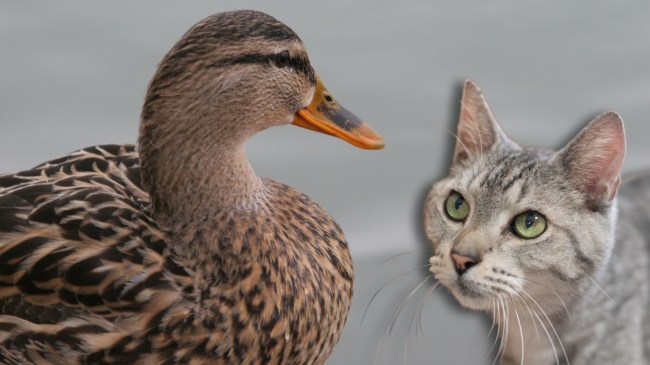
Grey cat staring at brown duck
There isn’t a single predator that kills more birds each year than cats, which are responsible for the deaths of billions of feathered animals in the United States alone. That’s not the only country where they can cause an issue, as wildlife officials recently ended a three-year reign of terror perpetrated by a feral feline that wouldn’t stop slaughtering a rare species of duck.
Experts believe cats were first domesticated between 10,000 and 12,000 years ago in the region of the Middle East known as the Fertile Crescent; people needed a way to prevent rodents from targeting stockpiles of grain, and the animals were more than capable of handling that job.
Cats are now only second to dogs when it comes to the most popular pets in the United States, which is one of many countries that also has a sizable population of feral cats that rely on their hunting ability as opposed to bowls of food and do their business in the wild as opposed to a litter box.
Untamed cats are responsible for the majority of the estimated 2.4 billion birds they kill in America each year, an issue that’s a major concern for avian conservationists. It’s also not unique to the United States, as officials in New Zealand were finally able to track down a single cat that spent years preying on an endangered species of duck.
An “infamous” feral cat dubbed Nine Lives was captured after it spent three years preying on a rare duck in New Zealand
The brown teal duck (also known as the “pāteke”) is native to New Zealand and has been a protected species in the country for more than a century. The population has been slowly but surely increasing over the past couple of decades (it currently sits between 2,000 and 2,5000), but it is still the rarest type of duck in the country.
The rise in its numbers can be linked to conservation efforts that have included programs designed to reintroduce them to certain areas, which was the case with one that began in 2023 on the Purerua Peninsula on the North Island.
According to Smithsonian Magazine, that initiative was rolled out in conjunction with Pest Free Purerua, a collective that focuses on “trapping possums, stoats, rats and feral cats” to protect kiwis and other birds in the area, which included the ducks that started being released there a few years ago.
Unfortunately, a pāteke carcass was discovered around a week after the first wave was set free, and it was the first of dozens that were eventually traced back to one culprit: a feral grey tabby cat that was given the name “Nine Lives.”
Wildlife officials spent the past three years attempting to capture Nine Lives, but those efforts were thwarted thanks to its unpredictable hunting patterns.
However, the saga came to an end last week after it roamed into a cage that was set up after it was spotted in the same area three days in a row, ending the killing spree of an animal that may have been responsible for slaughtering 75% of the ducks that were released.
Nine Lives was “humanely shot” after being captured, and officials say they plan to give it the taxidermy treatment while using it as an educational tool highlighting the damage feral cats can do.