



A24
Nathan Fielder's project continues to chart new territory for the medium of filmmaking
Being lost, depending on where you are, can be either thrilling or terrifying. Losing your sense of direction on the Lower East Side might spark an adventure; a night you never forget. Bangkok or St. Petersburg? Different story. The excitement depends on whether you believe you can find your way back.
Watching You Can See Everything, the new documentary from Lance Oppenheim and Nathan Fielder, means gradually surrendering that confidence. What initially appears to be a remarkably intimate portrait of Elizabeth Holmes becomes something much harder to get your bearings in.
Its subject changes. Its methods change. Eventually, even the question of what you’re watching becomes difficult to answer.
Perhaps that’s why Lance Oppenheim and Nathan Fielder decided to title their new form breaking documentary You Can See Everything — to give themselves a false sense as they went further and further off course: not just its story and its subject, but the way it was meant to be told.
The film picks up 34 days before Elizabeth Holmes — the infamous founder of Theranos — is due to check herself into an 11-year-long prison sentence.
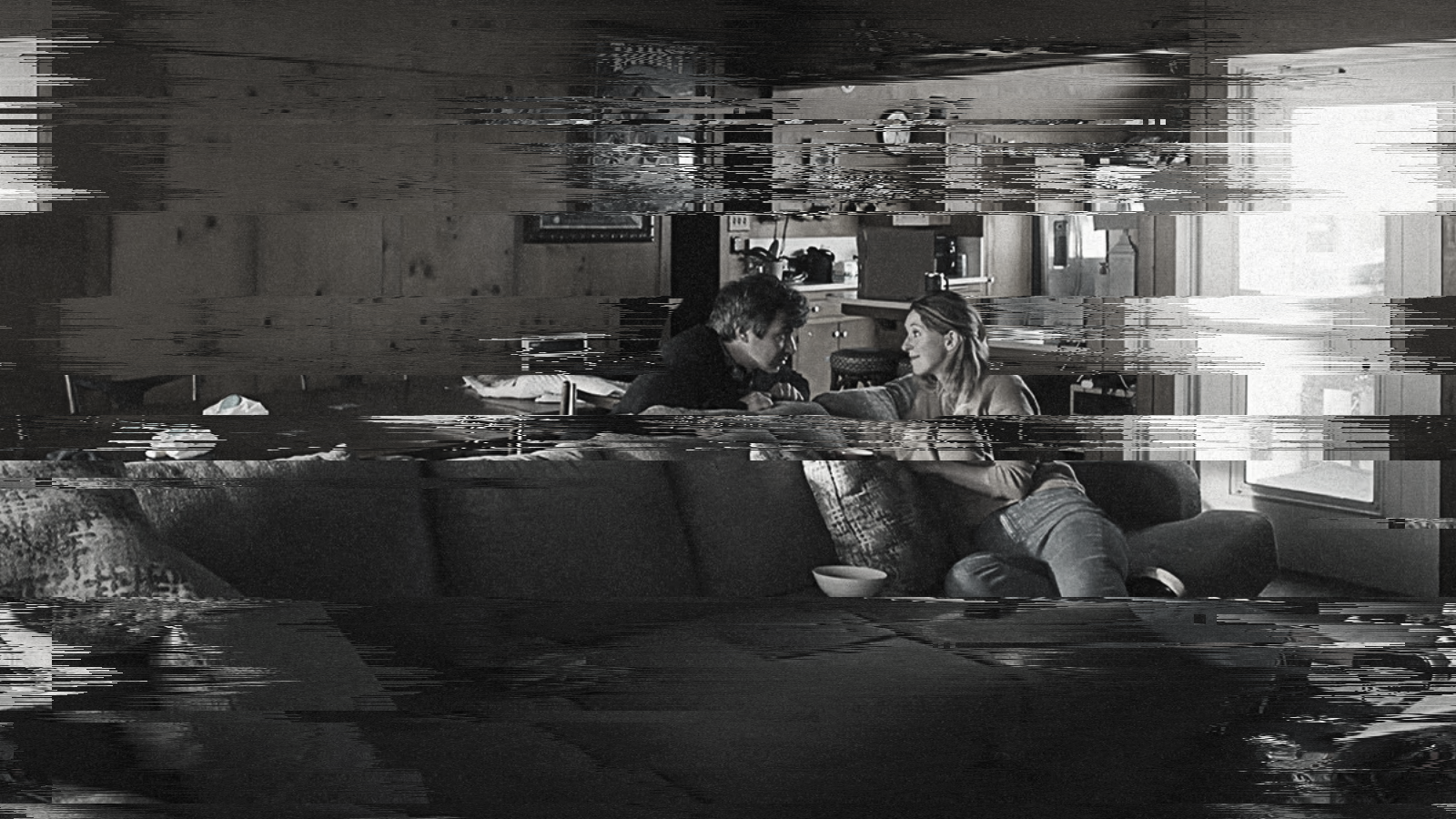
Camped out at an idyllic coastal rental in San Diego with her husband Billy Evans, Holmes simultaneously looks exactly how you remember her and entirely different. Her Pixar-esque doe eyes, rosy cheeks, and oversized ears remain, but her tight pull-back, monotone wardrobe, and artificially deepened voice had long been shed.
Holmes has been reduced to a collection of endlessly reproducible details: the voice, the clothes, the stare. Here, those details lose some of their power. You are allowed to spend time with her rather than immediately identify what is wrong with her. It becomes easier to imagine how people could have been drawn in, even while knowing where that attraction led.
Instantly upon seeing her in this light, you could understand how this woman — turned into a pantomime villain over the last decade with the outsized tales of her alleged deception and quirky, if not sometimes uncanny, personality — could be the version that had numerous billionaires believing in her.
She’s warm; her commitment as a mother is undeniable, and her general personality is inviting — it is her idea, after all, to have Fielder live with them for the first time.
She’s earnest and idealistic, perhaps to a fault: even after all these years, and all these consequences, she continues to pursue the Theranos dream, albeit this time with the seemingly duplicitous and domineering Evans by her side; the apparent recurrence of a pattern that suggests the only crime Holmes has ever committed is trusting the wrong men.
How much of her story can be explained by the people around her before explanation becomes absolution? And how readily will an audience accept that version of events once it has spent enough time watching her be a mother?
None of this disproves anything about Theranos. That is precisely what makes it uncomfortable. A person can be loving at home and responsible for terrible decisions elsewhere. We know that intellectually. Watching those qualities occupy the same face is another experience entirely.
Fielder’s presence makes these questions more difficult to settle. He occupies an awkward space between guest, confidant, and filmmaker, and his familiar discomfort can make an interaction funny without making its emotional stakes any less real. You can laugh at a conversation and then wonder whether you should have been listening to it differently.
There are moments of almost absurd domestic intimacy. He shows Holmes Abbott and Costello’s “Who’s on First?” routine. They watch The Dropout, Hulu’s dramatization of her life, together. Someone who has become a character in the public imagination is watching an actress play that character, alongside a man whose own screen presence has trained us to question the boundary between sincerity and performance.
For as revealing as this access may be, it is once Holmes goes to prison that You Can See Everything becomes something far stranger. To discuss that transformation requires a spoiler warning.
Spoilers for You Can See Everything will follow.
With Holmes no longer available in the same way, Fielder turns to Amanda Seyfried, the Oscar-nominated actress who won an Emmy for playing her in The Dropout.
Their relationship begins with Fielder showing Seyfried the footage they have collected. It is an extraordinary reversal: the woman who helped create a widely seen version of Elizabeth Holmes is now being shown the private person that version could never fully contain.
Seyfried’s presence also changes the visual language of the film. There is a striking contrast between the awkward familiarity of the domestic footage and the unmistakable screen presence of an actress. Oppenheim’s camera makes that distinction difficult to ignore. We have moved into a different kind of image, even as the conversation remains attached to the same person.
It’s Seyfried’s arrival that makes you sit forward, the moment the film stops testing the limits of documentary and starts tearing through them. Watching her become Holmes again, speaking Holmes’ exact words inside a documentary about Holmes, is a narrative Russian doll that folds the film—and your brain—back in on itself.
But Seyfried is more than a willing participant in Fielder’s grand experiment. She follows him down the rabbit hole with a curiosity that can turn combative, shifting between her subject’s fiercest defender and most unforgiving skeptic. She can inhabit Holmes without letting her off the hook, and the friction between those impulses gives the film an entirely new charge.
She seems less interested in what Fielder, A24, or Billy Evans want from the project than in understanding, and potentially helping, this woman. She just has to figure out whether sympathy is clouding her judgment.
The question is no longer simply whether the filmmakers can show us who Holmes really is. It becomes a question about what they expect an image of her to do. Explain her? Reproduce the feeling of being around her? Make sense of an attachment that has become difficult to examine from inside it?
An actress cannot resolve those questions merely by being good at her job. But her presence exposes how much interpretation was involved before she arrived. Holmes was already performing some version of herself for the camera, as anyone would. Fielder was already choosing how to respond. The film was already deciding which moments we would see and how long we would be allowed to sit with them.
Bringing in Seyfried makes that process visible. It also makes the title more unsettling. Seeing more does not necessarily mean getting closer to the truth. Sometimes it means being given a more persuasive version of the story you were already inclined to believe. The film’s achievement is making us recognize how readily we mistake a convincing portrait for a complete person.
And by this point, the viewer has a reason to be wary of persuasion. We have watched a woman whose ability to inspire belief helped build a disastrous company. We have felt the pull of her warmth. Now we are watching filmmakers work through that pull using the very tools that made us feel it.
The film has taken us a long way from that coastal rental. Whether anyone involved still knows the way back is becoming part of the story — Fielder approaches documentary like an astronaut venturing into uncharted space: the possibility that he might not find his way back seems less a deterrent than a reason to keep going
Fielder and Oppenheim promised to show us everything, and they did. And yet somehow, the full picture has never been harder to see. Whatever you thought of Holmes before You Can See Everything, good luck leaving with that certainty intact. Only Fielder could take one of the century’s most notorious con artists, a woman we thought we had thoroughly figured out through a decade of mental, emotional, and moral dissection, and make her this difficult to read by giving us more of her than ever before. Just as you find yourself drifting toward sympathy, you wonder if you’ve been had, too.
What begins as a window into her soul becomes a funhouse mirror: the closer you look, the less certain you become of the shape, size, and very nature of what’s staring back. By the end, you’re not even sure whose reflection you’re looking at.