



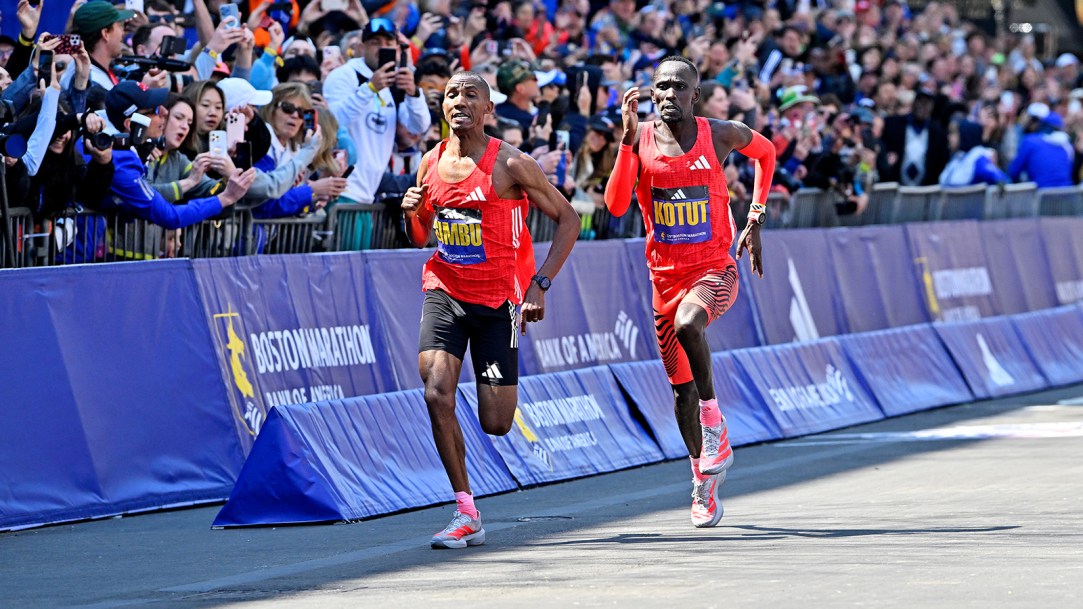
The Boston Marathon is the most prestigious event in running, outside of the Olympics. It will allow some runners who did not qualify for the race because of the cutoff to qualify through a random draw.
This could be the first step toward a lottery system in the future.
Although there is a lot of nuance to this latest track and field announcement, which is both good and bad, the overall sentiment remains the same. The system is broken and people who worked extremely hard to earn their way into the race are still left out. That shouldn’t be the case!
The Boston Marathon has a cutoff.
The qualifying window for the 2027 Boston Marathon began on September 13, 2025. Qualifying standards can be found below:
- Ages 18-34
- Men — 2:55
- Women — 3:25
- Ages 35-39
- Men — 3:00
- Women — 3:30
- Ages 40-44
- Men — 3:05
- Women — 3:35
- Ages 45-49
- Men — 3:15
- Women — 3:45
- Ages 50-54
- Men — 3:20
- Women — 3:50
- Ages 55-59
- Men — 3:30
- Women — 4:00
- Ages 60-64
- Men — 3:50
- Women — 4:20
- Ages 65-69
- Men — 4:05
- Women — 4:35
- Ages 70-74
- Men — 4:20
- Women — 4:50
- Ages 75-79
- Men — 4:35
- Women — 5:05
- Ages 80+
- Men — 4:50
- Women — 5:20
To qualify at the Boston Marathon, you must hit these times at a certified event. The marathon distance must be accurately measured, the race must take place on a USATF, AIMS or World Athletics-certified course, and must have at least three runners officially registered.
However, even if you hit those marks at a certified event, there is still a chance that you will not qualify for the Boston Marathon. It depends on how many other athletes do the same. Because the race is in such high demand, not ever runner who qualifies gets to run. The race makes cuts before the race based on how many people qualify.
For example… if you are a 37-year-old woman who runs 3:29:29, there is a high probability that you will not get into the race after the cutoff. The fastest qualifiers in each age and gender group will get first priority. Some people who “qualify” will not get in.
Here is a good look at the history of the cutoff:
- 2014: 1 minute, 38 seconds under the standard
- 2015: 1 minute, 2 seconds under
- 2016: 2 minutes, 28 seconds under
- 2017: 2 minutes, 9 seconds under
- 2018: 3 minutes, 23 seconds under
- 2019: 4 minutes, 52 seconds under
- 2020: 1 minute, 39 seconds under (race held virtually)
- 2021: no cutoff
- 2022: no cutoff
- 2023: no cutoff
- 2024: 5 minutes, 29 seconds under
- 2025: 6 minutes, 51 seconds under
In addition, the Boston Marathon set tighter standards in 2020. It is doing so again in 2026. You have to run faster than ever to qualify. You still may not make it in the field. If you ran a Boston Qualifying time for the marathon but did not make the cutoff, then technically speaking, you did not qualify for the Boston Marathon. Unless…
A random draw will change the qualification process.
The Boston Marathon made a huge announcement surrounding the cutoff for next year. It introduced the Boston Qualifier Selection. Approximately 1,000 runners who ran a qualifying time but missed the cutoff will be selected at random to run the race anyway.
In essence, 1,000 runners who did not run fast enough to make the field will still be allowed to run.
On one hand, that is a really good thing. Hitting the qualifying time above the cutoff still gives you a non-zero chance of getting in. It actually gives some meaning back to running the qualifying time alone. You still get a ~1/8 chance at running the race you qualified for.
On the other hand, this is yet another example of the broken system. Runners who work hard to qualify for the Boston Marathon should be allowed to run the Boston Marathon. Period. If you qualify, you qualify. You should not be subjected to random draw because you didn’t run faster than the time you were told to run.
It is great that runners who qualified (but didn’t meet the cutoff) are getting a chance to run. It is unfortunate that others won’t.